
A Closer Look: Hermès Arceau Le Temps Suspendu
Reviews
A Closer Look: Hermès Arceau Le Temps Suspendu

The Hermès Arceau Le Temps Suspendu, first introduced in 2011, marked the beginning of a trilogy of watches in which mechanics became a philosophical statement that was as much about the nature of time as it was about watchmaking. They were compelling because sophisticated mechanics were deployed to undermine the very purpose of sophisticated mechanics.
The Le Temps Suspendu wore its complexity so lightly and resolved its unusual function with such visual elegance that how it did it felt beside the point. The effect was self-contained and satisfying that it didn’t draw attention to the mechanical effort behind it. Now that the mechanism is partially visible through the sapphire dial, its technical reality has finally hit home.
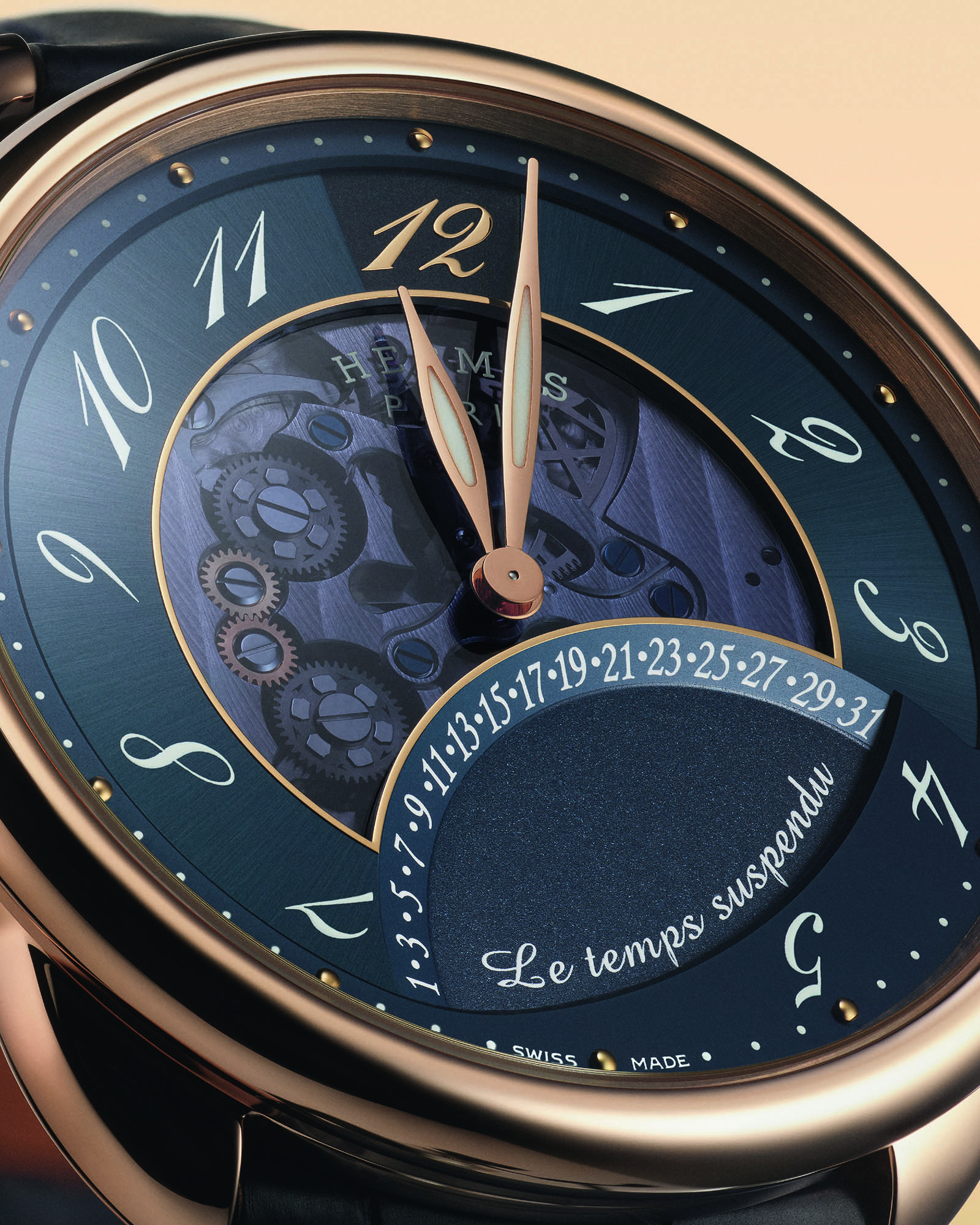
When time is suspended, the hands leap to an impossible position that reads 11:62
As a recap, pressing the button at nine o’clock allows the wearer to “suspend” time. The hour and minute hands snap into a deliberately unreadable position; the hour hand just shy of 12 and the minute hand slightly past it. If you insist on reading it, you’ll get an absurd 11:62. At the same time, the retrograde date hand disappears beneath the raised chapter ring at the lower-right quadrant on the dial. This allows the wearer to effectively “hide” the time and later restore the hands to their correct position on demand via the same button.
The complication module was developed by Jean-Marc Wiederrecht of Agenhor. The original Arceau Le Temps Suspendu measured 43mm, and the module was installed on an ETA 2892. In 2013, a smaller 38mm model was introduced with a Vaucher base calibre and a modified module in which the retrograde date was replaced with a small seconds indicator running backwards in a 24-second cycle, providing visual confirmation that the watch was still running even when time was “suspended.”
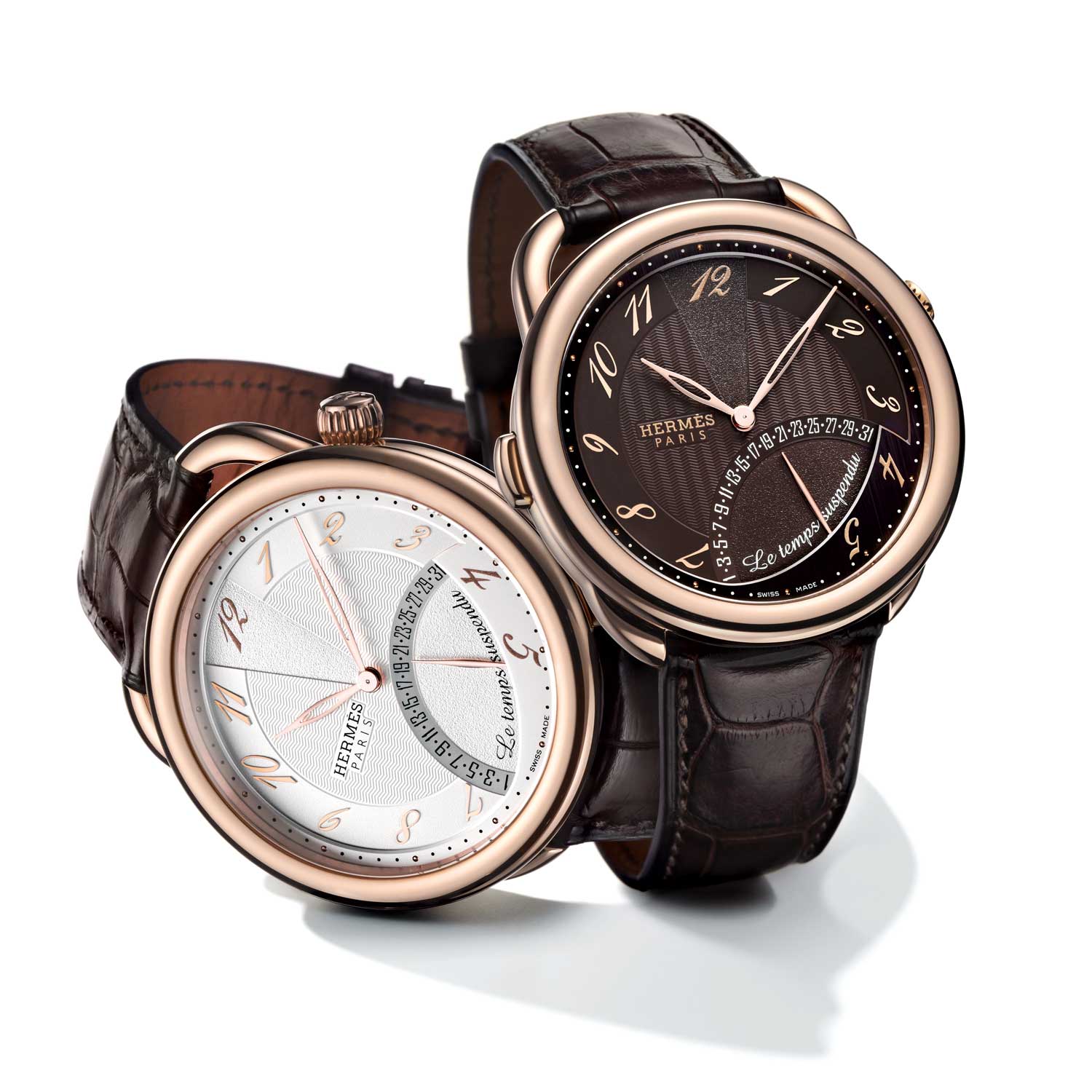
The original Arceau Le Temps Suspendu launched in 2011
-

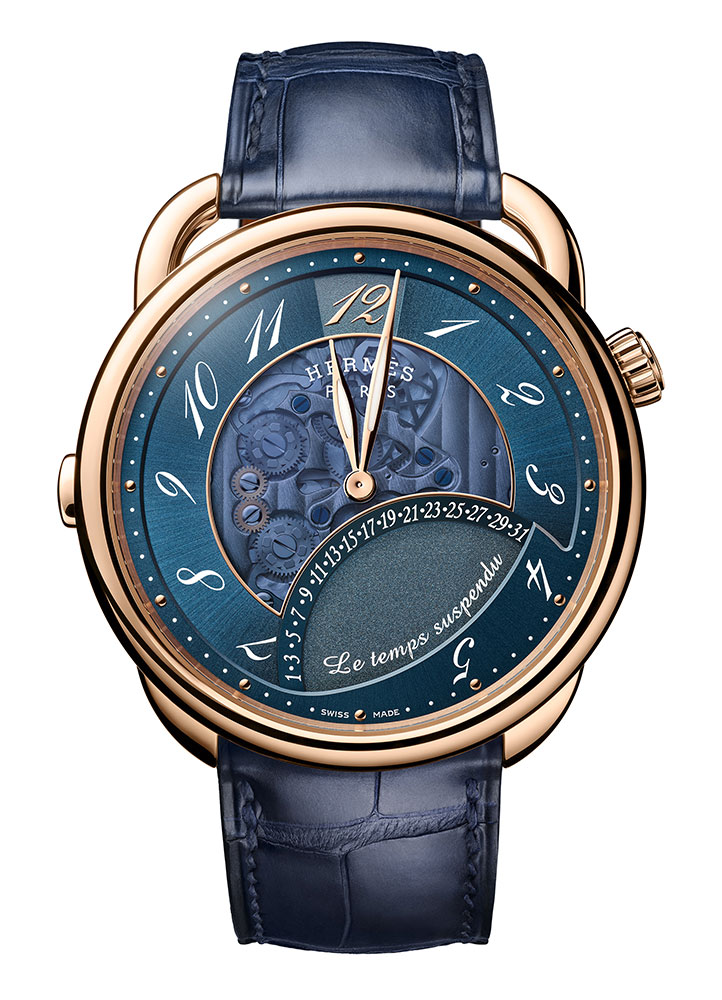
- Hermès Arceau Le Temps Suspendu in sunburst blue
-

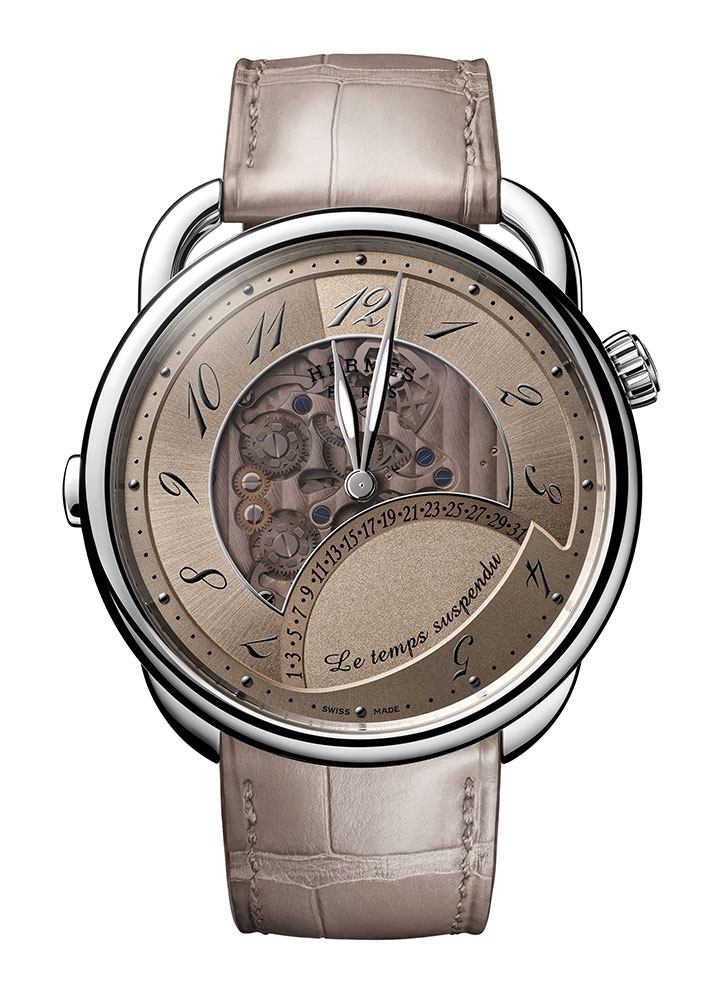
- Hermès Arceau Le Temps Suspendu in brun désert
The new model is 42mm wide and comes in three appealing iterations – rouge sellier (red), and brun désert (beige) in white gold, and sunburst blue in rose gold. The base movement is the self-winding calibre H1837 made by Vaucher. It is equipped with twin barrels delivering a 45-hour power reserve, and a free-sprung balance operating at 4Hz.
The Arceau case was originally designed by Henri d’Origny in 1978, and more than four decades on, it remains remarkably resistant to age. Its unusual silhouette was inspired by the stirrups on a horse’s saddle. Its asymmetrical lugs are integral to the case middle. The rounded bezel dominates the upper profile of the case. It gently flares outward from the mid case, concealing the lug junctions when viewed head-on and as such, your eye is naturally drawn to the dial and the polished dome of the bezel.

Hermès Arceau Le Temps Suspendu in rouge sellier (Image: Revolution ©)

The base movement is the self-winding calibre H1837 made by Vaucher (Image: Revolution ©)
The dial is very elaborate, consisting of five parts — an outer minute ring, main chapter ring, central sapphire window, date scale and an inner recessed plate beneath the date scale. The outer minute ring is secured to the main chapter ring with polished domed screws that double as the five-minute markers. Since acquiring case maker Joseph Erard in 2012 and dial manufacturer Natéber in 2013, cases and dials are produced internally which gives the brand more flexibility in developing complex designs.

What was once hidden behind the illusion of simplicity now reveals itself as a theatre of levers, cams, and column wheels (Image: Revolution ©)
The open dials offer a glimpse into the unexpectedly complex module beneath. Remarkably, the mechanism contains two column wheels – one dedicated to the hour hand, the other to both the minute hand and the date. The motion works are unconventional, relying on a rack and pinion system. This is because the hour and minute hands are 360-degree retrograde hands that make a full sweep before snapping back to the 12 o’clock position.

Not only is the date a retrograde display, but both the hour and minute hands are also 360-degree retrograde, sweeping a full circle before snapping back to their starting positions (Image: Revolution ©)
The Ingenious Movement
The diagrams below, taken from the original patent, show the same module in two different states: one where the time and date are actively displayed, and another where they are deliberately withdrawn to resting positions. The cannon pinion drives three cam systems through separate trains: one for the minutes (cam 7), one for the hours (cam 37), and one for the date (cam 86). Each of these cams rotates continuously, once per hour for the minute cam, once every twelve hours for the hour cam, and once per month for the date cam.


The minute cam (7) and hour cam (37) are followed respectively by feelers (14 and 54), each mounted at the midpoint of levers (10 and 50). These levers pivot at one end, with racks (12 and 52) at the opposite ends that mesh with pinions (13 and 53, shown in Fig. 3) to drive the minute and hour hands. Springs acting through fingers keep the feelers pressed against the cam surfaces. As each cam rotates, its feeler traces the contour, causing the corresponding lever to pivot and move its rack, which in turn rotates the hand.

The tail end of the levers interact with J-shaped rockers (19 and 59), each of which is controlled by its own column wheel. The beak-shaped ends of the rockers alternate between resting in the gaps between columns or sitting atop a column. In Fig. 1, both rockers are idle; their beaks rest in gaps so they exert no pressure on the levers. The feelers remain in contact with the cams, and the hands display the current time.
The date mechanism differs slightly but operates in harmony with the time display. The date cam (86), which rotates once per month, is followed by a feeler (84) built into the date lever (80). This lever pivots at one end (81), carries a rack (82) at the other end that drives the date pinion (83), and is kept in contact with the cam by a preloaded spiral spring (88) that applies torque directly to the pinion. The pivot end of the lever includes a contact surface (89), which is not pressed by a dedicated rocker, but rather by an extension (90) mounted on the minute rocker (19). When the minute rocker is idle, as in Fig. 1, the extension does not touch the date lever, allowing the feeler to remain in contact with the cam and the date hand to indicate the current day.
The date cam itself is driven from the cannon pinion through a reduction gear train. The cannon pinion drives the train, which advances a day wheel (92) once per day via an internal tooth ring (93). This day wheel carries external teeth (94) that advance a star wheel (95) one step daily. The star wheel is mounted on a shaft that also carries a pinion (96), which meshes with a wheel (98) fixed to the date cam (86). A jumper (97) ensures the star snaps precisely into position. This arrangement ensures that the date cam rotates once every month in precise daily increments.
In Fig. 2, the pusher has been actuated, causing both column wheels to rotate by half a pitch. As a result, the beaks of both rockers now ride on top of their respective columns, pivoting the rockers inward. The arms of the rockers press against the minute and hour levers, pushing them away from their cams. The feelers (14 and 54) are lifted off the cams, and the levers fall into predefined alternative positions. Since they are no longer governed by the cam profile, the hands move to their pre-fixed, unreadable positions.
Simultaneously, as the minute rocker pivots, its extension (90) presses against the contact surface (89) of the date lever (80), lifting its feeler (84) off the date cam (86). The spiral spring (88), which had previously kept the feeler engaged, now returns the lever to its resting position. The date hand, like the hour and minute hands, moves to a non-indicating position.

Throughout this entire transition, the cams continue rotating. The gear train remains uninterrupted, and the watch continues to keep time and calendar information in the background. Only the visual display is affected. When the corrector is pressed again, the column wheels advance by another half-pitch, returning the rockers to their neutral positions. The levers are released, their springs push the feelers back into contact with the cams, and the hands immediately resume displaying the correct time and date, as if nothing had paused.
The system is remarkably ingenious, with a complexity that’s genuinely astonishing even when you’re fully aware that this is a watch designed to suspend time. The very idea is poetic, but what’s startling is how mechanically involved that function is, especially for a display that looks so unassuming. It departs entirely from convention, where cams replace traditional gears, the motion works rely on rack-and-pinion transmission, and twin column wheels coordinate the engagement and disengagement of the display. It’s an elaborate mechanism designed to produce a moment of simplicity and perhaps that inversion is what makes it so compelling.

Tech Specs: Hermès Arceau Le Temps Suspendu
Movement: Self-winding Manufacture Hermès H1837 with Agenhor module; 45-hour power reserve; 28,800 vph or 4Hz
Functions: 360° retrograde hour and minute hands; retrograde date hand; pusher-operated start-stop function (suspending time)
Case: 42mm; white or rose gold; 30m water-resistance
Dial: Rouge sellier (red)/brun désert (beige)/sunburst blue; all with translucent colored lacquered sandblasted sapphire crystal
Strap: Alligator leather strap in rouge sellier/matt étoupe/bleu abysse; black Barénia calfskin leather; or navy blue Swift calfskin
Price: USD 39,800 in rose gold and USD 45,825 in white gold
Hermès

You may also like

Editorial
Hermès H08 Chronograph: A New Monopusher Sports Watch in Naples Yellow
Nov 6, 2025
Editorial
Hermès H08 Chronograph: A New Monopusher Sports Watch in Naples Yellow
Nov 6, 2025
News
Hermès Arceau Locomotion Transforms The Faubourg Boutique Into Pop-Art Vision
Jun 25, 2025
News
Hermès Arceau Locomotion Transforms The Faubourg Boutique Into Pop-Art Vision
Jun 25, 2025

Through the Looking Glass: Tinted Sapphires
Apr 20, 2025
Through the Looking Glass: Tinted Sapphires
Apr 20, 2025