A Closer Look: Ferdinand Berthoud Mesure du Temps 1787 Chronomètre FB 2TV
Reviews
A Closer Look: Ferdinand Berthoud Mesure du Temps 1787 Chronomètre FB 2TV

One of the most horologically compelling watches at Watches & Wonders is the new Mesure du Temps 1787 Chronomètre FB 2TV by Ferdinand Berthoud. It debuts an entirely new movement, conceived as the successor to the now-discontinued Calibre FB-T.FC.
It has been a decade since Chronométrie Ferdinand Berthoud was founded by the Chopard Group, taking its name from one of the great French marine chronometer makers of the 18th century, and in that time the brand has done something very unusual in modern watchmaking. It has built highly complicated watches on antiquated technical solutions to precision timekeeping, and carried them through with stubborn consistency. The most complete expression is the Naissance d’une Montre 3, remarkable both for the breadth of historical chronometric solutions and for the lengths taken to realise them by hand.
The very first watch and movement – the FB 1 and Calibre FB-T.FC – with which the brand made its debut was one of the most memorable launches of its time. At a moment when innovation largely meant aggressively futuristic watches, it looked instead in the opposite direction. It had a pillar-and-plate construction incorporating a reversed fusée with a Maltese cross stopwork, a large balance, a tourbillon and a cone driven power reserve indicator. The movement was exhaustively engineered, with subtleties that proved just as intriguing, including the flying construction of the barrel and fusée as well as a compact differential planetary gear that was built into the fusée as a form of maintaining power. Subsequent iterations retained this architecture while introducing other innovations.

Ferdinand Berthoud FB 1
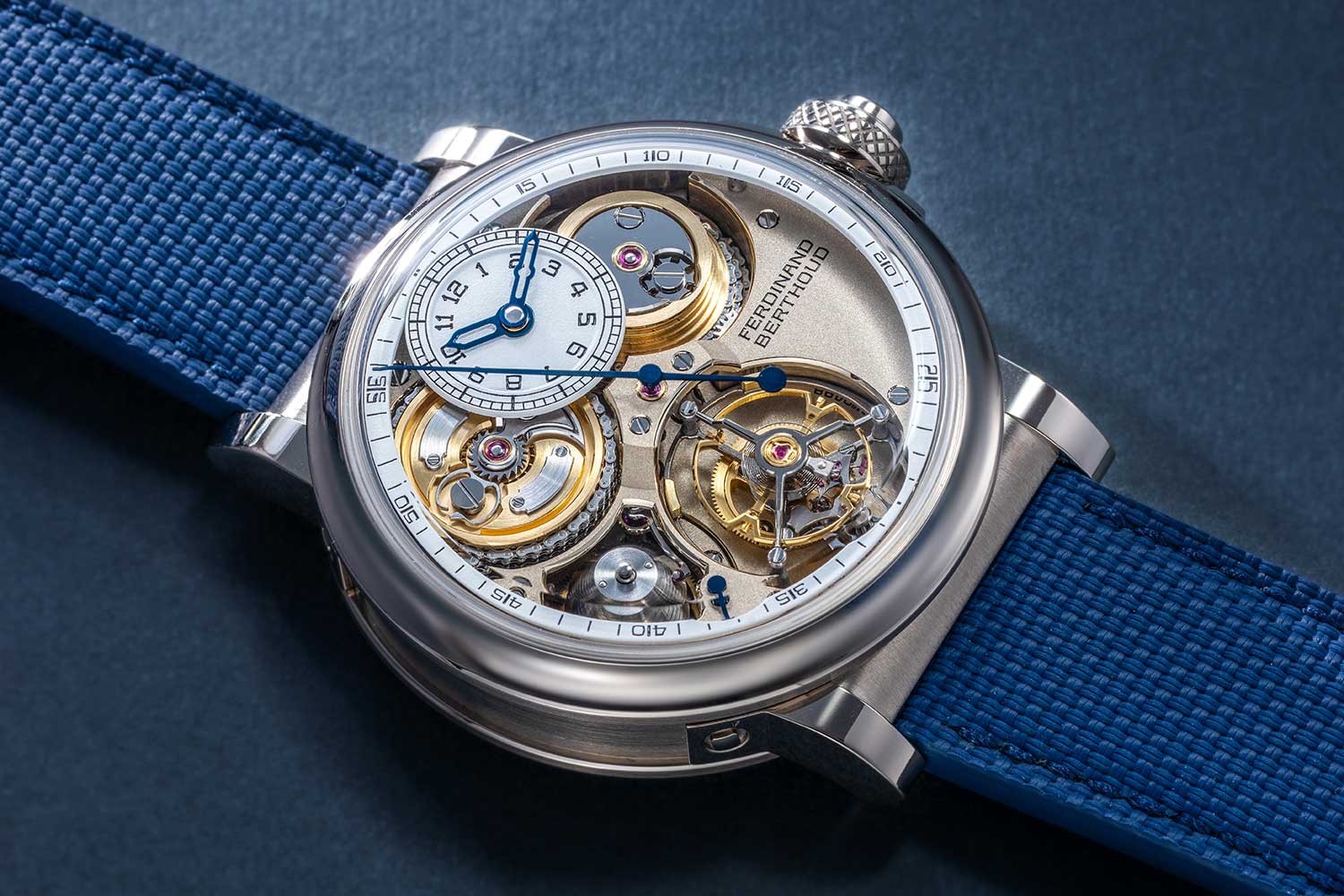
Ferdinand Berthoud Mesure du Temps 1787 Chronomètre FB 2TV (©Revolution)
In 2023, however, it was announced that the movement will be retired. The Mesure du Temps 1787 Chronomètre FB 2TV now marks the start of a new chapter, with an inverted calibre that puts its formidable mechanics in plain view. It offers a dense concentration of solutions, concerned as much with high-precision timekeeping as with mechanical purity. At EUR 383,000, it also represents, unexpectedly, compelling value for a watch built around solutions that are rarely executed at this level today, and seldom brought together with this degree of completeness.
Case and Dial
The FB 2TV is part of the FB 2 series and, unlike the FB 1 with its octagonal case, adopts a round profile that recalls the protective brass drums used in marine chronometers. Made in ethically sourced white gold, it has a robust, substantial construction with short tapered lugs that are secured to the case by bolts. The crown is large in diameter and deeply knurled while the crown guard is secured to the case middle by screws. As before, the crown incorporates a safety device that disengages the crown from the winding pinion once the barrel is fully wound.
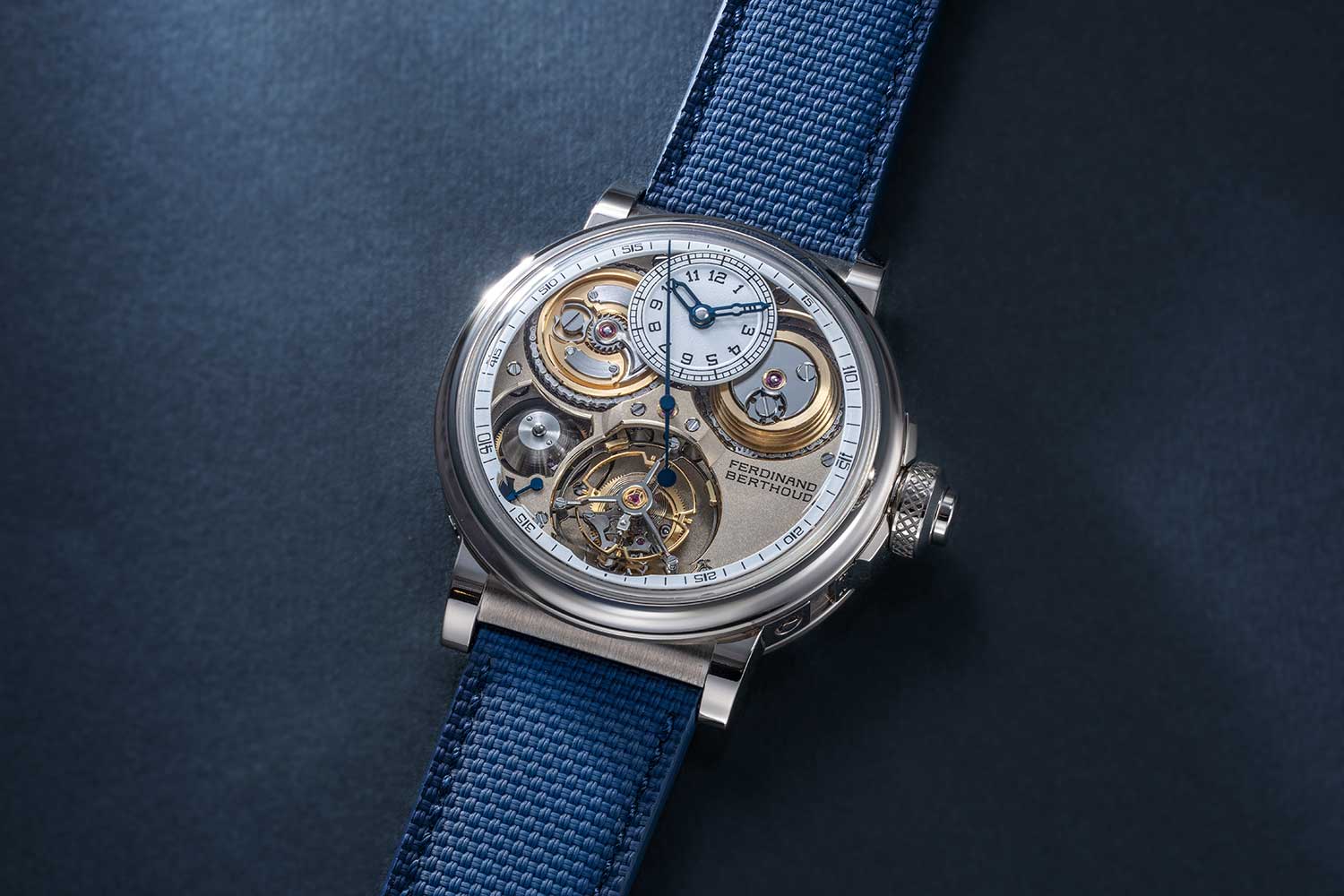
Ferdinand Berthoud Mesure du Temps 1787 Chronomètre FB 2TV (©Revolution)
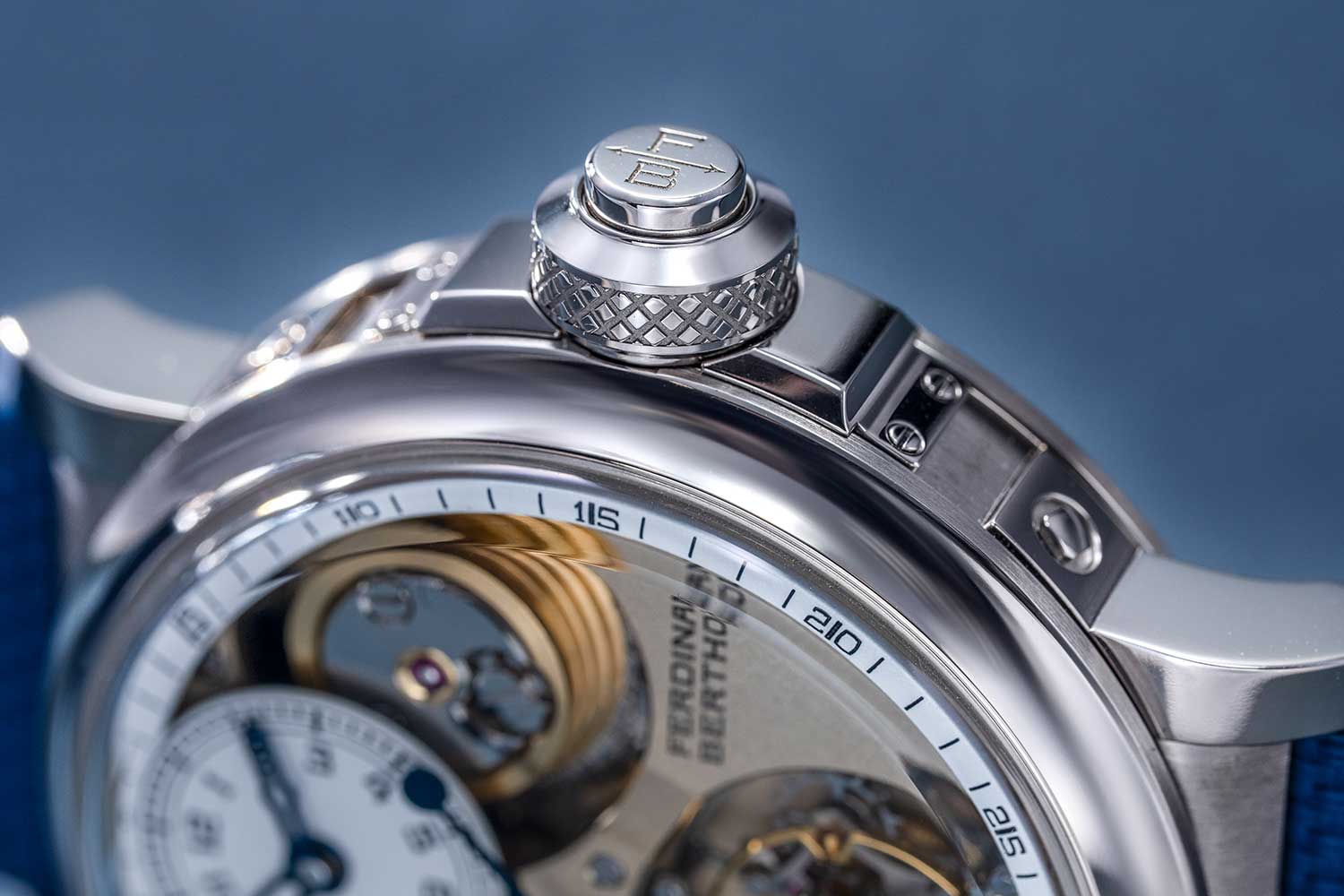
The lugs are secured to the case middle by bolts, while the crown guard is fixed with screws. A zero-reset pusher is integrated into the large, knurled crown (©Revolution)
It measures 44mm in diameter and 15.46mm in height, which makes it 2.46mm thicker than the original FB 1 and 1.16mm thicker than the FB 2T Final Edition. It is undeniably massive, but in keeping with the scale of its mechanics. At 35.6mm by 10.7mm, the Calibre FB-T V.FC is effectively the size of a pocket watch calibre.
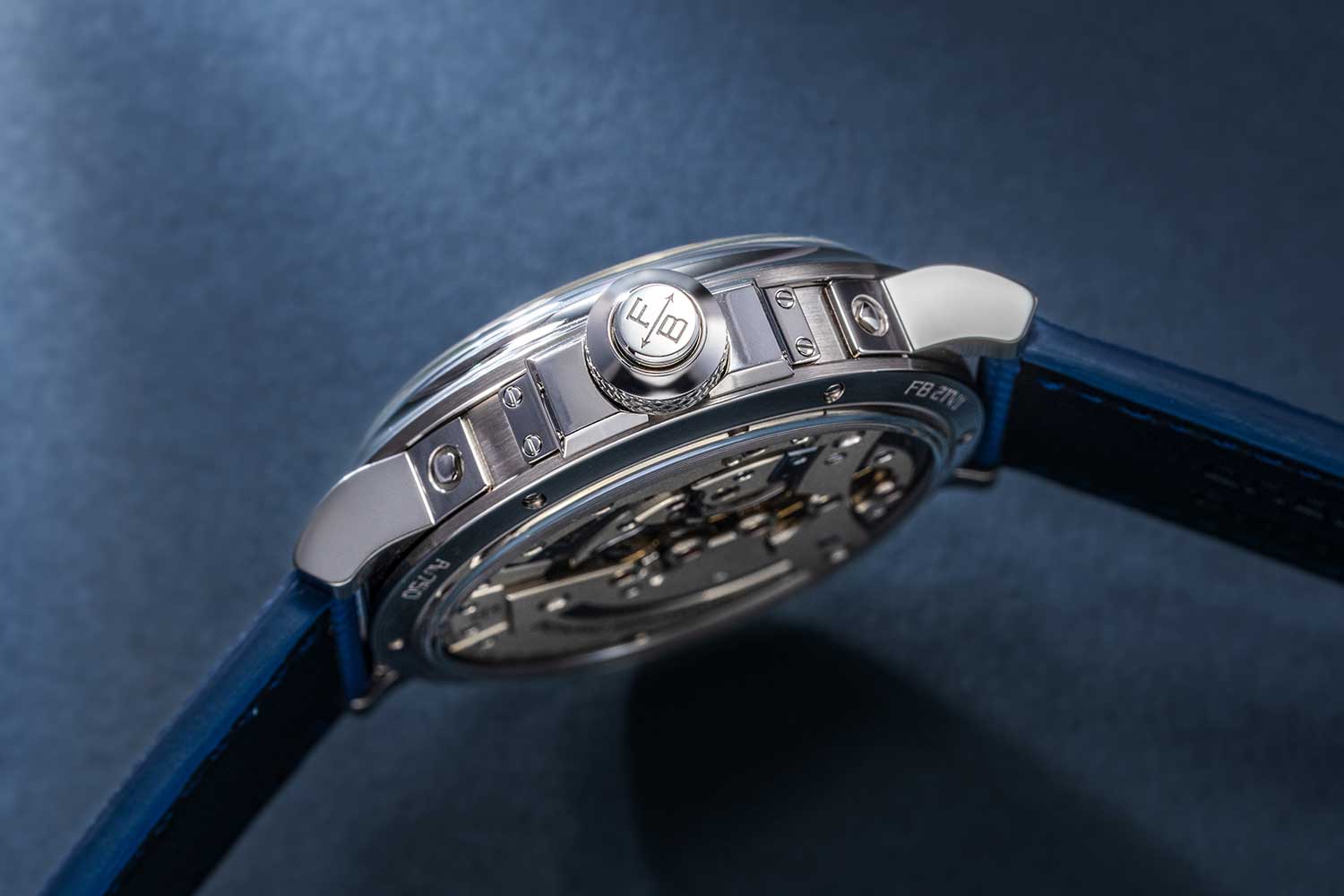
Ferdinand Berthoud Mesure du Temps 1787 Chronomètre FB 2TV (©Revolution)
The new Calibre FB-T V.FC was thoroughly redesigned while retaining the defining characteristics of the first calibre – chain-and-fusée, tourbillon and the cone-and-feeler power reserve device. Notably, it introduces both a hacking seconds and a zero-reset mechanism.
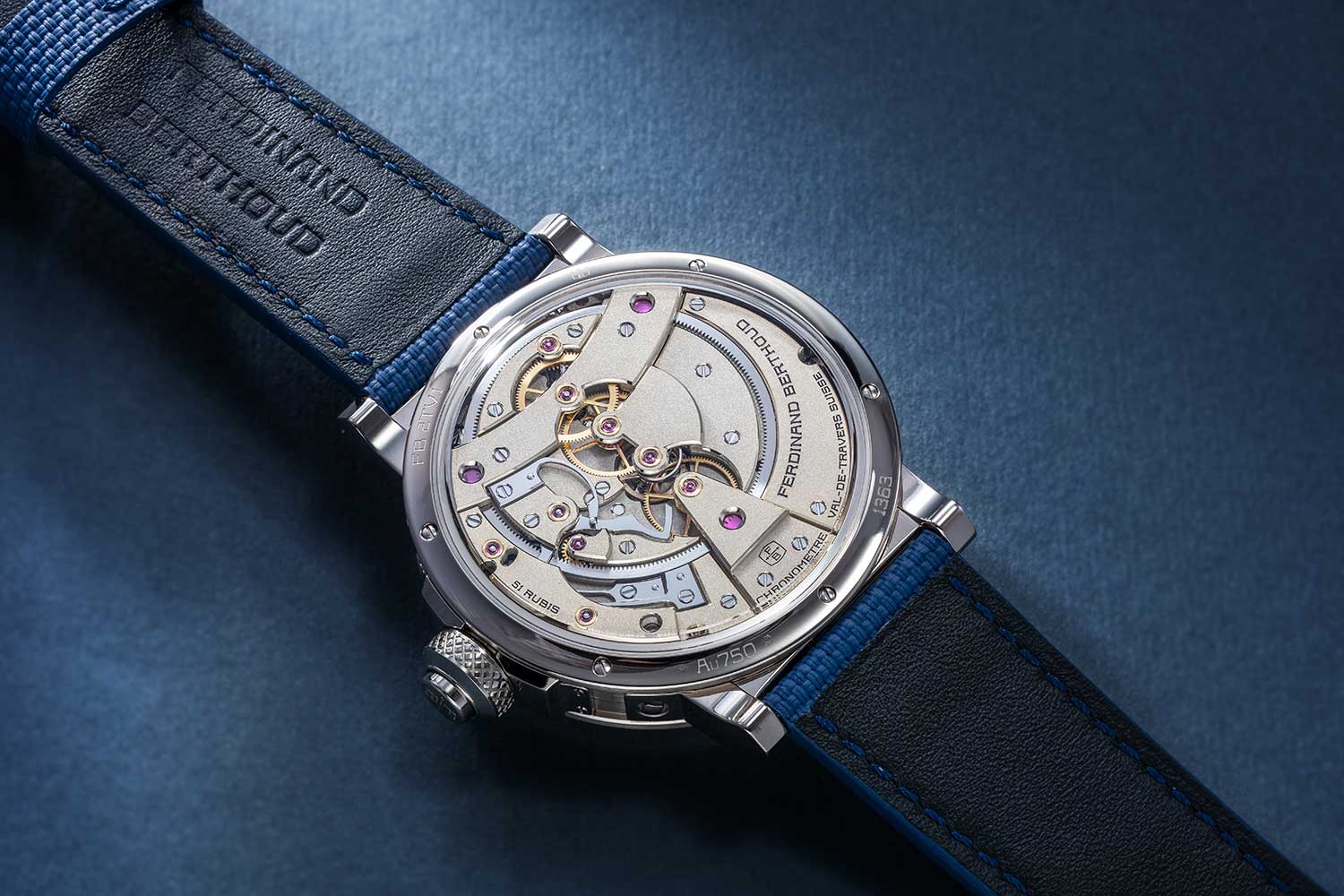
The gear train and zero reset mechanism are visible on the back (©Revolution)
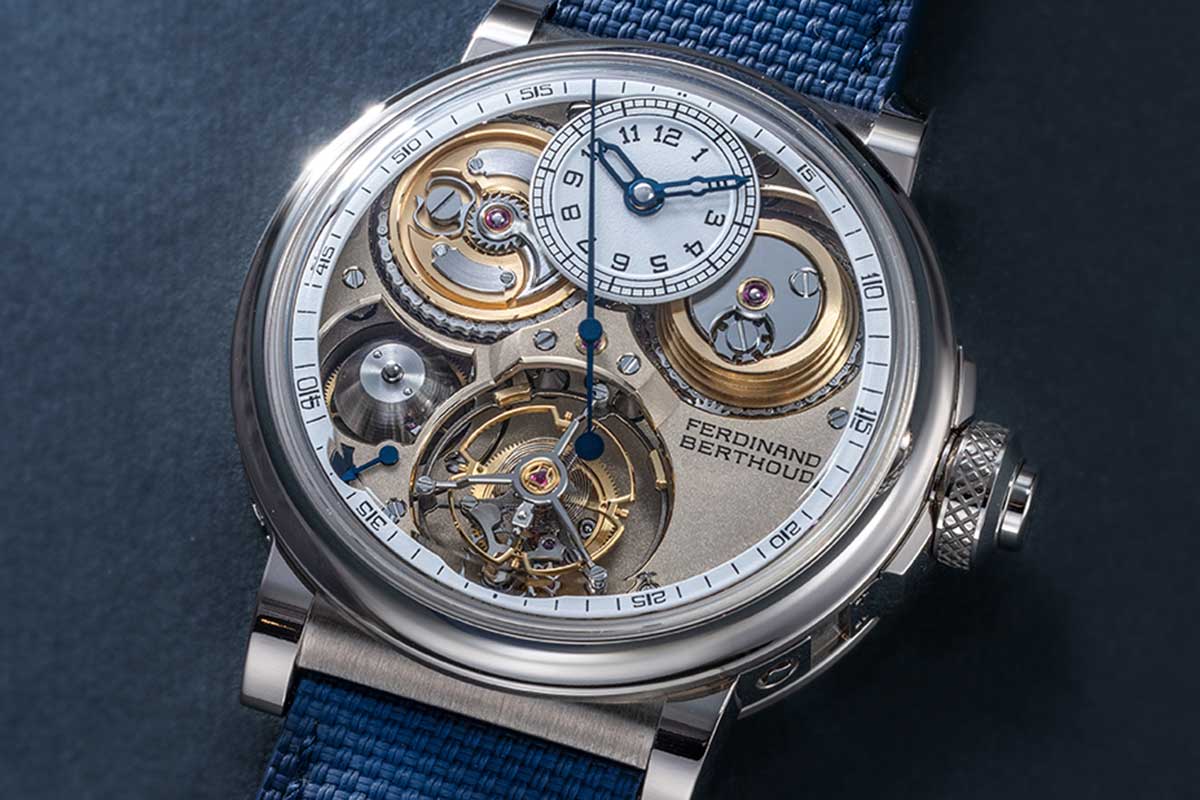
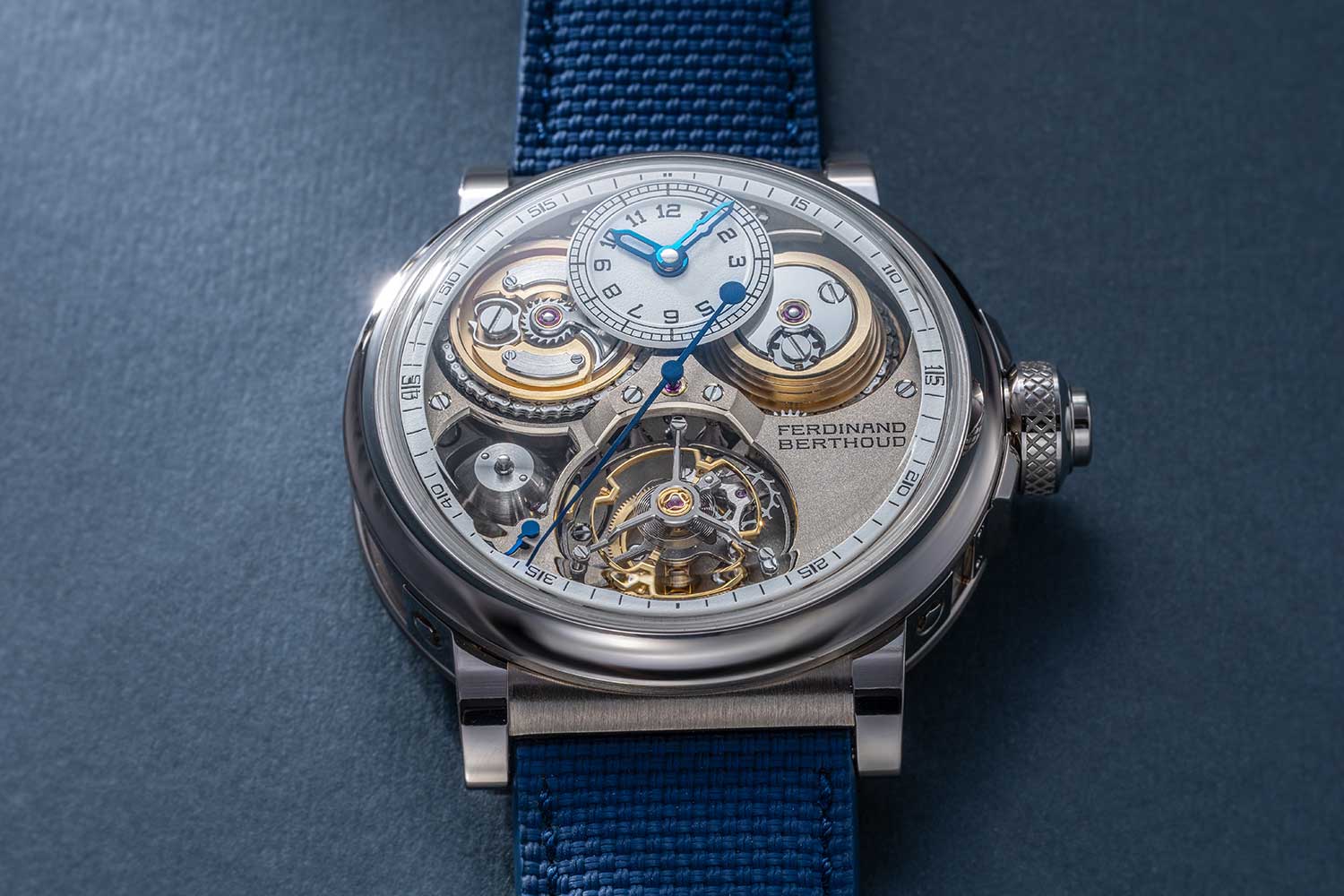
The movement is effectively the dial, and it retains the same overall composition, with three dominant circles – the barrel and fusée set above, and the large tourbillon at six o’clock. It retains its pillar construction, with the center bridge and mainplate held together by vertical columns. On the top plate, there are additional bridges to support the gear train and zero reset mechanism.
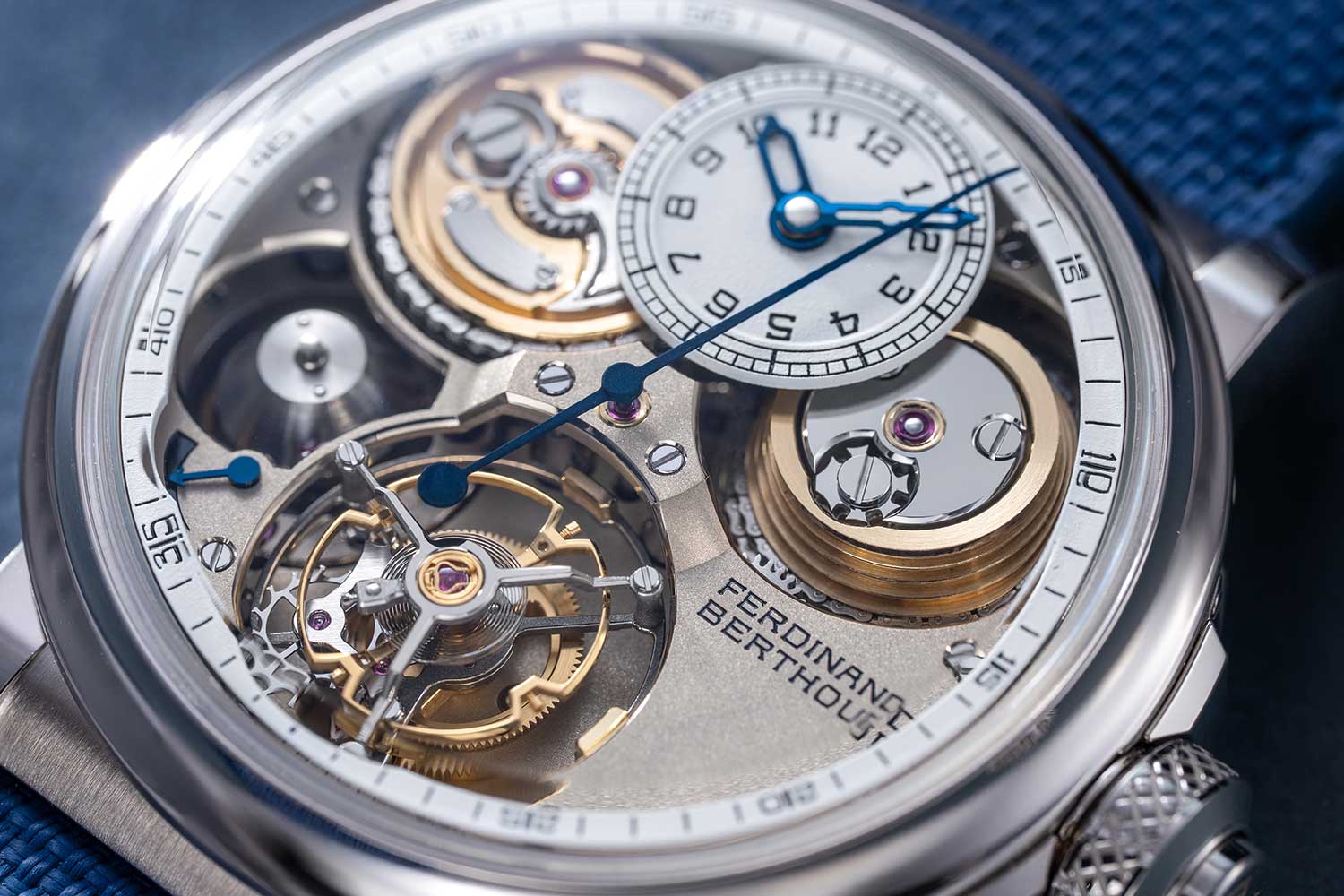
A closer look at the stunning three-dimensional movement, topped by long sweeping seconds hand (©Revolution)
The hours and minutes are relegated to an offset subdial at 12 o’clock itself mounted on pillars above the mainplate. Encircling the movement, a slender white lacquered inner ring, also supported by four pillars, forms the seconds track, read by a long central seconds hand stretching 25.80 mm across the dial. To minimise inertia, the seconds hand is in titanium, sandblasted and treated with a blue CVD coating. It sits above the dial on a three-dimensional bridge that’s made of German silver and hand-finished throughout, with a finely grained surface and polished, bevelled edges. Both the branding and power reserve sector scale at 7:30 are hand-engraved and filled with black varnish. Notably, the cone-and-feeler mechanism is completely exposed in this watch, visible through a large, finely finished cut-out on the centre bridge.
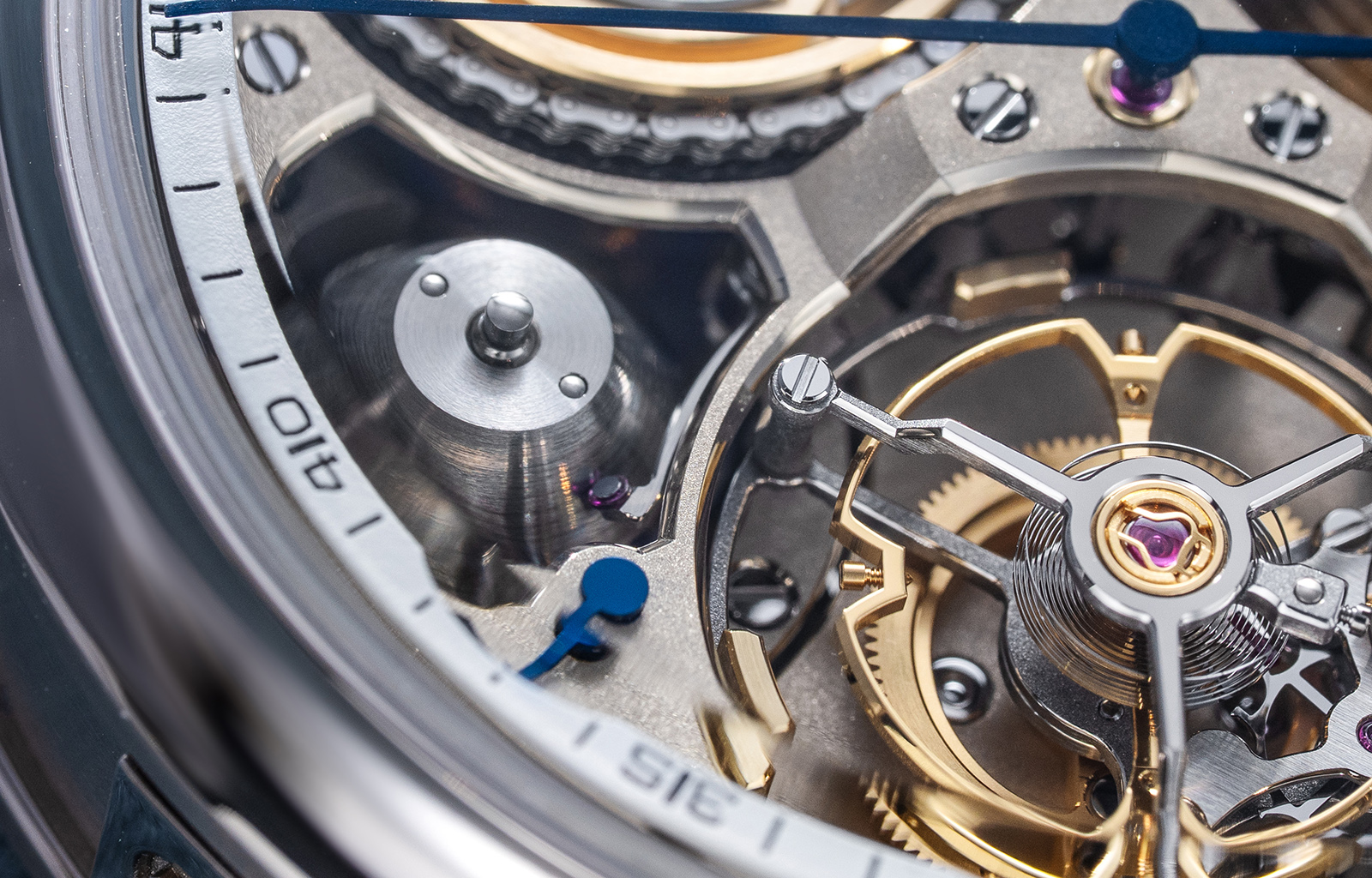
The cone-and-feeler device is visible through a finely finished cutout on the centre bridge, making the act of winding a visible, mechanical event (©Revolution)
While screw-driven conical cams read by a feeler are well established in historical power reserve indicators, they operate differently in a fusée watch. This is because the barrel drum, which drives the mechanism, must rotate in both directions, requiring the indicator to respond correctly to reversed motion. In standard constructions, the cone forms part of the screw system itself, and its motion arises directly from the rotation of the threaded shaft, while its axial position is read by the feeler.
Here, as before in the original calibre, the arrangement is inverted. The threaded shaft is fixed, while the cone is carried on it and driven in rotation by a separate wheel via a set of pins. As the wheel turns with the barrel, it forces the cone to rotate, and the thread converts that rotation into axial displacement. The conical surface is thus advanced or withdrawn along the axis according to the direction of rotation, and its position is read directly by the jewel tipped feeler.
Advances Across the Movement
The most immediate visual change is the tourbillon. It is now in a flying configuration, supported from below by a single bearing, with the upper bridge removed entirely. The carriage is particularly beautiful. At 15mm in diameter, it is large yet unusually elegant. As before, the cage is executed in titanium to minimise inertia, but it is finished to a level that belies the material. The arms are slim, black-polished on their upper surface and polished, bevelled along their edges, with an upward step. Likewise, the balance is unusually large, even by the standards of a 3Hz oscillator, measuring 11.2mm in diameter. For comparison, the balance in the Naissance d’une Montre 3 is 10.94mm. Naturally, it is paired with a hairspring formed with a Phillips outer curve, an evolution of the Breguet overcoil that improves concentric breathing and reduces residual positional error.
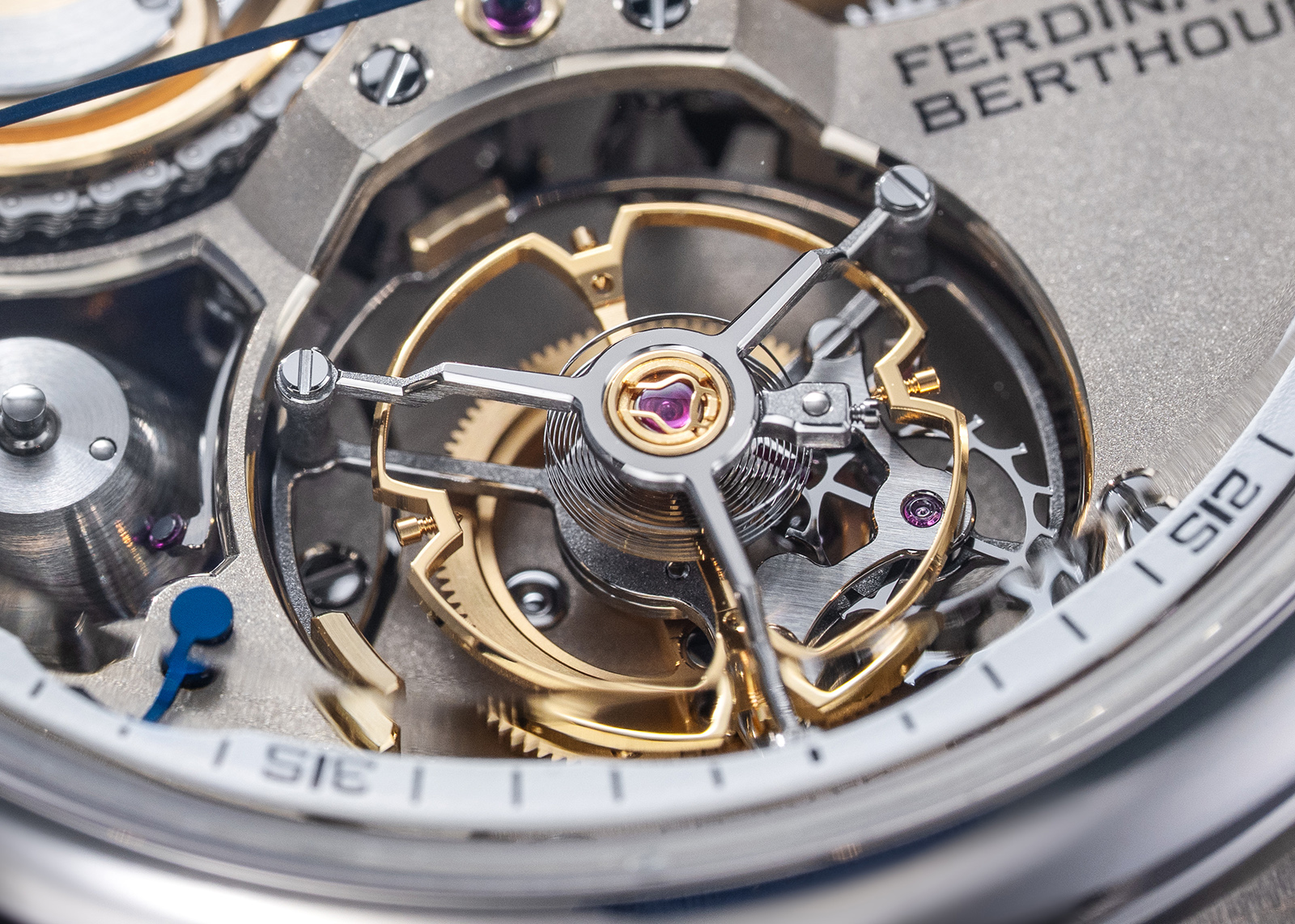
The massive yet finely executed tourbillon cage with a black polished top surface, fine graining and polished, bevelled edges (©Revolution)
Whereas the first calibre employed a reverse fusée which distributed the load between the centre pinion and the fusée pivots, reducing pressure on the latter, the new movement returns to a conventional fusée-and-chain layout, in which the chain is wound onto the fusée as the mainspring is wound, and unwinds from it during operation as power is delivered to the going train.
(©Revolution)
The tricky part about fusée watches, apart from the sheer complexity of the chain itself, is that the shape of the fusée cannot be arbitrary. It has to be tailored to compensate for the changing output of the mainspring as it unwinds. The mainspring does not deliver force in a simple, predictable curve, and the fusée must translate that irregular output into something approaching constant torque by varying its radius turn by turn. The required strength of the spring, the number of usable turns, the diameter of the barrel and the constraints of the movement all have to be accounted for, often through a combination of measurement and iterative adjustment.
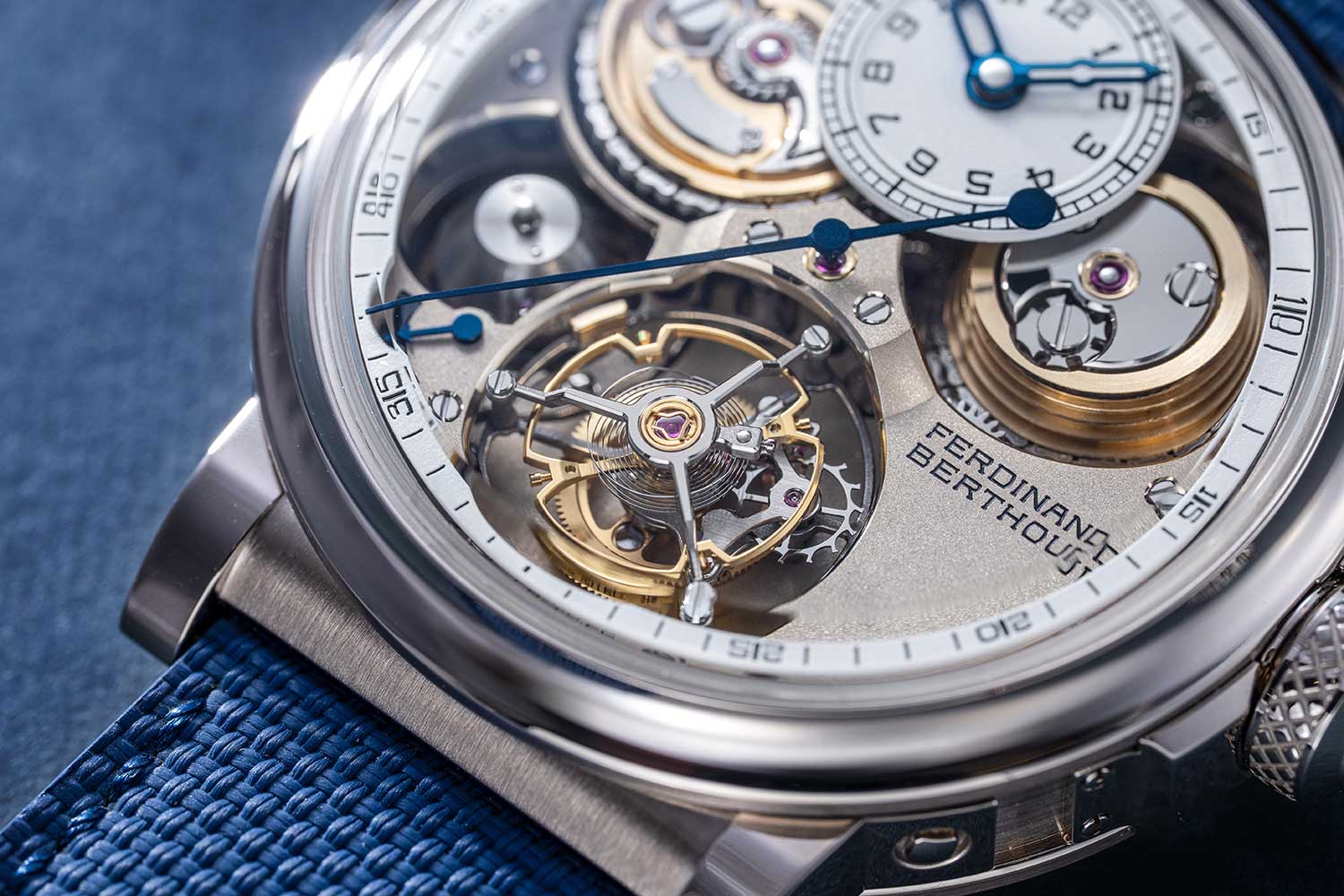
(©Revolution)
Additionally, the fusée in FB 2TV is equipped with a double Maltese cross stopwork. It is a rare extension of a traditional stopwork, found in very few watches throughout history including certain Breguet Souscription pocket watches. Its function is straightforward. Because the blocking action involves metal-on-metal contact under high load, two stopworks – one superimposed over the other – are used to distribute the forces and provide more stable engagement. The function of the stopwork is to confine the mainspring to its most stable torque window, and in a fusée watch, this is achieved by limiting the rotation of the fusée, and hence the extent of travel by the chain.
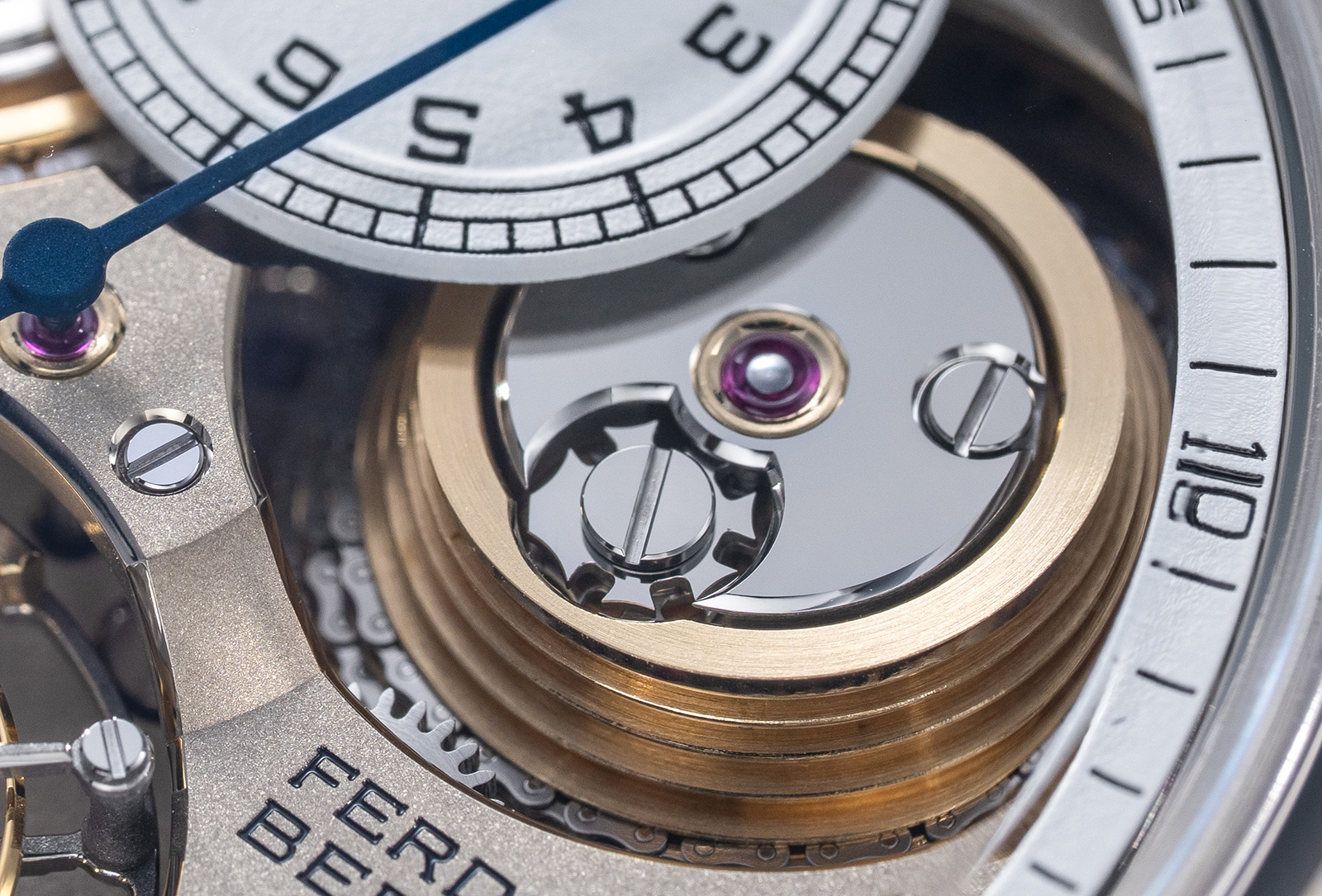
The fusée is fitted with a double Maltese cross stopwork to ensure precise, secure stopping. The Maltese crosses, cap and screws are all rendered in full black polish, with anglage to boot (©Revolution)
As for the fusée itself, it wasn’t simply carried over from pocket watch tradition, but rethought for the realities of a wristwatch. Traditionally, a fusée sits between two plates, supported at either end by pivots and capped with a bridge, which inevitably adds thickness to the movement. Here, the fusée is built in a flying configuration, secured at one end to the movement and positioned axially on a single support axis between a shoulder and a retainer engaged in a circumferential groove. This removes the need for an upper bridge, reducing thickness while maintaining proper alignment of the cone.
A fusée and chain introduces a further complication. During winding, the chain is drawn off the mainspring barrel and onto the fusée cone, which forces the fusée to rotate in the opposite direction to that required to drive the going train. This was first addressed by John Harrison, who devised a form of maintaining power in which a spring is housed within the great wheel, effectively interposed between the fusée and the train. Under normal operation, the fusée drives the train in the usual way, while this auxiliary spring is kept in tension. During winding, when the fusée is turned in the opposite direction and can no longer drive the train directly, a pawl prevents the intermediate wheel from following that motion. This creates relative movement that winds the spring, which in turn continues to drive the great wheel, ensuring that the train remains in motion even as the watch is being wound.
Ferdinand Berthoud takes a different approach to maintaining power, dispensing with the intermediate spring altogether. Instead of storing energy and releasing it during winding, the system relies on a differential integrated into the fusée, which redistributes torque in real time.
In both the original Calibre FB-T.FC and the new Calibre FB-T V.FC, this takes the form of a compact planetary differential built into the base of the fusée. In the latter, the construction is further refined with three planet gears instead of two. The sun pinion is coupled to the ratchet wheel below, so that even as the fusée is turned during winding, the going train remains steadily driven.
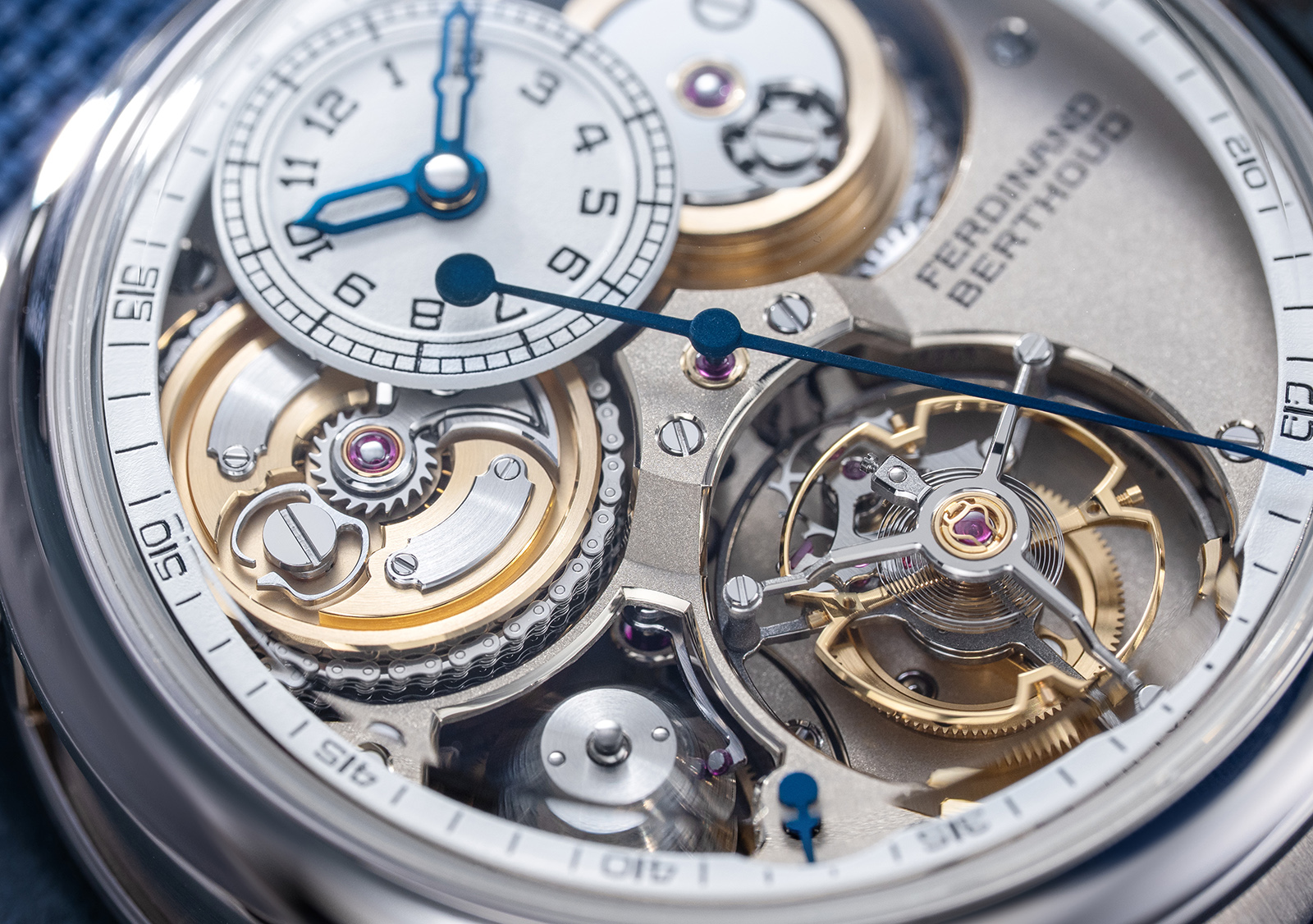
(©Revolution)
The flying barrel of Calibre FB-T V.FC has also been reworked. Unlike the first calibre, the barrel drum no longer has the circumferential grooves that previously guided the chain, and this reduces friction as the chain travels across the surface.
All told, these changes produce a movement that is both more efficient in its transmission and more stable in its delivery of energy. The power reserve extends to a full 60 hours, up from 53, the torque curve is flatter, and the system reaches full wind with roughly 10 fewer turns of the crown from empty.
The barrel also introduces a practical refinement aimed squarely at the watchmaker. A pre-winding mechanism, visible on its upper side and consisting of a pawl and a ratchet wheel, allows the mainspring to be wound during assembly. Once that’s done, the system is simply disengaged by rotating it through 180 degrees, so it plays no role once the watch is in normal operation.
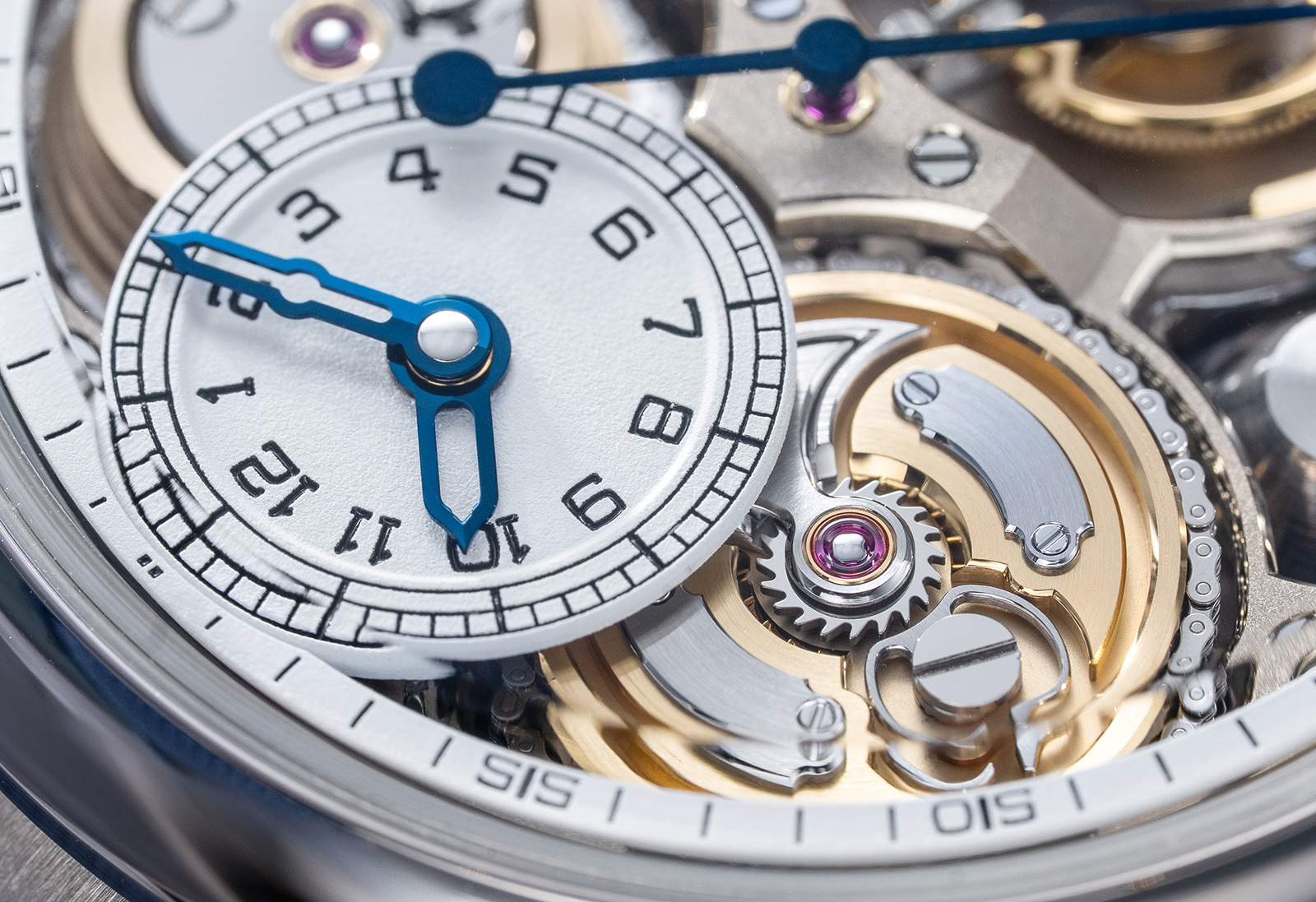
A pre-winding mechanism consisting of a pawl and a ratchet wheel, allows the mainspring to be wound by the watchmaker during assembly (©Revolution)
The thickness of the chain has been reduced in this movement, and it comprises of 465 links and one hook, held together by 311 pins, all manually assembled.
Hacking Seconds and Zero Reset
With all the principal components brought to the dial side, the reverse is left to accommodate the gear train. The zero-reset mechanism is fully exposed, which turns the back of the watch into a stage of its own.
Notably, the zero-reset is designed to operate while the movement is running, actuated via a pusher integrated into the crown. The seconds hand can therefore be zeroed at any moment, without the need to pull the crown. The brand has framed this as a flyback function, though the comparison to a chronograph is only superficial. In a chronograph, flyback is a matter of resetting and restarting a secondary timing train. In this case, the operation intervenes directly at the level of the going train of a fusée-and-chain, tourbillon-regulated watch, the very system that keeps the watch alive, so every action has to be managed with a degree of care that goes well beyond the usual notion of a flyback.
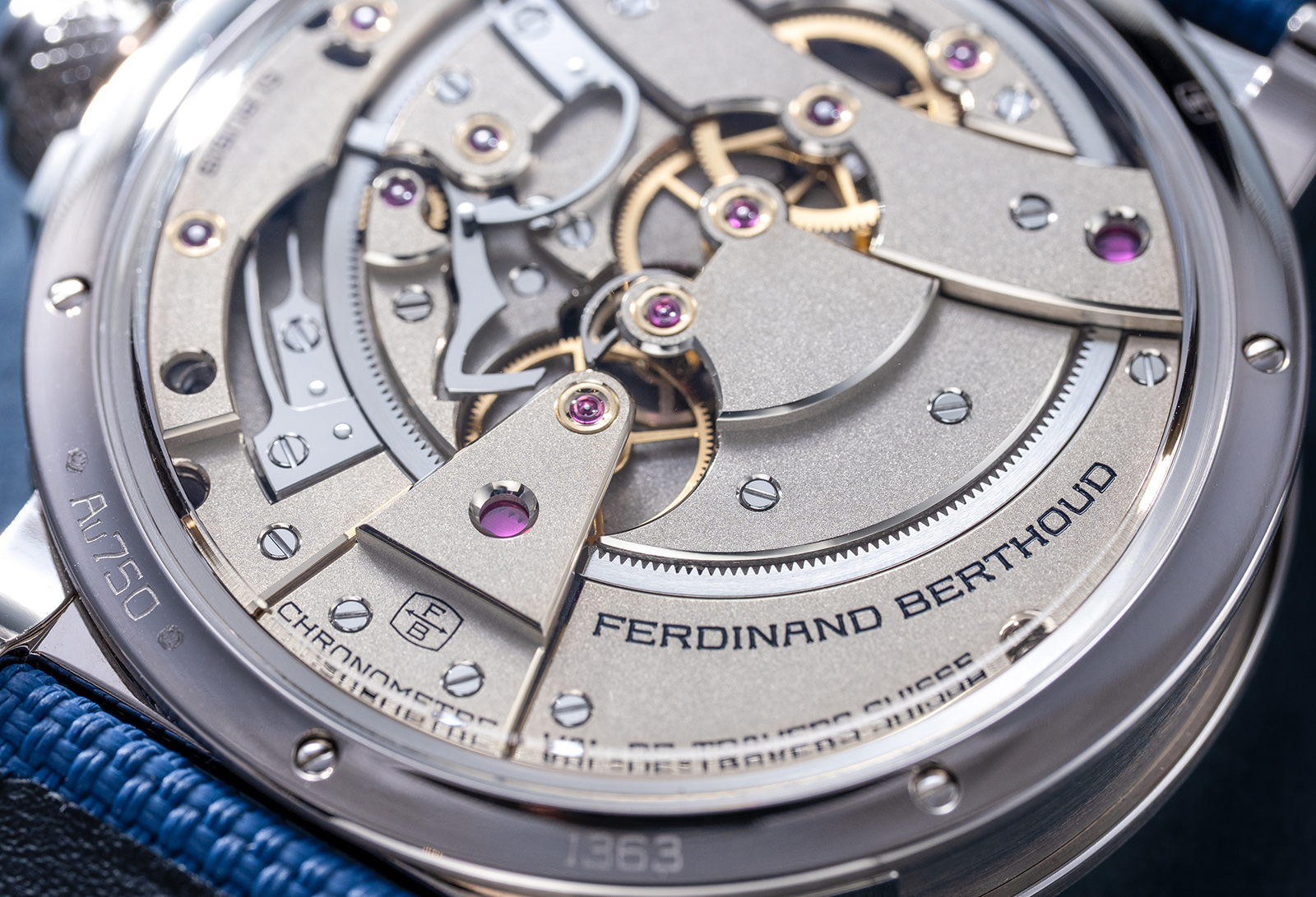
The mechanics on the back are equally engaging, with a zero-reset mechanism that can be observed in action (©Revolution)
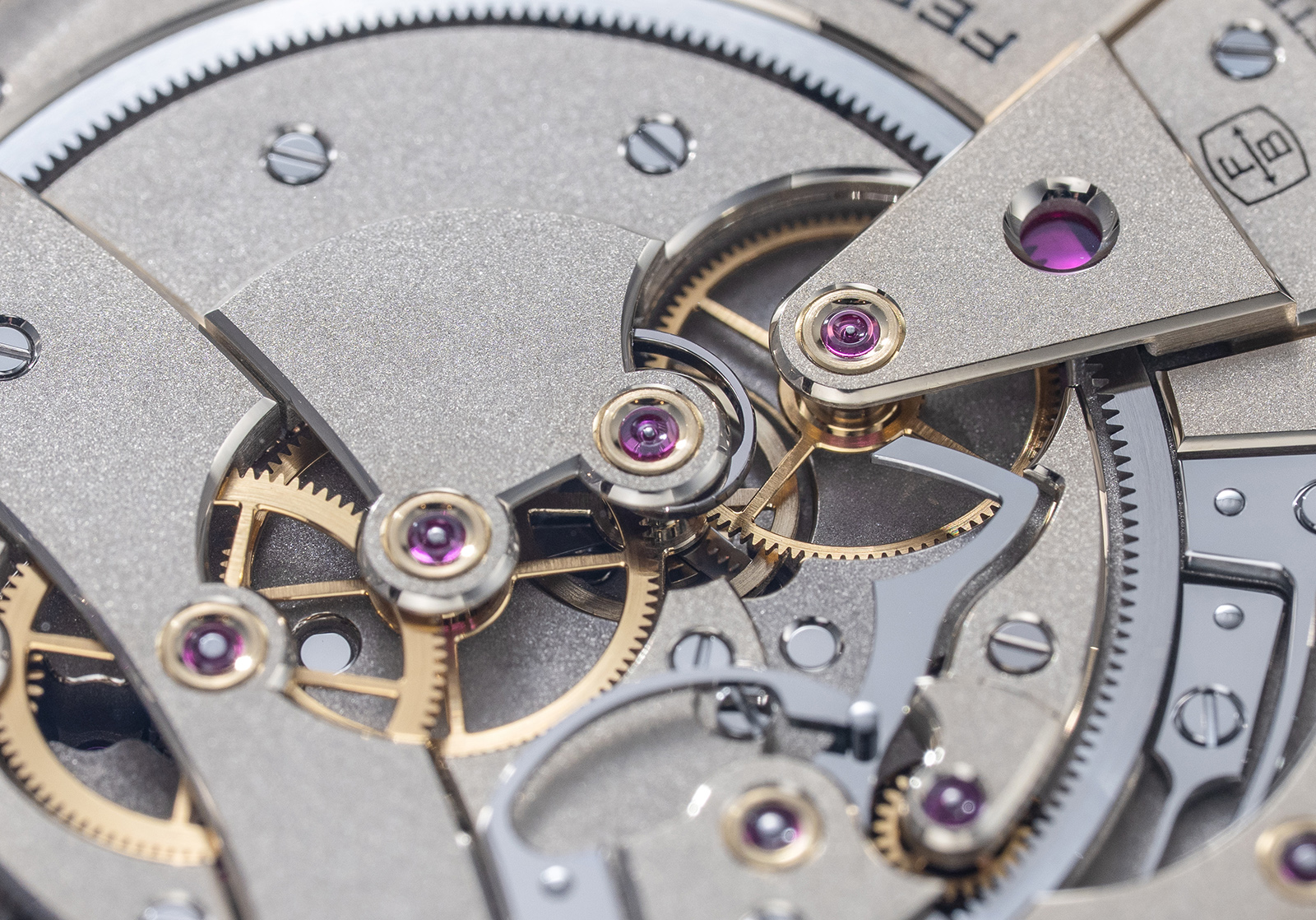
A closer look at the zero-reset lever and the skeletonised snail cam, both in full black polish no less (©Revolution)
On the seconds arbour there is a cam carrier, a wheel without teeth carrying a cam. It is not a heart cam but a snail cam with a progressive rise and steep transition between its highest and lowest point. During reset, a hook-shaped lever applies a force directed towards the centre of the cam, causing it to rotate until it reaches its point of smallest radius, where the mechanism comes to rest at zero.
At the same time, the movement is dominated by a large 28mm diameter transmission wheel. It is part of the motion setting train and connects the keyless works to the motion works. The large diameter of the wheel allows the transmission to be made with stability, avoiding a more complex cascade of intermediate gears while maintaining sufficient torque and smoothness in the setting action.
The movement also incorporates a stop-seconds function, which remains relatively rare in tourbillon watches and is meaningful in a watch conceived with chronometry in mind. It allows the time to be set to the exact second, something that is often overlooked in highly complicated constructions where visual spectacle tends to take precedence over precision in use. When the crown is pulled for time-setting, a brake lever arrests the flying tourbillon carriage and, with it, the entire going train.
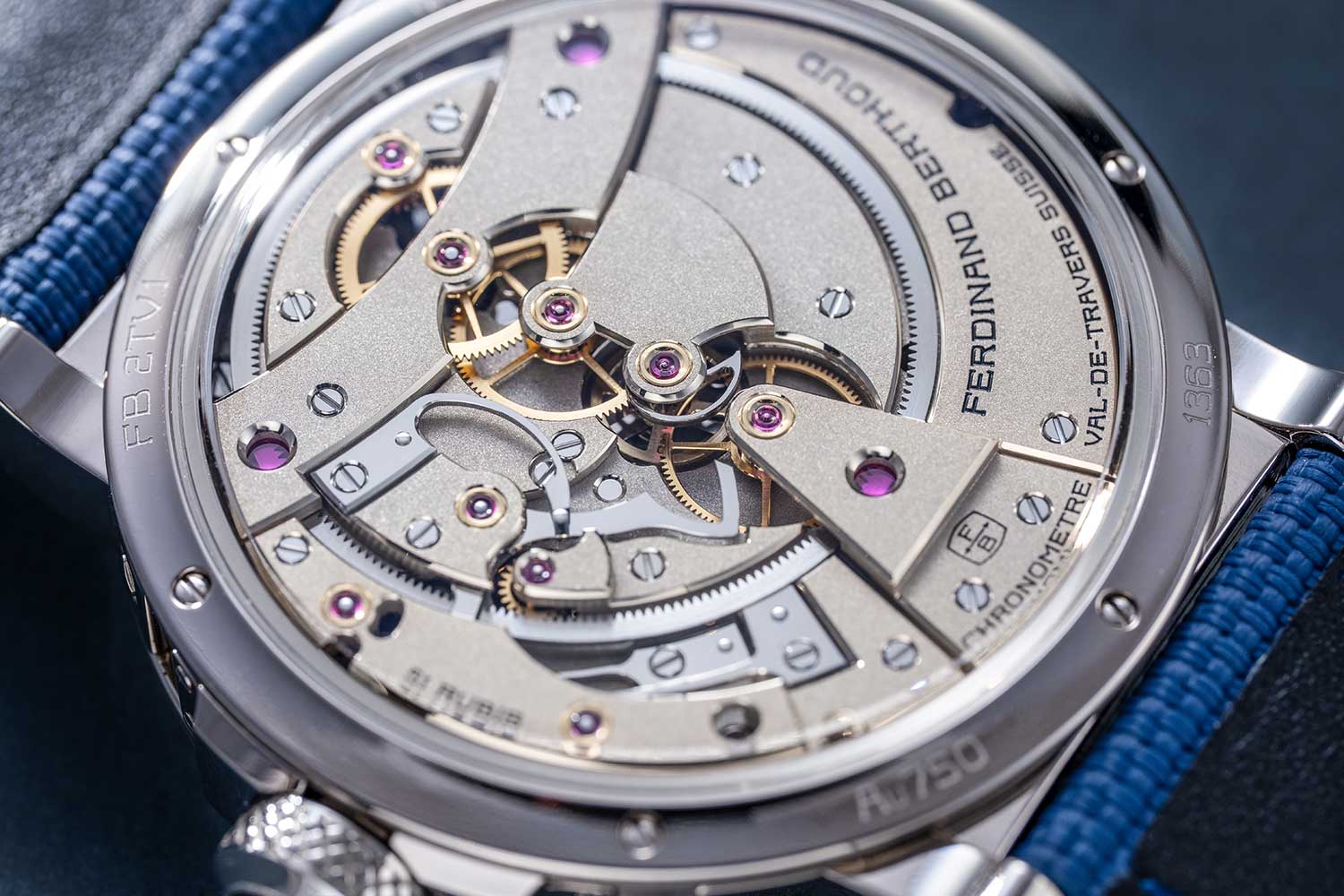
A large 28mm diameter transmission forms part of the setting train connecting the keyless works to the motion works (©Revolution)
The Mesure du Temps 1787 Chronomètre FB 2TV is, all in all, a remarkably complete exercise in chronometry, one that honours the solutions of the past while adapting them, uncompromisingly, for the wrist. The movement is densely conceived, but aside from the power reserve, there is very little in there that would traditionally be considered a complication, and that is entirely the point. It is built instead around the fundamentals of timekeeping and brings together a whole arsenal of solutions in a construction that is both deeply engaging and unusually direct in the way it presents itself – all with a level of finishing that hardly needs pointing out.
Tech Specs: Ferdinand Berthoud Mesure du Temps 1787 Chronomètre FB 2TV
Movement Manual-winding Caliber FB -T V.FC; 60-hour power reserve; 3Hz or 21,000vph; Chronometer-Certified by COSC
Functions Hours and minutes; central second; power reserve indicator
Case 44.3mm x 15.46mm; white gold; water-resistant to 30m
Dial Hours and minutes dial at 12 o’clock in matte white varnished brass with glossy black engraved markings; Matte white lacquered brass seconds inner bezel ring with glossy black lacquered engravings; Power reserve indicator engraved on the mainplate at 7:30
Strap Hand-sewn, rolled-edge alligator strap; 18k white gold double-blade safety folding clasp, adjustable length; pin buckle available on request
Availability At a rate of 10 to 12 pieces per year
Price EUR 383,000
Ferdinand Berthoud

You may also like

Editorial
Watches and Wonders 2026 Editor’s Pick: Cheryl Chia, Technical Editor
May 2, 2026
Editorial
Watches and Wonders 2026 Editor’s Pick: Cheryl Chia, Technical Editor
May 2, 2026

Editorial
Revolution Awards 2025: Watch of The Year — Ferdinand Berthoud Naissance d’une Montre 3
Jan 27, 2026
Editorial
Revolution Awards 2025: Watch of The Year — Ferdinand Berthoud Naissance d’une Montre 3
Jan 27, 2026
Editorial
The Revolutionary List: 24 Technically Brilliant Watches – Ferdinand Berthoud FB 1
Dec 12, 2025
Editorial
The Revolutionary List: 24 Technically Brilliant Watches – Ferdinand Berthoud FB 1
Dec 12, 2025