
A Closer Look: Breguet Tradition Seconde Rétrograde 7035
Reviews
A Closer Look: Breguet Tradition Seconde Rétrograde 7035

The Breguet Tradition is one of the most beautiful and thoughtfully executed watches in Breguet’s modern catalogue. It is a watch that reproduces both the arrangement of the train and dial orientation of A.-L. Breguet’s montres à tact. While the distinctive movement architecture is a hallmark of the souscription watches Breguet began producing in 1796, it’s worth noting that when he introduced the montres à tact in 1799, he applied the same mechanical foundation to a watch designed to be read by touch.
In addition to featuring a tact hand on the front cover or back, these pocket watches included a small dial displaying the hours and minutes on the movement side so the time could also be read and set visually. The barrel is centrally located and drives the motion works directly, with the gear train arranged below. Mechanically, they were essentially souscription movements adapted for a different mode of interaction. As an aside, Breguet’s one-hand souscription watches were conceived to make high-grade watches more accessible and were priced at around 600 francs. By comparison, a plain montre à tact ranged from 1,000 to 2,000 francs, which was comparable to his repeating watches, while the most elaborate examples could cost up to 5,000 francs.
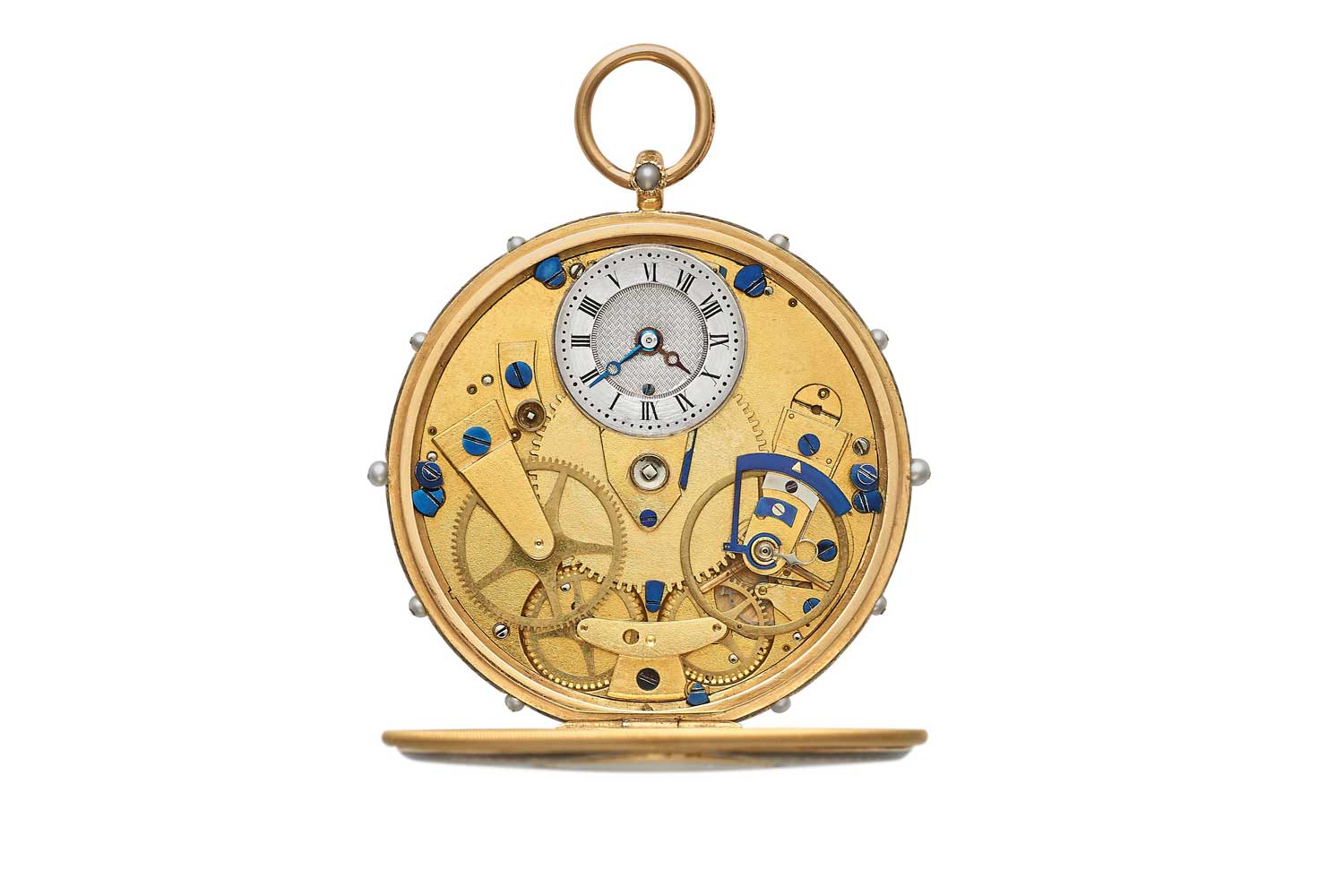
Breguet montres à tact No. 2292
The Tradition is essentially a reimagining of one of Breguet’s most ingenious formats for the wrist. It was originally introduced as a hand-wound model in 2005 with the 37mm Ref. 7027, followed by a 38mm automatic version, the Ref. 7037 a year later. Then in 2010, the larger 40mm hand-wound Ref. 7057 was introduced, and in 2015 the automatic Ref. 7097, also 40mm, with an oscillating mass derived from the shape of A.-L. Breguet’s original perpétuelles. The same automatic movement was later used in the first women’s model, the 37mm gem-set Ref. 7038 launched in 2016.
To mark its 250th anniversary this year, the brand has now introduced the automatic Tradition Seconde Rétrograde 7035 in a limited edition of 250 pieces. (It’s worth noting that 7035 is also the reference number of a limited edition women’s model launched in 2021, featuring a snow-set dial and movement.) The new Ref. 7035 has a 38mm case made from Breguet gold, paired with a flinqué enamel dial featuring a newly developed guilloche pattern. It also features a platinum winding weight, echoing the material choice used by A.-L. Breguet in his original perpetuelle winding system.

Breguet Tradition Seconde Rétrograde 7035 (Revolution©)
Breguet Gold Case & Flinque Enamel dial
At 38mm, the case is smaller than that of the Ref. 7097, though thicker at 12.6mm versus 11.8mm. Both watches share the same movement, and the slight increase in height is attributable to the thickness of the flinqué enamel dial. The case is rendered in what Breguet calls Breguet gold, a new proprietary alloy that was introduced in the Anniversary Souscription. It’s composed of gold, silver, copper, and palladium, the last of which is more commonly associated with white gold alloys. Its inclusion here lends the metal a more neutral tone, sitting somewhere between yellow and rose, without clearly resolving into either.

Elaborate in form and classic Breguet (Revolution©)
The case is elaborate in form and classic Breguet. It has a fluted case band which is first pressed into the metal through a cold-rolling process, then manually finished. The lugs are individually welded onto the case and fitted with screw-set bars for attaching the strap.
The movement plate and bridges are plated with 18k Breguet gold while the dial and hands are in solid Breguet gold. The dial features a newly developed engine-turned pattern that first appeared on the caseback of the Anniversary Souscription. Named “Quai de l’Horloge,” the pattern was inspired by the shape of the Seine as it curves around the Île de la Cité, where Breguet had his workshop, and Île Saint-Louis, as seen on the Turgot map which presents Paris in a highly detailed and somewhat stylised oblique perspective. The pattern was engraved by hand using a rose engine, for which custom rosettes had to be created.

The beautiful flinqué enamel dial in Breguet blue, matching the screws (Revolution©)
The guilloché gold base then undergoes grand feu enamelling. Gold is highly stable under heat, resistant to corrosion and oxidation, and does not deform during firing even after repeated cycles, making it an ideal material for flinqué enamel in which translucent enamel is used to showcase the engraved base. Breguet gold appears to be formulated with these demands in mind. The addition of palladium likely helps suppress oxidation from metals such as copper, which can otherwise affect adhesion or clarity during high temperature firing. While enamel is more often applied as a wet slurry where finely ground enamel powder is mixed with water and brushed onto the surface, it was applied in powder form here using a sieve. This method is suited to engraved surfaces, as it allows the enamel to settle evenly across the guilloché, ensuring a consistent layer once fused in the kiln.

Breguet Tradition Seconde Rétrograde 7035 (Revolution©)
The dial markings, Breguet numerals, the minute track with its fleurs de lis, and the serial number at four o’clock are in silver print. The dial closely matches the shade of the retrograde seconds hand and the blued screws, which ties the composition together and offers a wonderful contrast against the gilded movement.
A subtle but visually significant difference between the Ref. 7097 and the 7035 is the retrograde seconds scale. Previously the sector-shaped scale cuts into the dial, creating a deliberate visual overlap that places the complication at the forefront of the design. Now the retrograde seconds indication has been repositioned along the outer edge of the dial, which was previously seen in the women’s models. It’s a small change in design, but one that shifts the tone from expressive technicality to composed elegance.
Breguet Calibre 505SR
The Calibre 505SR has been around for a decade now, and with its visual simplicity, it’s easy to take for granted how unusual this is. In Breguet’s original souscription watches, the barrel is wound directly via a key fitted onto the winding square of the arbour. The barrel also held the single hand, hence setting the time would simultaneously wind the mainspring. The simplicity and clarity of the movement were thus a natural product of the absence of keyless works, setting and winding trains. In a wristwatch, where all these mechanisms are necessary, achieving the same effect requires a fundamental rethinking of the layout. The keyless works and setting train had to be relegated to the back of the movement, and although the movement is “inverted”, the winding train had to remain on the back to preserve clarity. As such, there is an elongated bridge on the left side on the back that carries the winding wheels and simultaneously supports the pivots of the setting train, which are located in the mainplate. Since the setting train must engage the motion works on the dial side, an intermediate extension wheel is used to bridge the two layers. For a clear view of its inner workings, visit The Naked Watchmaker.

The elongated bridge carries the winding pinions while supporting the setting train in the main plate
The Calibre 505SR has a platinum oscillating weight that derives its shape from Breguet’s perpetuelle watches. Mechanically, however, it functions as a conventional rotor, rotating a full 360 degrees. Breguet’s original perpetuelle used a hammer-style automatic winding system, with a platinum weight pivoted at the edge of the movement. When the watch was carried vertically in a pocket, the natural up-and-down motion from walking caused the case to move, while the inertia of the heavy platinum weight caused it to remain relatively still. This relative motion between the moving watch and stationary weight drove the winding mechanism. Platinum was chosen precisely for its density as it gave the weight enough inertia to resist motion and wind the mainspring effectively. The weight swung through only a limited arc, bounded by the curves of the case interior. To further absorb shocks and control motion, buffer springs were incorporated on either side of the weight.
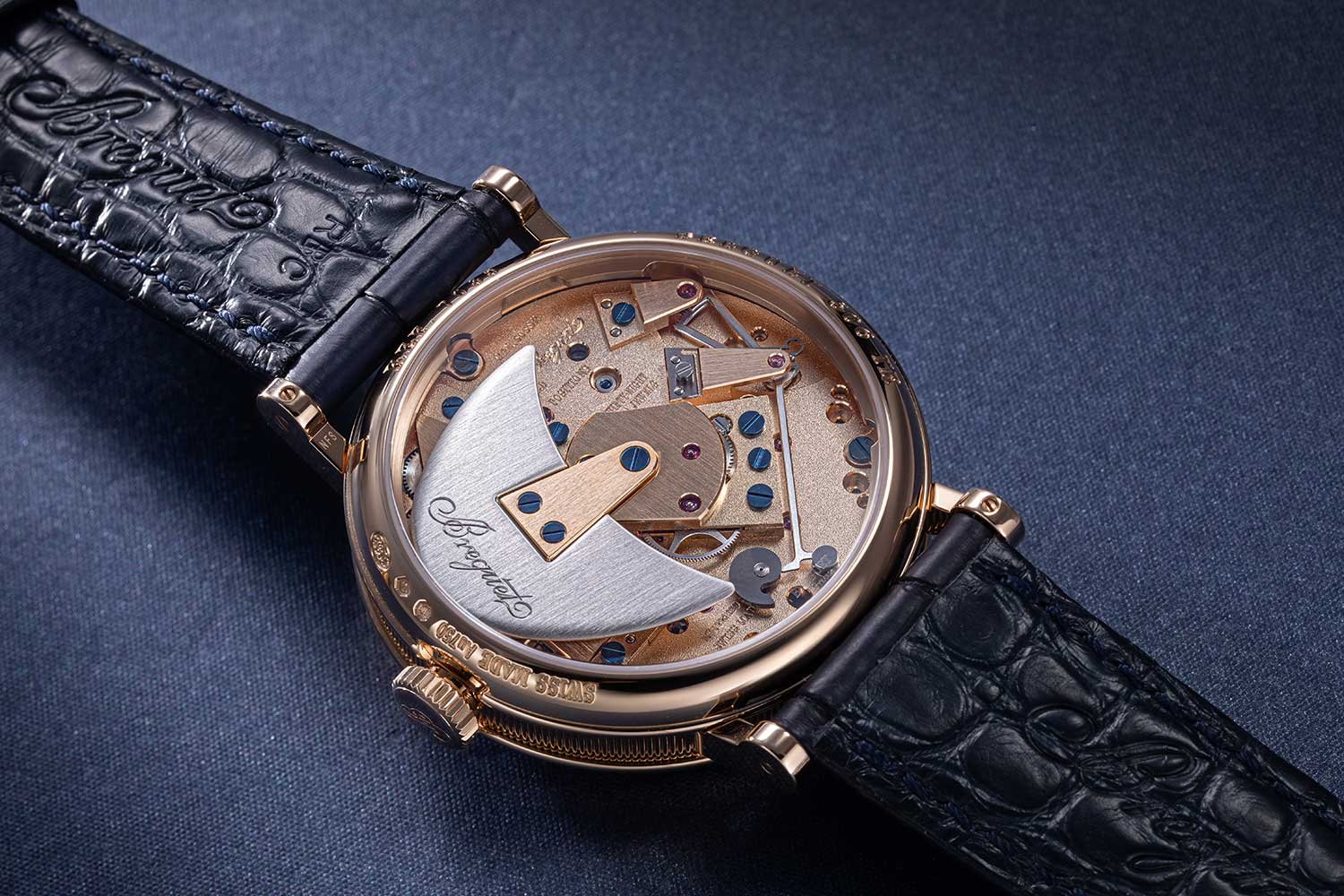
The oscillating weight is now in platinum, echoing the material choice used by A.-L. Breguet in his original perpetuelle winding system (Revolution©)
The gear train in the Calibre 505SR, like in Breguet’s souscription watches, is disposed around the barrel below. An intermediate wheel has been added at the start of the going train, perhaps to position the centre wheel opposite the balance and match their diameters for symmetry. The balance wheel is free-sprung but beat error can be adjusted with the screw in the curved slot. The assembly is completed with Breguet’s pare-chute shock protection system.

Free-sprung balance with a blued Nivachron overcoil hairspring and Breguet’s pare-chute shock protection system, which incidentally was invented for his perpetuelles (to protect the balance staff from shocks caused by the heavy platinum oscillating weight, especially when the watch was jostled or shaken) (Revolution©)
Notably, the hairspring in this movement is no longer in silicon. In earlier models, silicon hairsprings were used and the overcoil was formed using a separate spring and a connector. Here it is in blued Nivachron, a titanium based alloy developed by Swatch Group, in partnership with Audemars Piguet. It offers comparable magnetic resistance but with less brittleness and easier handling than silicon.
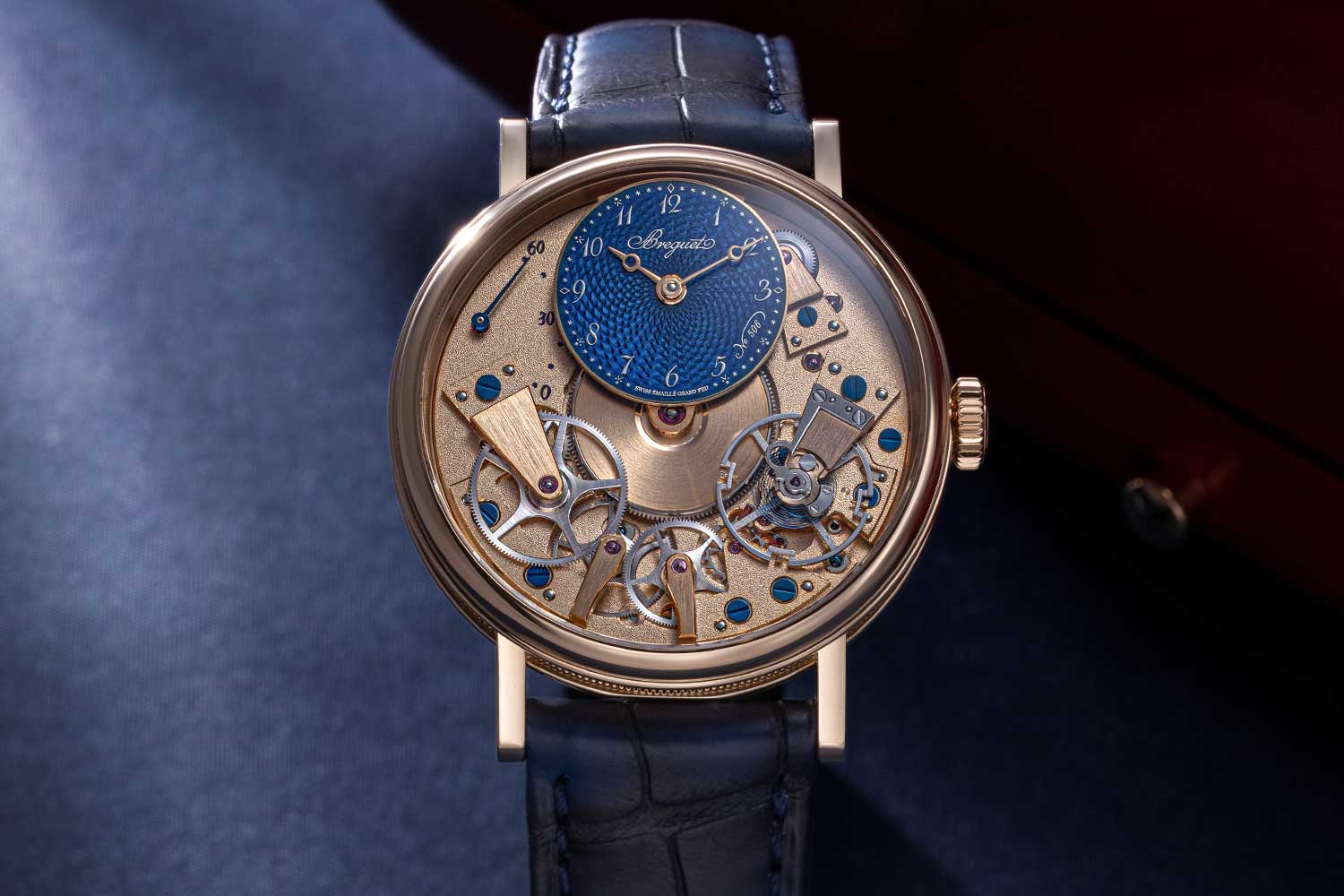
Breguet Tradition Seconde Rétrograde 7035 (Revolution©)
Overall, the new Ref. 7035 is straightforward in its appeal and hard to fault; it is a tasteful and perhaps the most compelling expression of an already inspired design.
Tech Specs
Reference: 7035BH/H2/9V6
Movement: Calibre 505SR; self-winding; 50-hour power reserve; 3 Hz (21,600 vibrations per hour)
Functions: Hour, minutes and retrograde seconds
Case: 38 mm x 12.6 mm; 18k Breguet Gold; water resistant to 30 m
Dial: 18K Breguet gold, translucent blue, grand feu enamel, hand-guilloché Quai de l’Horloge motif
Strap: Blue alligator leather with Breguet Gold pin buckle
Limited edition: 250 pieces
Price: CHF 43,000 with VAT
Breguet
You may also like
News
Last Week in Watches: Moser Goes Off-Grid, the Vacheron Constantin Overseas Turns 30
Sep 28, 2026
News
Last Week in Watches: Moser Goes Off-Grid, the Vacheron Constantin Overseas Turns 30
Sep 28, 2026
Reviews
Breguet Marks the 225th Anniversary of the Tourbillon with Four New Watches
Jun 26, 2026
Reviews
Breguet Marks the 225th Anniversary of the Tourbillon with Four New Watches
Jun 26, 2026
Editorial
Breguet Classique Chronométrie Ref. 7727: The World’s Most Accurate Mechanical Watch?
May 29, 2026
Editorial
Breguet Classique Chronométrie Ref. 7727: The World’s Most Accurate Mechanical Watch?
May 29, 2026