

The Revolutionary List: 24 Technically Brilliant Watches – Girard-Perregaux Constant Escapement L.M.
Editorial
The Revolutionary List: 24 Technically Brilliant Watches – Girard-Perregaux Constant Escapement L.M.

This year, Revolution turns 20. Two decades of chronicling watches, people and ideas have given us a front-row seat to a remarkable story: how an age-old craft has both preserved its soul and reinvented itself for the 21st century. To celebrate, we’ve chosen over 100 names and milestones that, for us, define the era so far. From leaders to watches, you can see the whole list here.
The idea of a constant-force escapement, in which the properties of constant force are inherent to the design of the escapement, has existed conceptually for centuries. Thomas Mudge devised one based on the verge in the 1770s and employed it in his marine chronometers, while Breguet filed a patent for such an escapement in 1798 and in corporated it in to his Sympathique clocks. Yet no true escapement of this type ever entered widespread use — a brilliant idea in principle, but too complex and finicky to be practical.
In 2013, Girard-Perregaux revived the concept with the Constant Escapement, a milestone that demonstrated the vast potential of silicon compliant mechanisms. The basis for such an escapement arises from the fundamentals of mechanical watchmaking. A mainspring delivers considerably more torque when fully wound than it does when it approaches the end of its power reserve. This uneven supply translates into varying impulse forces at the escapement, which in turn disturb the rate of the oscillator. A constant-force escapement seeks to resolve this by interposing a regulating element within the escapement itself, ensuring that the oscillator always sees the same impulse regardless of the state of wind.
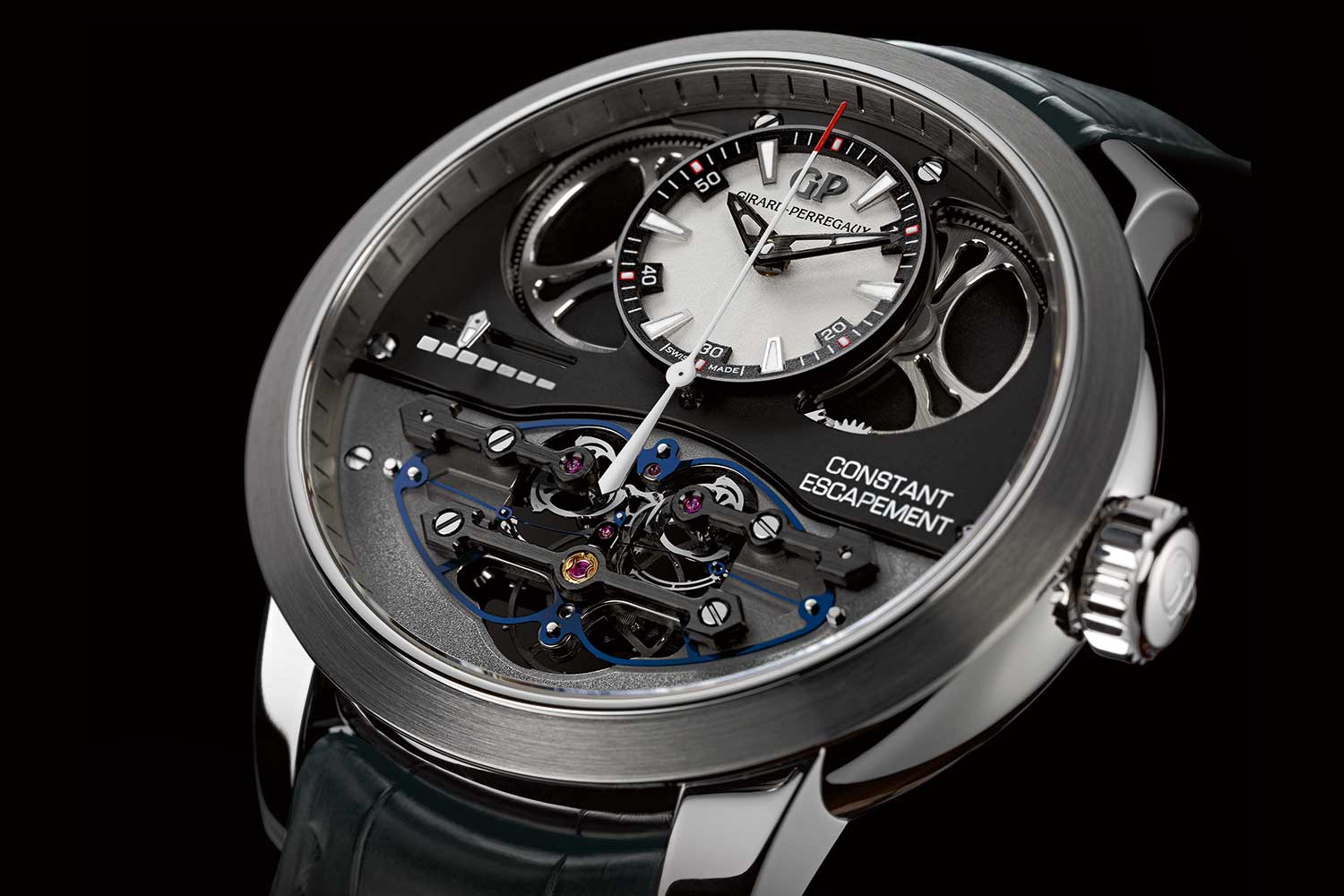
Girard-Perregaux Constant Escapement L.M.
This must be distinguished from older solutions such as the remontoir d’égalité or the fusée-and-chain. Both are torque-equalizing devices, but they act upstream of the escapement. The remontoir introduces a secondary spring along the gear train rewound at intervals by the barrel to smooth the delivery of power before it reaches the escapement. The fusée modifies the leverage of the mainspring at the very outset of transmission, acting directly between the barrel and the rest of the going train. By contrast, a constant-force escapement builds the regulating action directly into the escapement mechanism itself. The oscillator is thus fed equal impulses at every vibration due to the geometry and elasticity of the escapement’s own components.
The Constant Escapement uses two escape wheels, each with three lobed teeth, positioned on either side of the fifth wheel of the going train, which drives them both directly, so they rotate in the same direction. Spanning a butterfly-shaped silicon frame is an ultra thin silicon blade spring just 14 microns thick, divided at its center by a pivot lever. This lever engages the balance roller, twisting the blade into an S-shape as the balance swings. At the critical point, the blade unbuckles and snaps into the opposite S-curve. Because the snap through action of the blade always releases the same stored energy, it delivers a constant, fixed impulse to the balance regardless of the torque from the mainspring.

At the same central pivot sits an arming rocker with two curved arms, loosely coupled to the blade. When the blade unbuckles, it nudges the rocker, unlocking one escape wheel. The freed wheel spins briefly under the power of the train, pushing the rocker across until it blocks the opposite wheel. In the process, the rocker re-twists the blade into an S-shape, recharging it for the next oscillation.
In 2023, the geometry of the escapement was significantly reworked to improve efficiency and self-starting ability, giving rise to the Neo Constant Escapement. In this version, the arming rocker is locked and unlocked directly by a pair of smaller escape wheels mounted co-axially with the larger three-lobed wheels. This revision allows the bistable blade to be brought to its buckling threshold more readily and with less loss. The larger wheels, once responsible for both arming and impulse in the original 2013 construction, no longer perform escapement work. Instead, they serve as added rotational mass within the system. By tempering the sudden acceleration of the smaller escape wheels at each release, they absorb shocks and stabilize the motion of the arming rocker.

Girard-Perregaux Constant Escapement L.M.
The escapement is fascinating on many levels, but chiefly because, unlike the majority that emerged through incremental refinements of existing designs, it required a genuine leap of imagination. That leap came when Nicolas Déhon, on his way to work, snapped his train ticket back and forth and recognized in that motion the basis for it.
Tech Specs: Girard-Perregaux Constant Escapement L.M.
Movement Manual winding Caliber MVT-009 100-0007; seven-day power reserve
Functions Hours, minutes and central seconds
Case 48mm × 14.2mm; 18K white gold; water resistant to 30m
Dial Open-worked with off-centered time display
Strap Black leather with folding clasp
Girard-Perregaux

You may also like

Editorial
The Revolutionary List – 26 Inspirational Leaders: Luigi “Gino” Macaluso
Dec 1, 2025
Editorial
The Revolutionary List – 26 Inspirational Leaders: Luigi “Gino” Macaluso
Dec 1, 2025
News
Girard-Perregaux Laureato Three Gold Bridges Returns in Fine Form
Nov 19, 2025
News
Girard-Perregaux Laureato Three Gold Bridges Returns in Fine Form
Nov 19, 2025

Reviews
Girard-Perregaux Updates The Laureato For Its 50th Anniversary
Oct 8, 2025
Reviews
Girard-Perregaux Updates The Laureato For Its 50th Anniversary
Oct 8, 2025