Girard-Perregaux Laureato Three Gold Bridges Returns in Fine Form
News
Girard-Perregaux Laureato Three Gold Bridges Returns in Fine Form

Following the launch of the Laureato Fifty, the 50th anniversary celebrations of the Laureato continue with the Laureato Three Gold Bridges, a piece that brings two of the brand’s strongest identities together – the quintessential ’70s sports-integrated design and the 19th-century invention that defined Girard-Perregaux at the highest level of watchmaking.
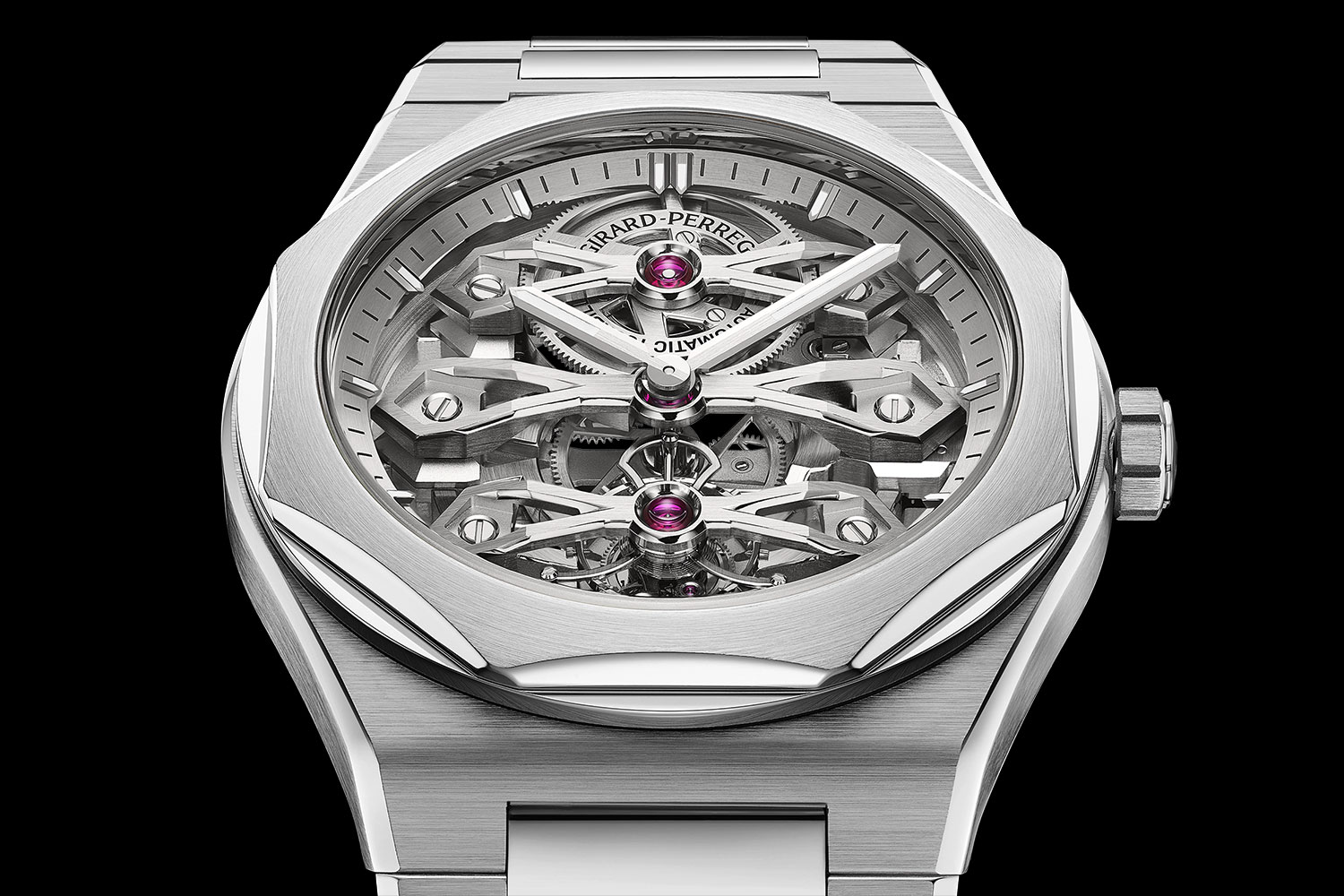
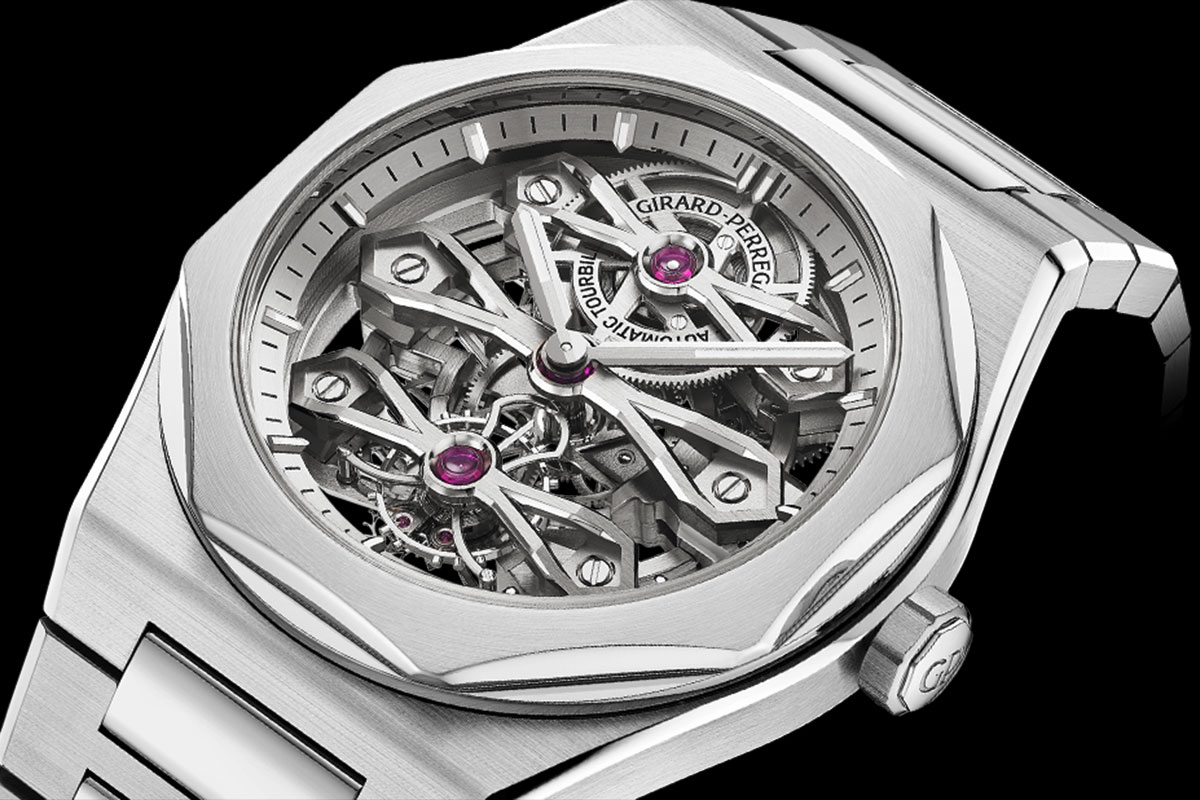
Girard-Perregaux Laureato Three Gold Bridges
It was in 1867 that Constant Girard produced what would become one of the most distinctive and beautiful tourbillon movements in all of watchmaking. His tourbillon with three bridges was unlike anything of its time, being visually symmetrical, mechanically linear, and endowed with an architectural clarity that gave an artistic presence to a mechanism then regarded as strictly functional, however prized. Three parallel bridges, each drawn out into an elongated hexagon, anchored the key components of the movement, with the train running in a straight axis from the barrel at the top through the centre wheel to the tourbillon at six o’clock. The bridges were first made in nickel silver and later in gold with their now-familiar arrow-shaped profile, a design for which a patent was registered in 1884.
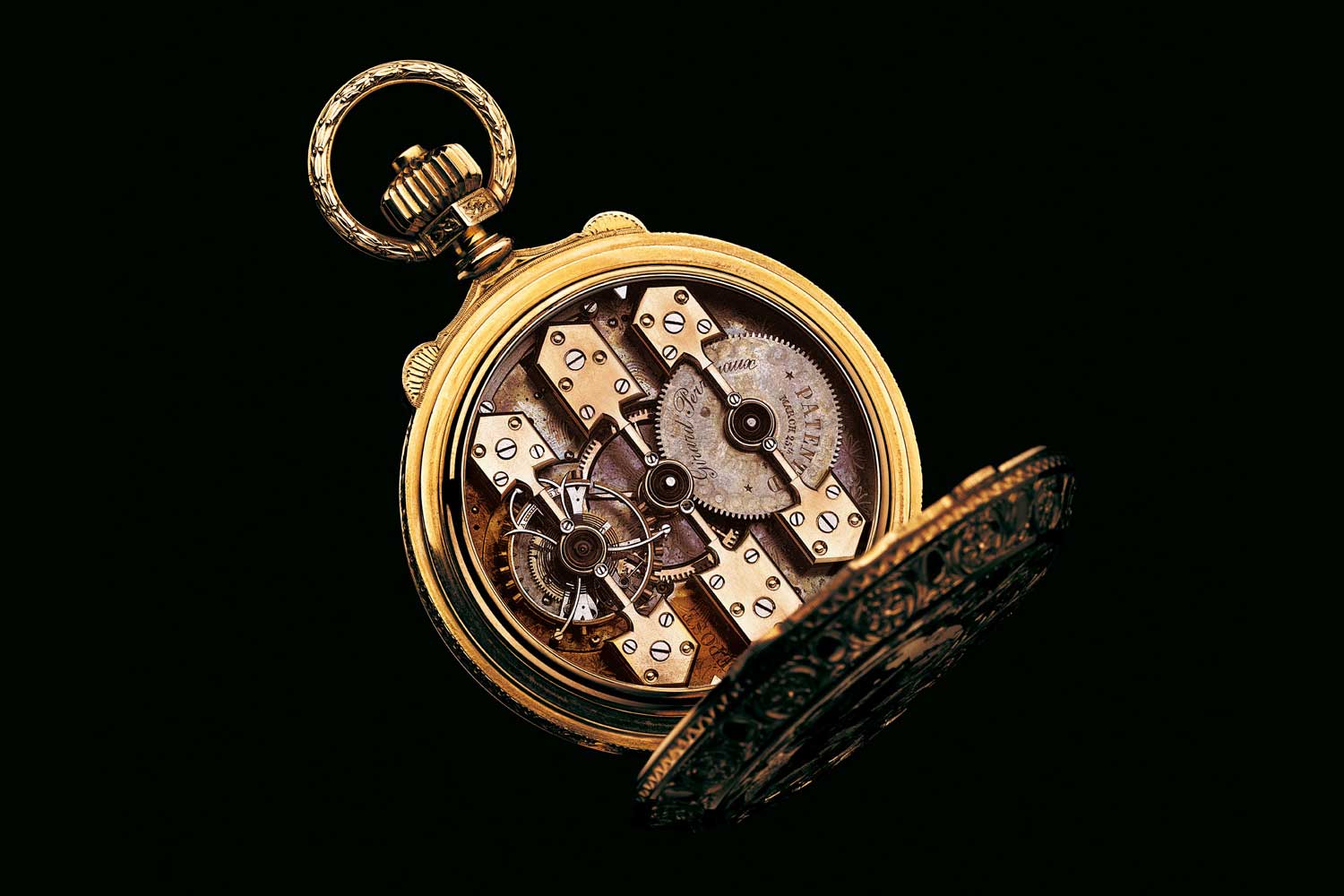
Girard’s La Esmeralda Tourbillon with Three Gold Bridges
What made the design more than an aesthetic conceit was its performance. Many examples were fitted with pivoted detent escapements. In 1867, it was awarded a first class bulletin by the Neuchâtel Observatory. The seamless integration of aesthetics and mechanics was reflected even in the tourbillon regulator itself, which had an elegantly formed lyre-shaped carriage with two distinctive horns that departed from the conventional three-armed design, and became the model for all of Girard-Perregaux’s modern tourbillons.
In the wake of the quartz crisis in 1980, as traditional watchmaking slowly found its footing again, Girard-Perregaux returned to the idea and produced a series of 20 pocket watch tourbillons based on Constant Girard’s original design. Each required roughly 1,500 hours to complete. The transition from pocket to wrist would follow. In 1991, Girard-Perregaux created its first wristwatch Tourbillon with Three Gold Bridges. Subsequently, in 1997, the first Laureato Tourbillon with three gold bridges was introduced. It was also the first automatic tourbillon with this architecture, integrating a micro-rotor winding system without disturbing the visual symmetry that had become the hallmark of the design. The line would later evolve to include versions fitted with sapphire bridges and even spinel bridges.
The new Laureato Three Gold Bridges has its case in stainless steel with a white gold octagonal bezel. It measures 41mm wide and 10.85mm in height and incorporates all the refinements introduced with the Laureato Fifty. The bezel, lugs, crown, and bracelet have each been reworked with sharper lines and finished to a notably higher standard with deeper bevels and broader polished facets. Like the Laureato Fifty, the bracelet has a twin-trigger double-folding clasp that brings both blades together so they meet to form the motif of a double-arrow bridge. In addition to half-link adjustment, the clasp is equipped with a micro-adjustment system that allows up to 4mm of extension on the go.

The bezel, lugs, crown, and bracelet have each been reworked with sharper lines and finished to a notably higher standard with deeper bevels and broader polished facets
But the main event is ultimately the movement. The Calibre GP9620 was developed expressly for the Laureato, characterised by three openworked, sculpted bridges in white gold. Power reserve is 55 hours and beat rate is 21,600vph. At 32mm wide, it is smaller than the earlier similarly openworked 36mm Calibre GP9400, whose three bridges were finished in black PVD. Dark coatings have their place, but they conceal the anglage. For me, it’s a pet peeve, and its absence here is a relief.

The Calibre GP9620 was developed expressly for the Laureato, characterised by three openworked, sculpted bridges in white gold
The bridges on the back mirror those on the front, while the mainplate itself is skeletonised as well. Accordingly, there is an abundance of anglage in this new movement, laboriously executed with a total of 362 inward angles finished by hand, including those on the wheel spokes. The various levels of wheels share the same spoke design and finishing.
On the front, the upper bridge holds the barrel, which has been skeletonised to echo the overall design of the movement. The platinum micro-rotor is cleverly positioned just beneath it. This stacked layout preserves the vertical axis of the Three Bridges design while allowing automatic winding without obstructing the view from the either side. The key detail is the relationship between the barrel arbor and the micro-rotor. The arbor, which anchors and winds the mainspring, passes through the centre of the micro-rotor. The micro-rotor is mounted coaxially on the arbor and pivots around it.

The central bridge carries the centre wheel, and the lower bridge supports the tourbillon. The upper cage bridge of the tourbillon follows the original Constant Girard design from the 19th century. Notably, the three bridges on the front aren’t flat but angled upwards towards the centre, which invites a more expressive display of finishing. Apart from the razor-sharp angles, it has some of the largest train jewels and deepest countersinks.

The elegantly formed lyre-shaped carriage
To preserve the visual purity of displaying only the barrel, centre wheel and tourbillon on the dial side, the motion works, setting and winding trains had to be located beneath the base plate on the back of the movement. On the back, the upper bridge supports the barrel ratchet, flanked by the manual and self-winding trains. At 1 o’clock is a ratchet winding wheel which allows the manual and self-winding trains to be uncoupled during hand-winding. A stop pawl, through its spring, ensures the reduction train rotates in one direction only.

The bridges on the back follow the same architecture as those on the front, and the mainplate has been skeletonised to match

The upper bridge supports the barrel ratchet and on the left is the offset crown wheel
The central bridge carries the motion works, which passes through the centre wheel to drive the hands. The shaft of the hour wheel is inside the shaft of the cannon pinion rather than the other way round. The last bridge on the back supports the lower pivot of the cage, while the third wheel is carried by its own bridge between the mainplate and the upper bridge.

Two versions are available – with or without a diamond-set bezel. The non-set version is limited to 50 pieces, while the diamond-set model is not limited. The latter is notable as setting baguette-cut diamonds into an octagonal bezel requires custom stones, a custom channel and hand-adjusted tolerances. It is a demanding execution. The bezel must be engineered to accept stones of slightly differing proportions, flare subtly at the corners and maintain perfectly level alignment under an invisible setting.

Girard-Perregaux Laureato Three Gold Bridges with diamond set bezel
Ultimately, the Laureato Three Bridges represents Girard-Perregaux at its best. It is a watch that threads its 19th-century lineage into a contemporary form without compromise, proving that the manufacture still commands the depth of skill and expertise that shaped its greatest work.
Tech Specs: Girard-Perregaux Laureato Three Gold Bridges
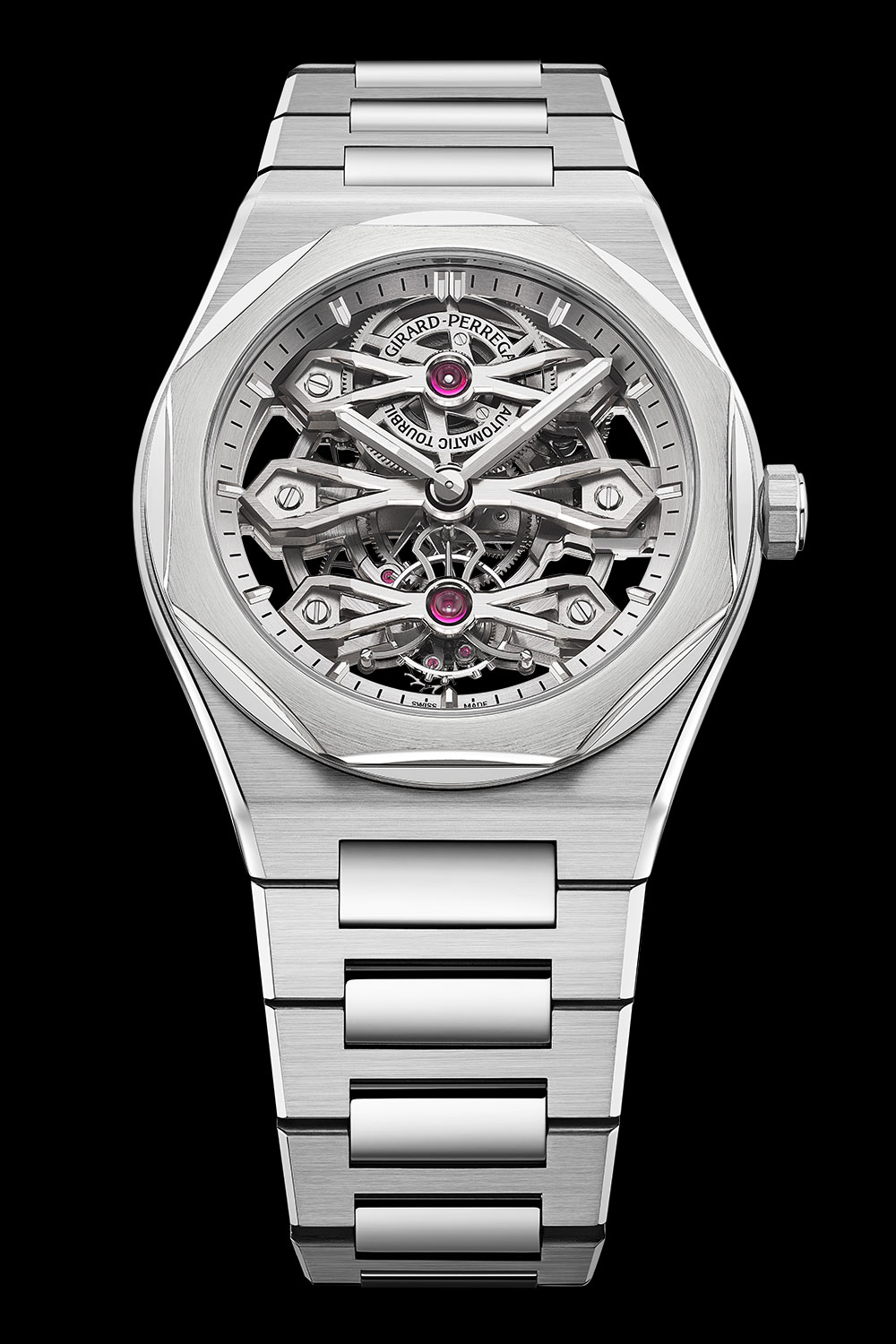

Reference: 99112-58-3576-1CM and 99112-58S3451-1CM (with diamond-set bezel)
Movement: Self-winding Caliber GP09620-2206 with platinum micro-rotor; 55-hour power reserve; 3Hz or 21,600vph
Functions: Hours and minutes; seconds via tourbillon cage
Case: 41mm × 10.85mm; stainless steel with white gold octagonal bezel (with or without 32 baguette-cut diamonds ~3.2 cts); water-resistant to 30m
Dial: Ring displaying suspended indexes, white gold indexes with luminescent material; white gold baton hands with luminescent material
Strap: Stainless steel bracelet with triple folding clasp, featuring up to 4mm of fine adjustment
Availability: The non-set version is limited to 50 pieces; the diamond-set version is not limited
Price: CHF 162,000 and CHF 215,500 (diamond-set bezel), excluding taxes
Girard-Perregaux
You may also like
Editorial
Introducing the Girard-Perregaux Minute Repeater Flying Bridges
Mar 12, 2026
Editorial
Introducing the Girard-Perregaux Minute Repeater Flying Bridges
Mar 12, 2026
Editorial
New Chapters in Seddiqi’s Legacy
Jan 29, 2026
Editorial
New Chapters in Seddiqi’s Legacy
Jan 29, 2026
Editorial
The Revolutionary List: 24 Technically Brilliant Watches – Girard-Perregaux Constant Escapement L.M.
Dec 12, 2025
Editorial
The Revolutionary List: 24 Technically Brilliant Watches – Girard-Perregaux Constant Escapement L.M.
Dec 12, 2025