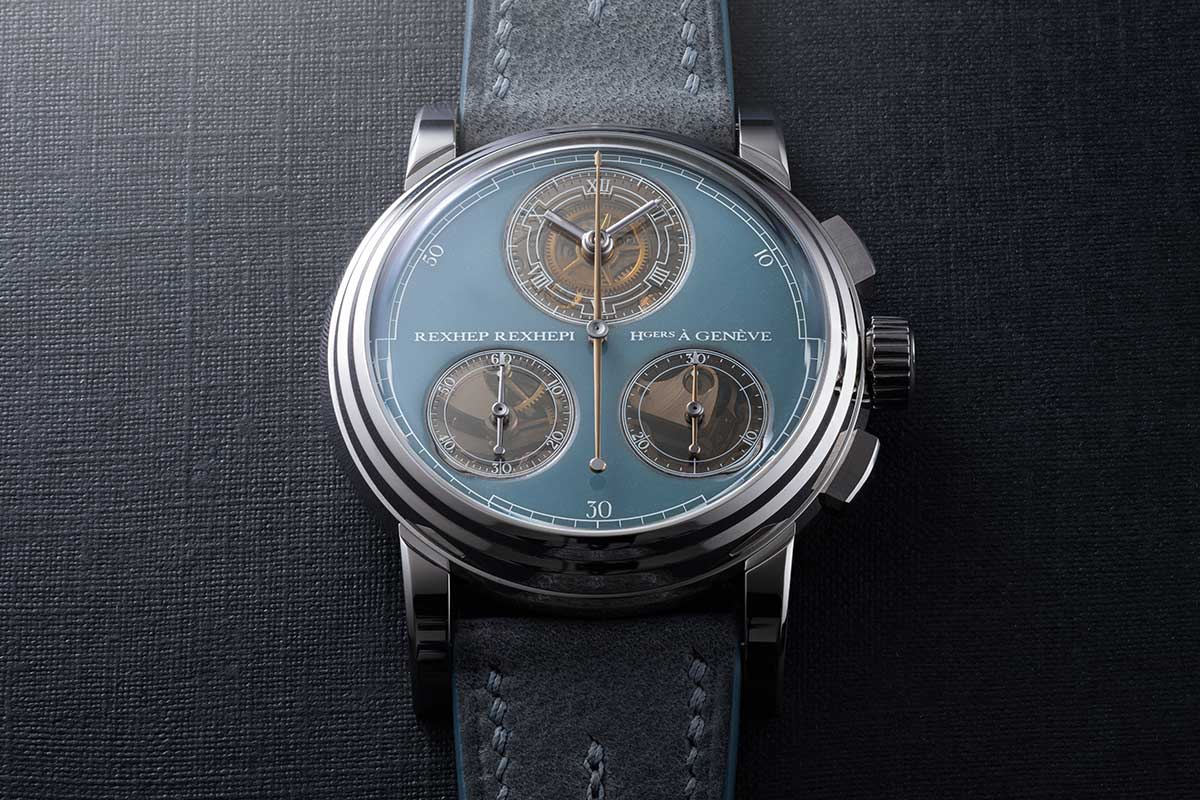
Rexhep Rexhepi on Building the RRCHF, His First In-House Flyback Chronograph
Interviews
Rexhep Rexhepi on Building the RRCHF, His First In-House Flyback Chronograph

The conversation opens in the run-up to Geneva Watch Week — that familiar moment when the industry gathers, calendars compress and attention sharpens around what is about to be released.
Of course, Rexhep Rexhepi is aware of it, but he is not especially concerned by it. For him, the focus is elsewhere. On a watch and on the moment it represents. A chronograph, fully developed in-house, released under his own name.

Rexhep Rexhepi at his atelier, Akrivia
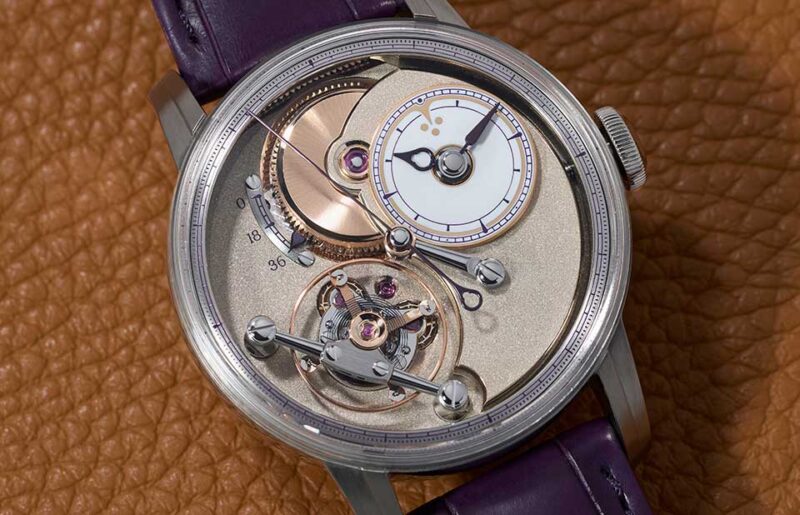
He has, to his credit, the monopusher tourbillon chronograph AK-01 launched in 2013, the brand’s inaugural watch, which had a movement that traces back to the work he undertook at BNB Concept. More recently in 2023, there was the Akrivia x Louis Vuitton LVRR-01 Chronographe à Sonnerie which combined a monopusher central chronograph with a chiming mechanism that sounds each elapsed minute in passing, together with a five-minute tourbillon.
-
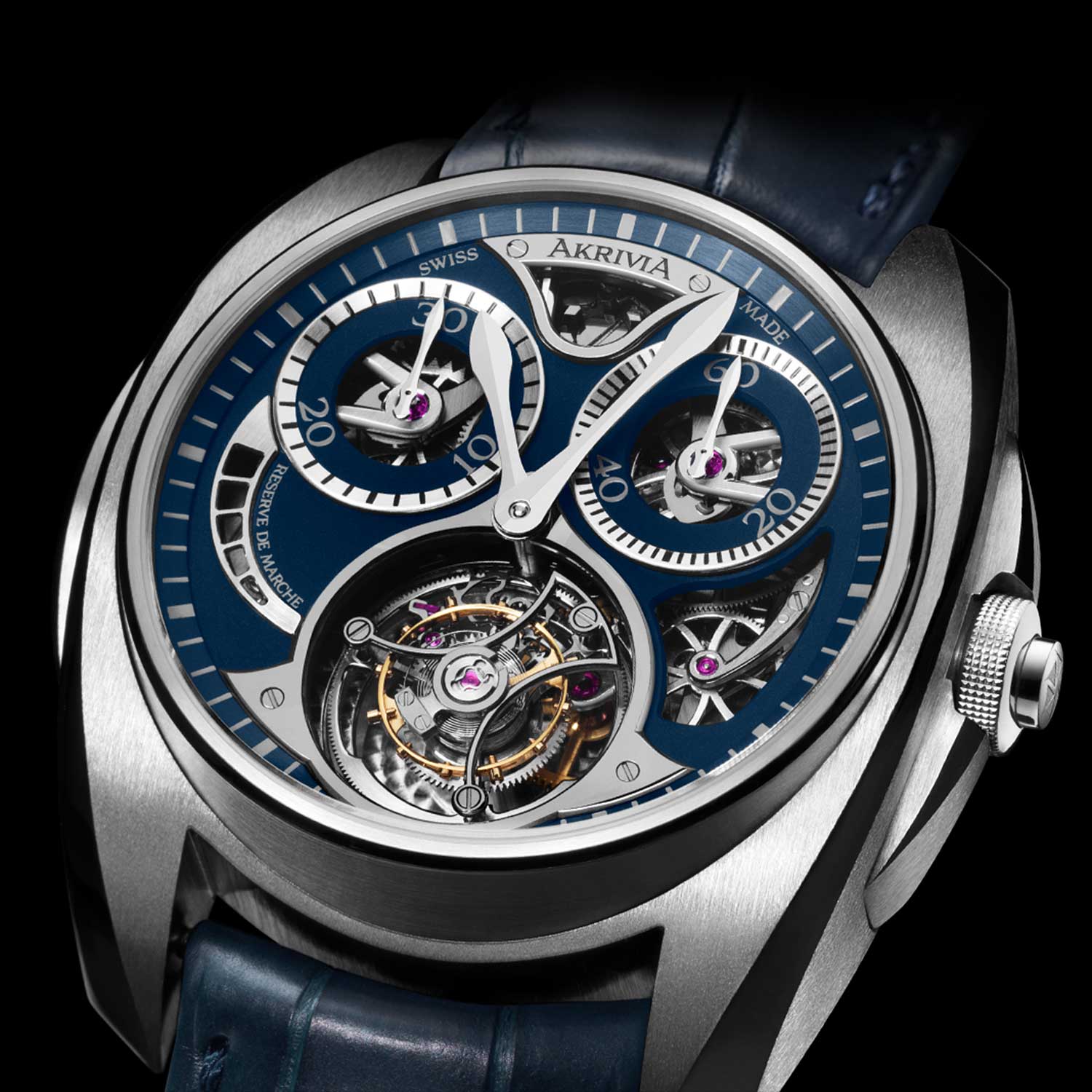
- 2013: Tourbillon Monopusher Chronograph AK-01
-
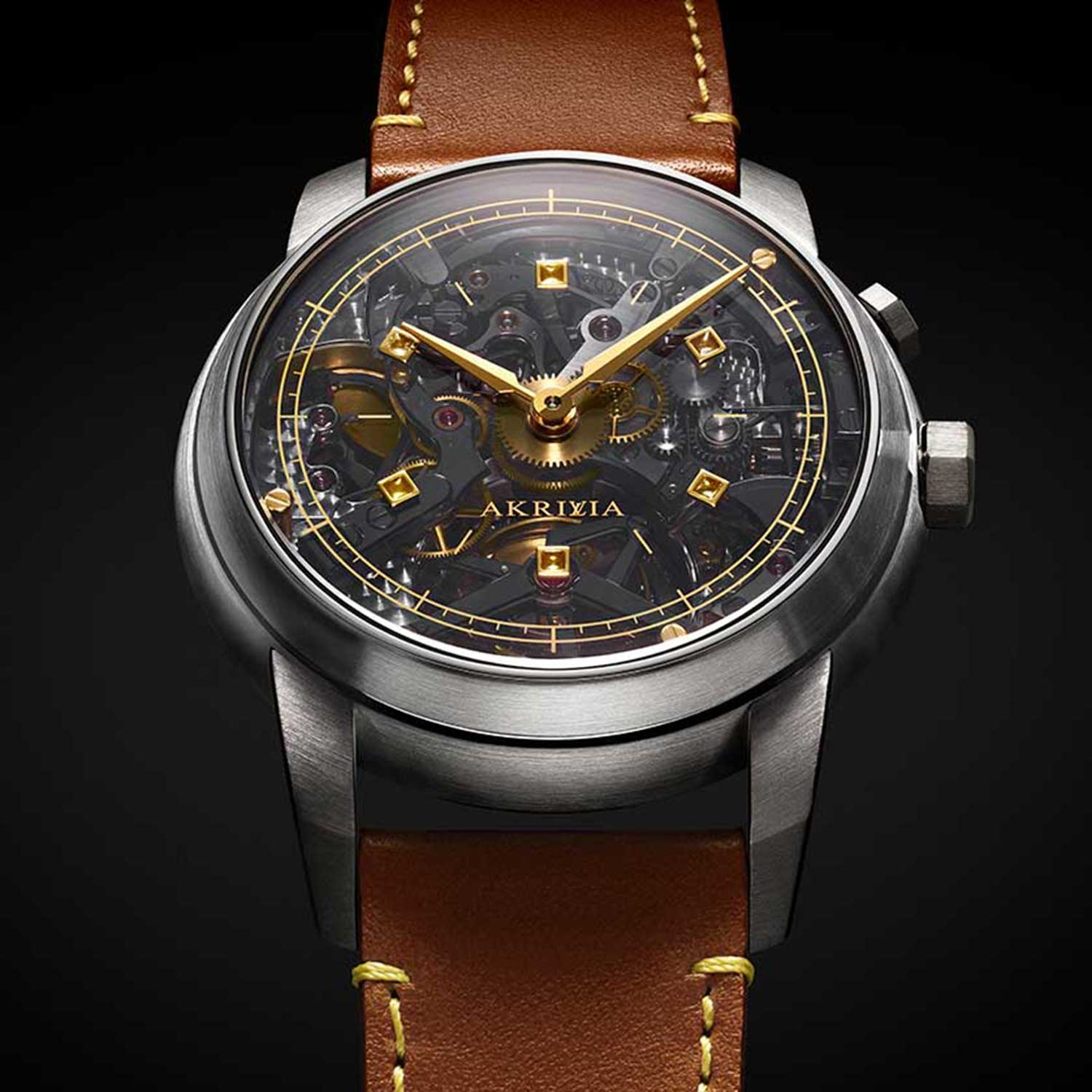
- Louis Vuitton x Akrivia LVRR-01 Chronographe à Sonnerie
But the Rexhep Rexhepi Chronograph Flyback (RRCHF) is neither an iteration nor a continuation of the Louis Vuitton x Akrivia LVRR-01. It is something he describes simply as “a new watch and a new movement… developed for this piece.”
Chronographs are among the most difficult complications to execute well. At the highest level, traditional, hand-finished, manually wound, in-house examples have long been the province of a very small number of manufactures, and in practice dominated by just two names. Among independents, they remain exceptionally rare, due to the extensive development work, production complexity as well as the technical challenges inherent to the complication. If anyone were to take it on, it was always likely to be Rexhep Rexhepi, and his answer arrives with all the expectation that such a complication, in such hands, inevitably carries.
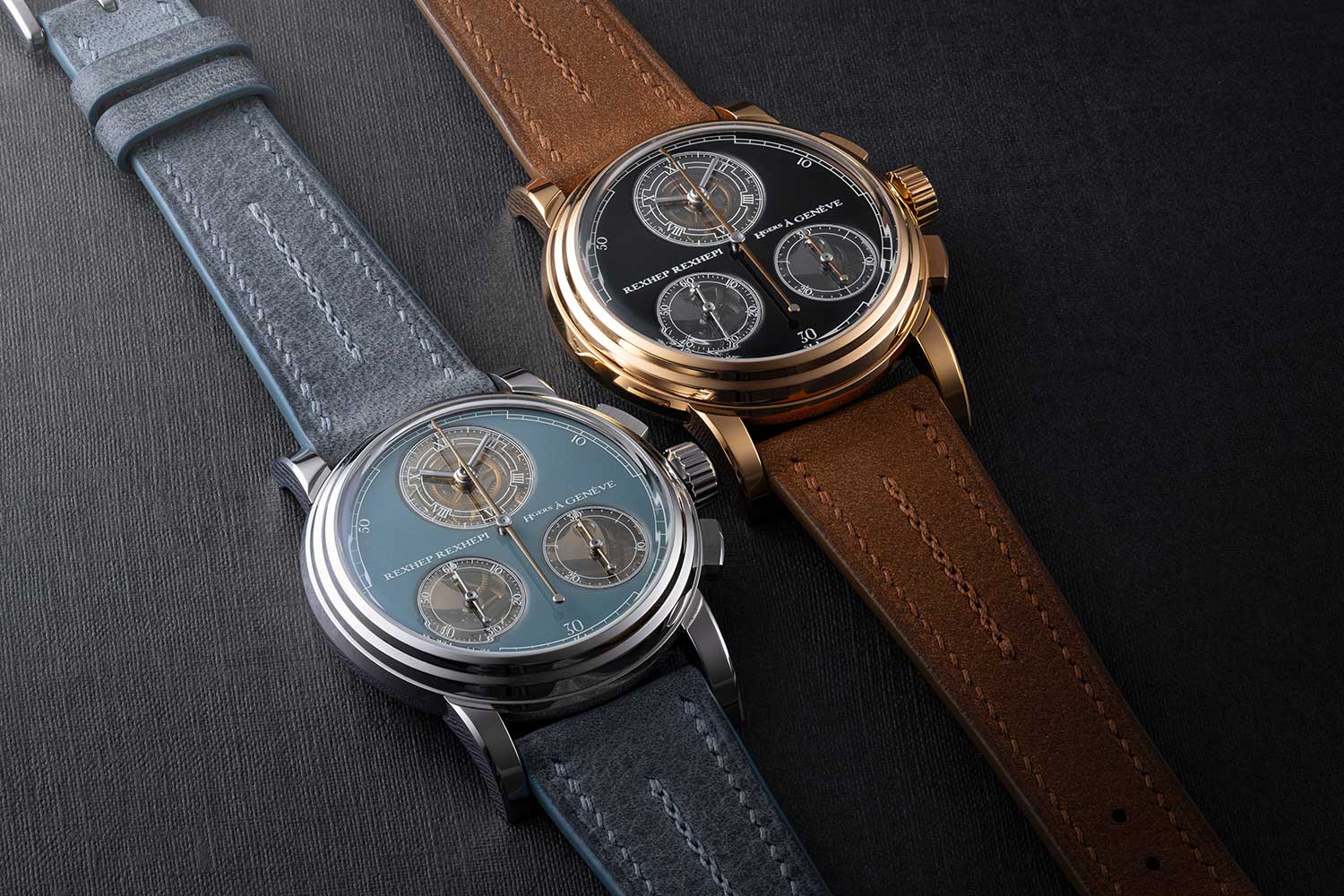
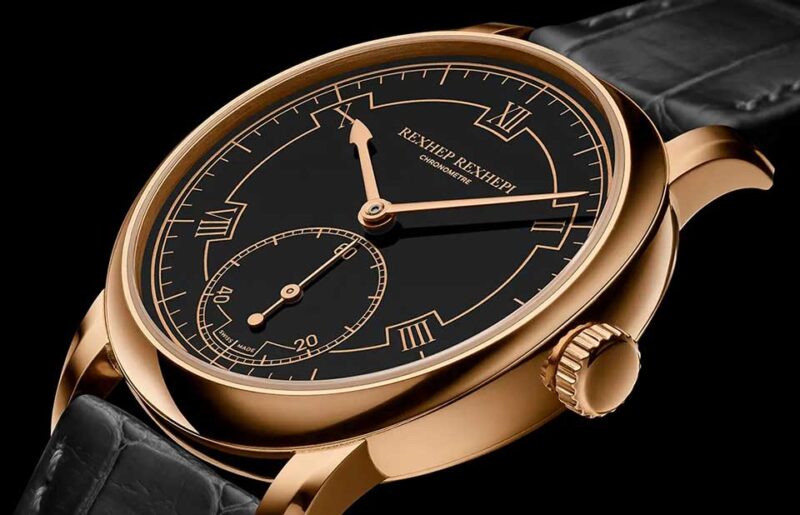
The RRCHF comes in two variations. The dial is in grand feu enamel — stormy blue for the platinum model and black for the rose gold version — with grey-tinted sapphire counters (Image: Alex Teuscher for Revolution)
For Rexhepi, the chronograph is not just another complication to add to a collection. It is, in his words, something a watchmaker has to confront. “It’s a complication everyone can understand,” he says. “People can play with it. It’s interactive. But for a watchmaker, to realise a chronograph – well it’s important. At some point, you have to go through it.” He pauses, then adds: “And for me, it was that time.”
That sense of timing, not just in the mechanical sense, but in terms of his own development, runs through the entire project. At 39, he describes this as a “mature” watch. Not because it is more complicated than what came before, but because it reflects what he and his atelier are now capable of doing. “A few years ago, this watch couldn’t exist,” he says. “I didn’t have the knowledge. Not the small touches.”
Those “small touches” are what define the watch. The movement is integrated and flyback, built specifically for this case rather than adapted to it, with an instantaneous minute counter and a traditional 21,600 vph frequency. It is based on the movement in the Chronomètre Antimagnétique (RRCA) created for Only Watch, which sold for CHF 2.1 million in 2024. It is an interesting starting point, and seen in retrospect, one that already seems to suggest how such a mechanism might be integrated. For one, the latter employs an elaborate solution to achieve centre seconds. With the fourth wheel positioned at four o’clock, a sequence of three additional wheels is required to bring the motion to the centre, arranged above the plane of the gear train. This arrangement already has the character of a chronograph coupling train.
-
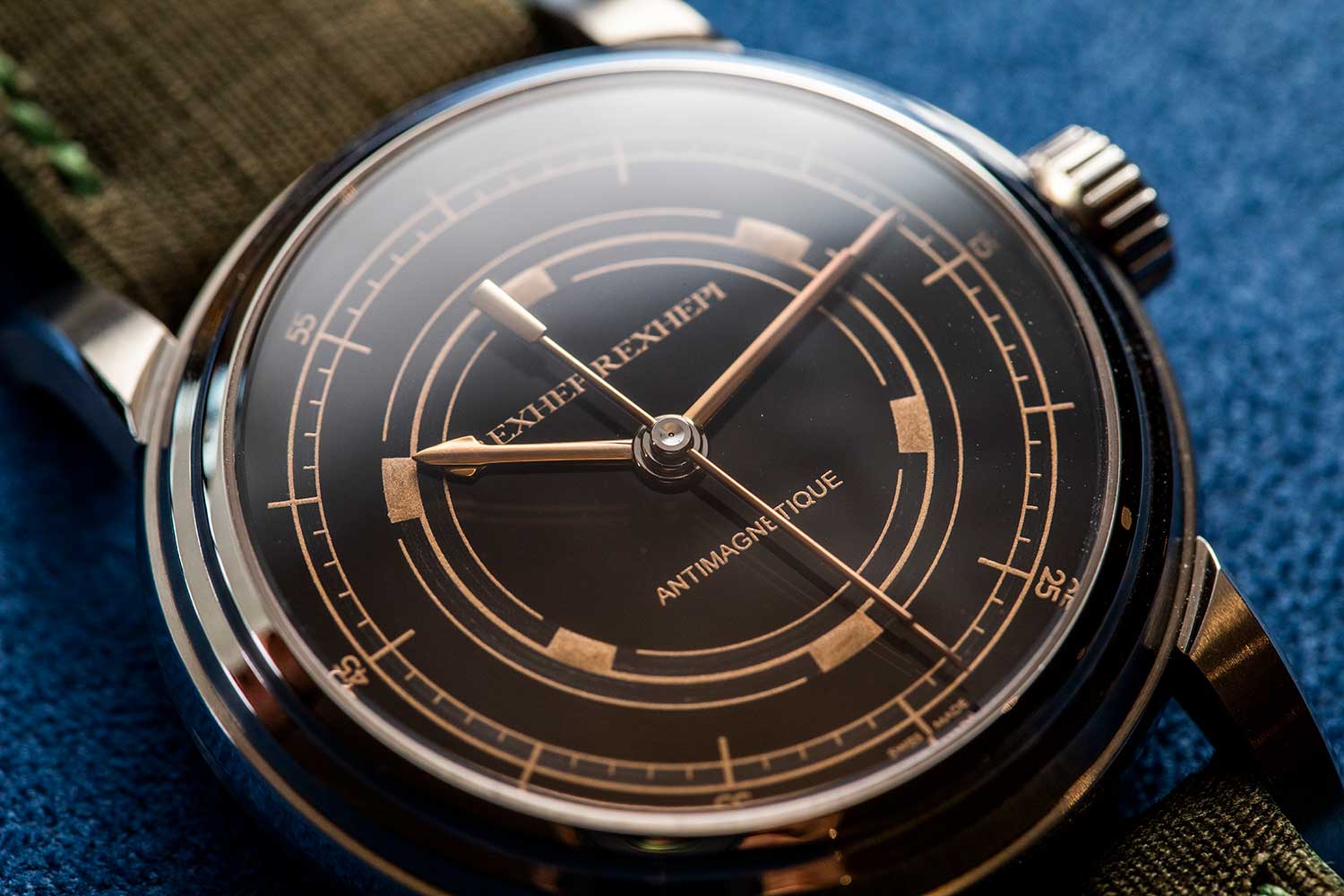
- Chronomètre Antimagnétique (RRCA) created for Only Watch
-
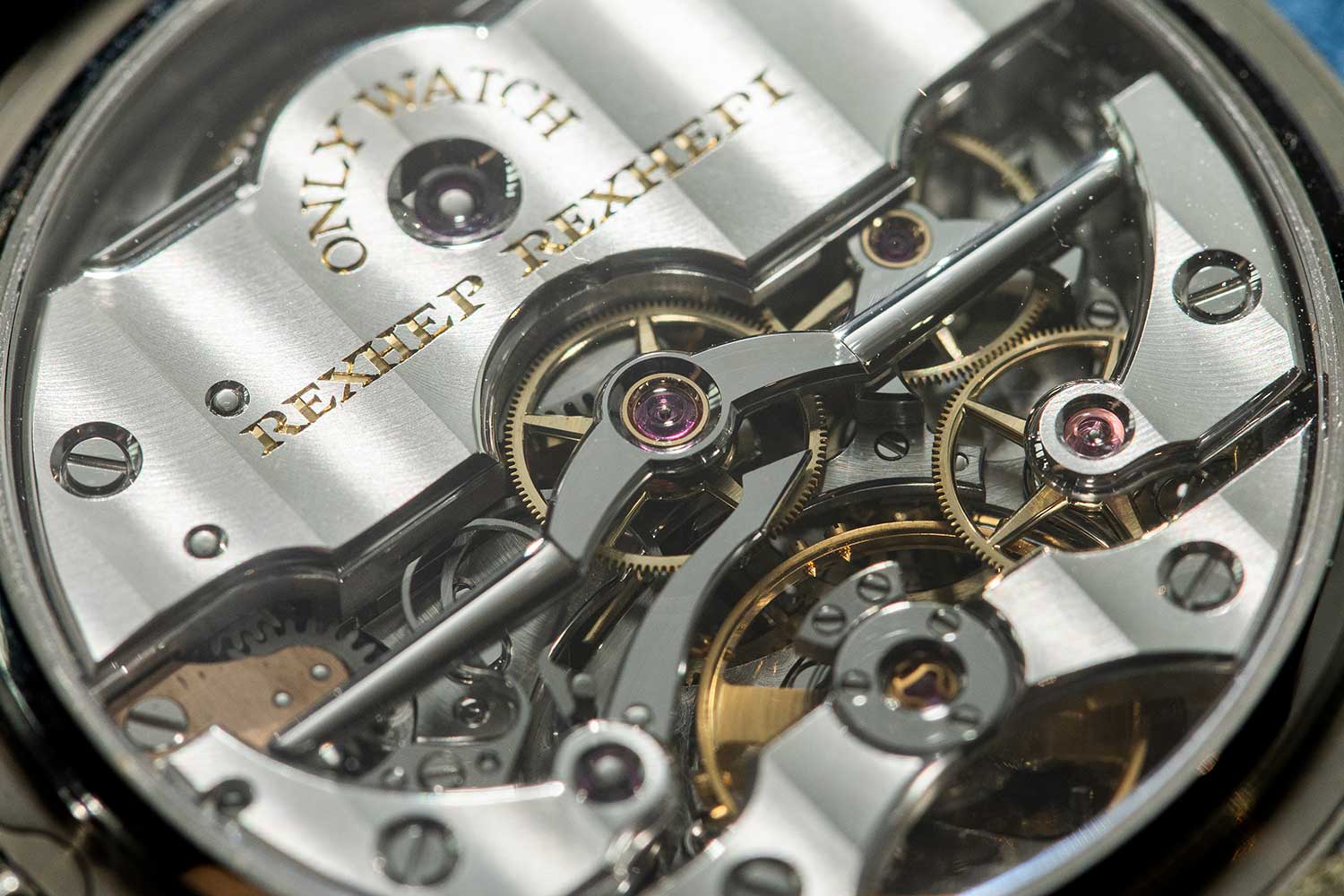
- The auxiliary train used to achieve centre seconds comprises of three wheels driven off the fourth wheel underneath at four o’clock
There was also a hacking, zero-reset function in the RRCA where a bridge at 8 o’clock supports a reset lever, which acts on a heart cam on the centre seconds wheel. That same bridge lends itself naturally to supporting a minute recording wheel. Thus, the position of the fourth wheel naturally places the running seconds at 4 o’clock on the dial, with the minutes counter falling correspondingly at 8.
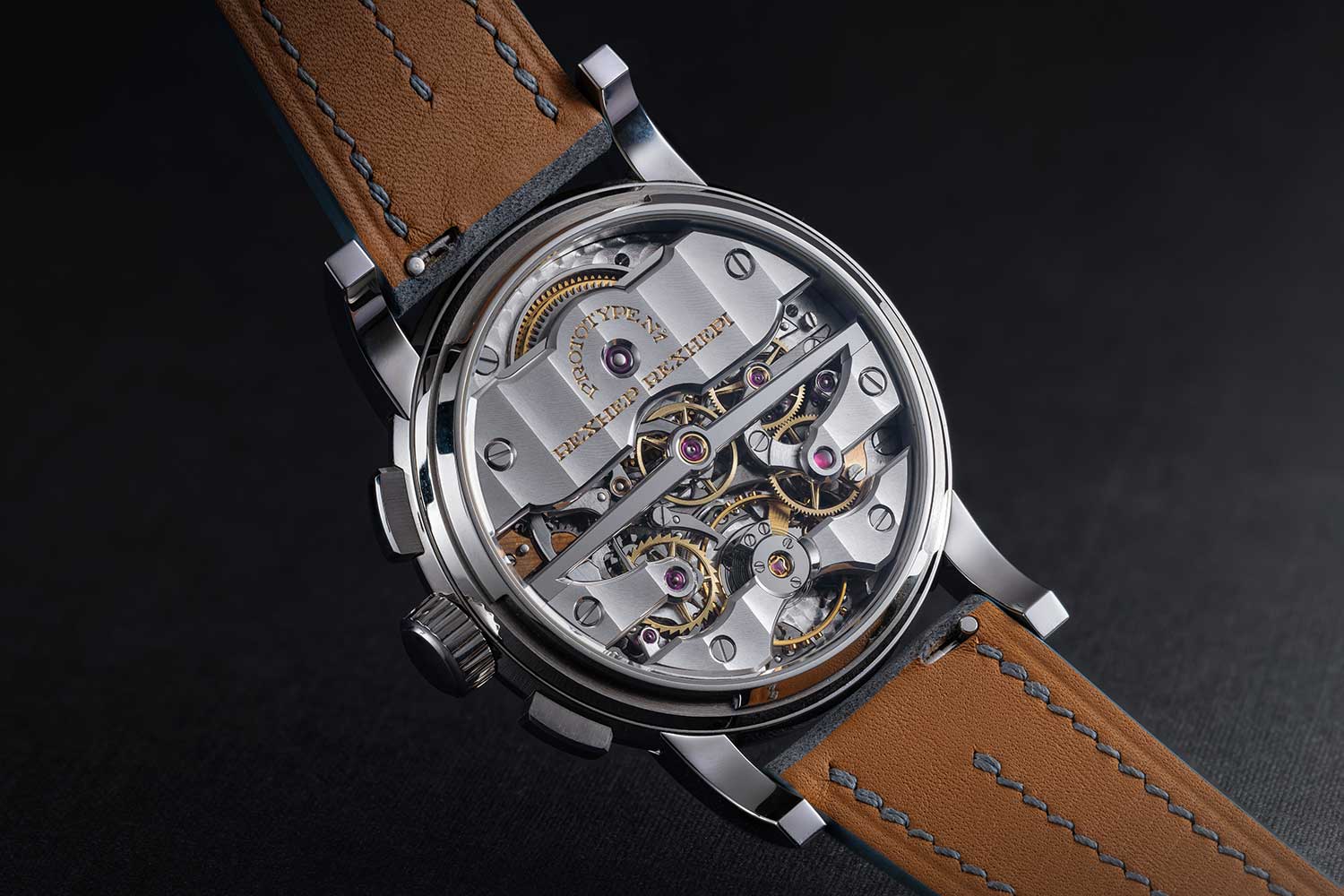
The chronograph is notably complete from a traditional technical standpoint. It incorporates both an instantaneous jumping minutes and a flyback function (Image: Alex Teuscher for Revolution)
Most chronographs on the market have a dragging or semi-instantaneous minute counter, in which the hand creeps forward before completing its jump to the next minute marker. By contrast, a true instantaneous minute hand advances in whole steps.
The minute recording wheel is formed with ratchet teeth. These are indexed by a lever carrying a pawl on one end, while a feeler on the other acts on a snail cam fitted to the arbour of the chronograph seconds wheel. As the cam rotates with the chronograph wheel, the feeler is progressively lifted and, once every minute, as it falls from the highest to the lowest point of the cam, the pawl pulls the minute ratchet forward by one tooth. A jumper, which pivots in a jewel, then secures the wheel in its new position.
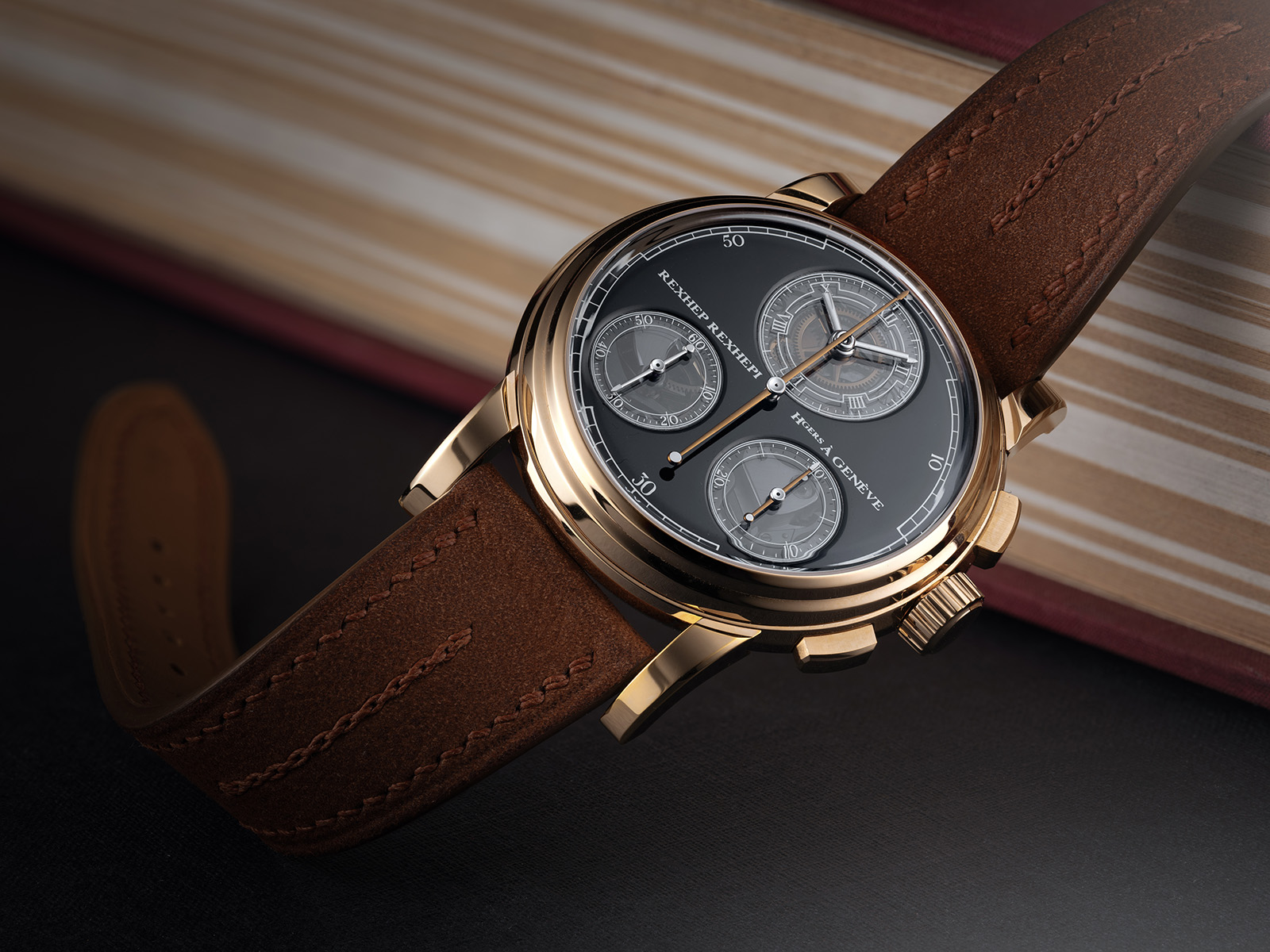
The brand’s signature alternating inward and outward motif is worked into the chronograph seconds track and carried through to the hour and minute sub-dial. It is a discreet detail, but one that really lifts the entire composition (Image: Alex Teuscher for Revolution)
Visible beneath the minute wheel is the column wheel. While most of the levers can’t be seen, the complexity of the system lies precisely in how they interact. Flyback mechanisms are inherently difficult to implement because the chronograph must be reset and restarted regardless of wheel positions. This collapses a sequence of operations that are normally kept separate into a single, continuous act. The coupling must first be momentarily disengaged by a flyback lever driven directly by the reset system to relieve torque before the hammer is allowed to act on the heart cams, while the minute recording mechanism is simultaneously retracted from its indexing. Once zeroed and the hammer returns, the coupling must be brought back into engagement immediately. The entire operation is tricky business, as part geometry, spring forces and timing must be precise to allow proper functioning.
But more telling is how he chose to begin.
Where he once might have begun with the movement, Rexhepi now works in reverse. “Before, I always started with the calibre,” he explains. “Now I start with the dial, the hands, the case. I design the watch first. Then I build the movement around it.”
It is a practical decision as much as an aesthetic one. He has long been dissatisfied with chronographs that feel put together rather than thought through – pushers and crowns positioned according to the needs of the movement rather than the logic of the watch. “You see sometimes the pusher [too far] up, the crown [too far] down,” he says. “Because it’s not integrated.”
Here, integration is the point. The case, dial and movement are conceived together, resulting in a watch that is both restrained in scale – 38.8mm in diameter and 9.7mm thick – and composed. “It’s thin, it’s not big,” he says. “Quite delicate.” In fact, it is even slimmer than the time-only Antimagnétique, which measured 9.9mm in height. This can be attributed in part to the offset hours and minutes sub-dial and the fact that the chronograph parts are not layered on a sub-plate but instead integrated directly into the mainplate.
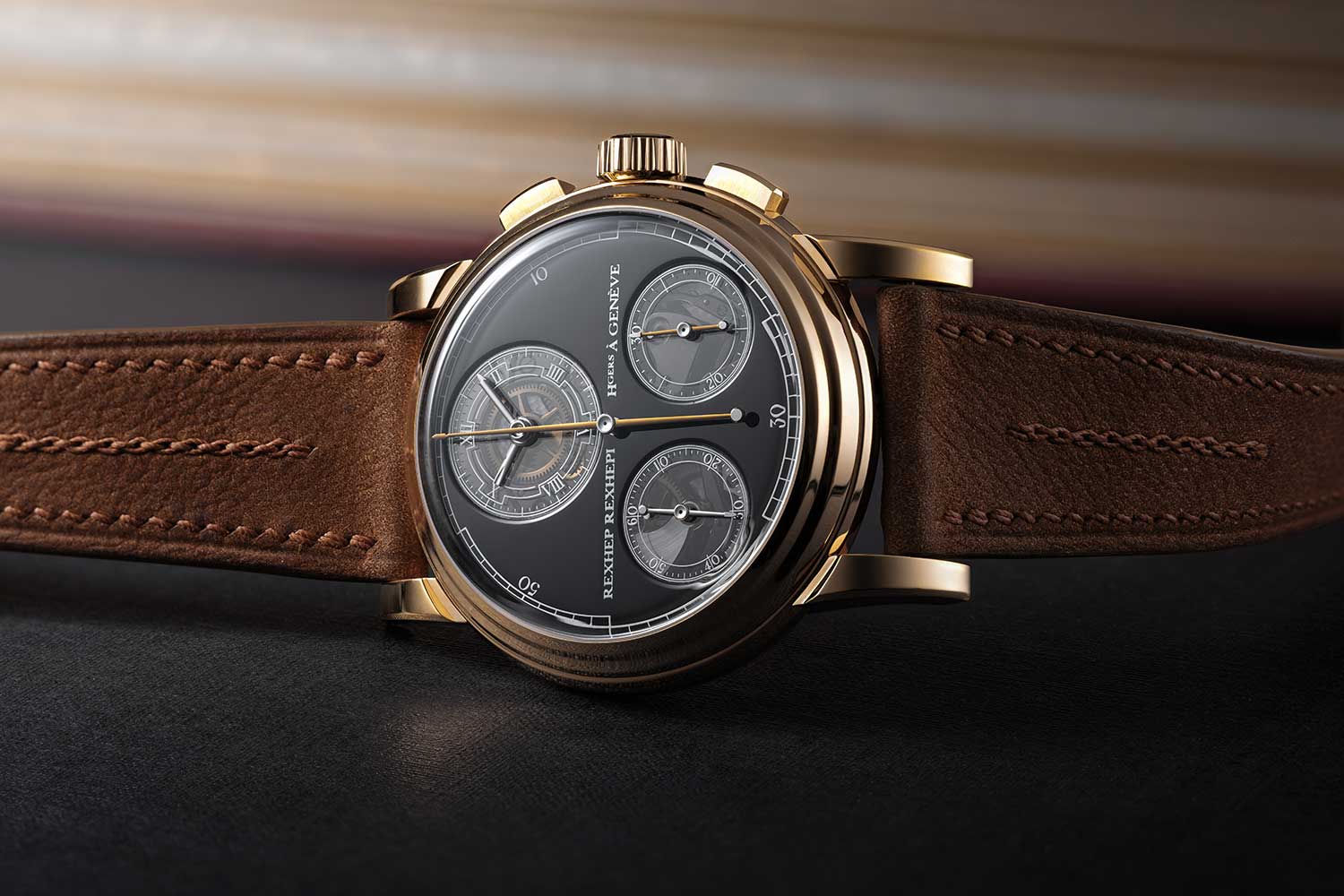
The case retains the double stepped bezel seen in the RRCA, along with long, elegantly curved lugs that are been individually soldered to the case (Image: Alex Teuscher for Revolution)
That sense of balance extends to the dial. The chronograph counters sit at 4 and 8 o’clock, an unusual arrangement, but one that serves a purpose. “I wanted the chronograph to be the star,” he says. “When you turn the wrist, you still see the counters, but you see the long central seconds hand first.”
A third register was never considered as it would have disrupted the balance. Equally, placing the counters in a more conventional position would have diluted their presence. The final layout is less about novelty than about emphasis. “It’s about proportion,” he says.
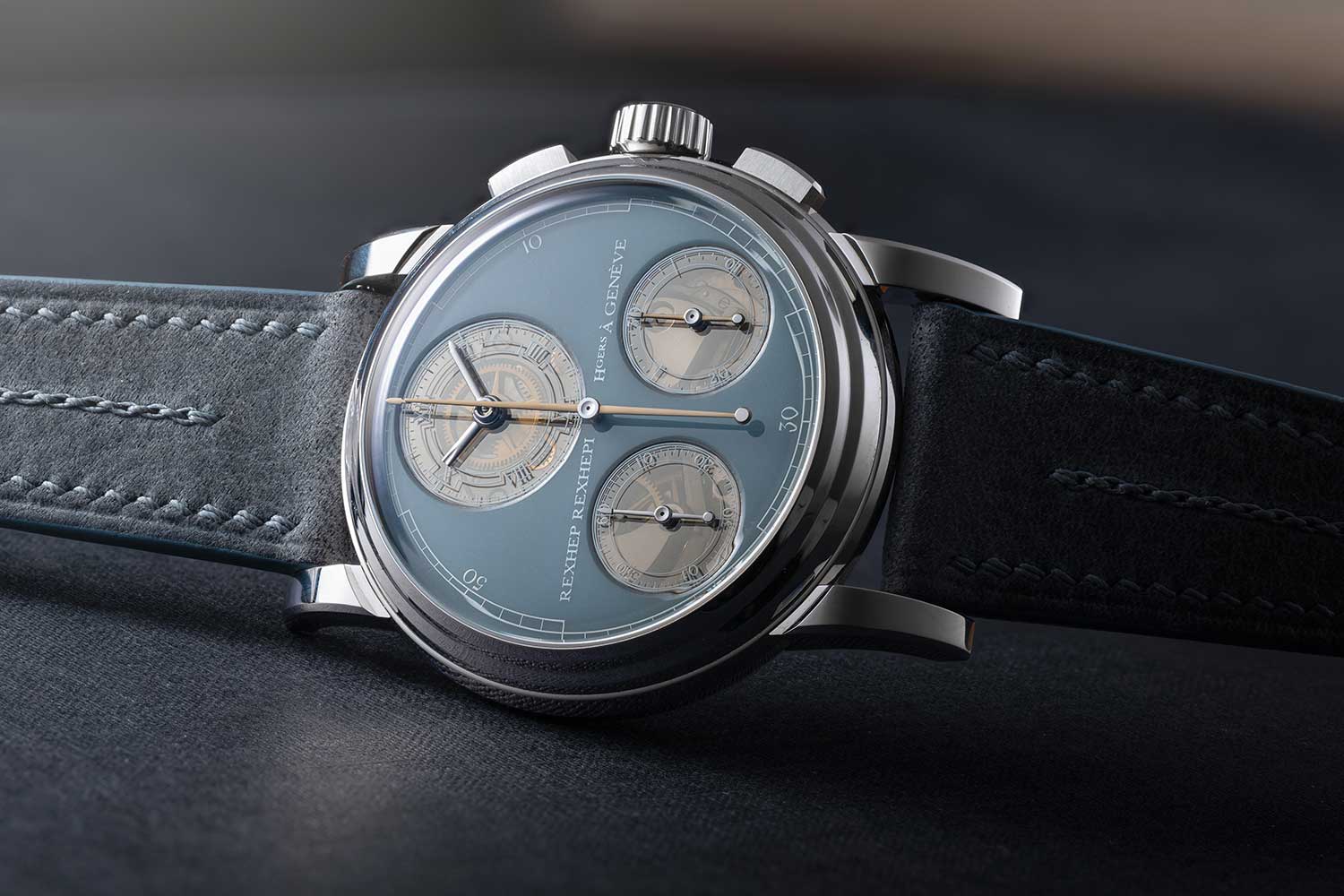
The hands are in polished, rounded steel, while the chronograph hands are distinguished by tempered sections (Image: Alex Teuscher for Revolution)
For all the attention given to layout, the movement itself remains central to how Rexhepi thinks about the watch. He has chosen a horizontal clutch, fully aware of its limitations, but drawn to what it offers visually. “It’s more romantic,” he says. “You can see it moving.”
The use of the word romantic is telling. Not in a nostalgic sense, but as a way of describing something that invites engagement. A chronograph, for him, is not just measured in terms of performance, but in how it feels to use. “I want something smooth but still strong,” he says of the pushers. “You have to feel the mechanical parts.”
This emphasis on interaction shapes the watch at every level. The press material speaks of “harmonious proportions” and “generous hand-decoration” and indeed, what sets it apart, as with any watch from Rexhepi, is the finishing. The bevels are of a kind that can only be achieved by hand. They are rounded and generous in width. But in conversation Rexhepi frames it more directly. “I wanted to do a watch that people can understand,” he says. “Sometimes when you go too ‘geek’, people don’t get it.”
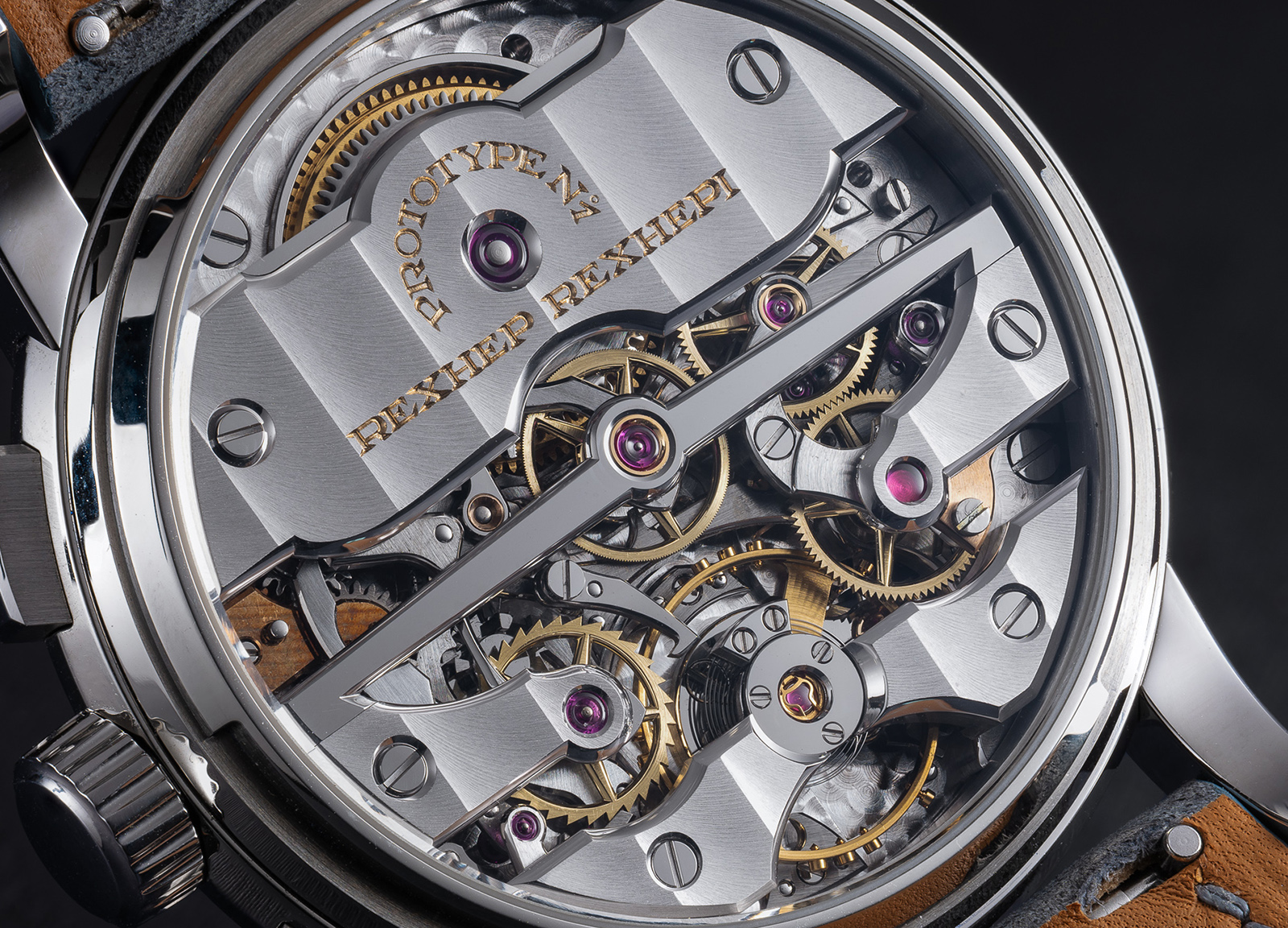
The movement is richly finished, with rounded and broad bevels. The chronograph seconds wheel is meanwhile carried beneath an elongated bridge finished in black polish (Image: Alex Teuscher for Revolution)
That is a pointed remark. Earlier pieces from the atelier, particularly time-only watches, have required a degree of patience from their owners with the details revealing themselves slowly rather than immediately. “This one looks more complex,” he says. “But it’s very, very minimalist. You have depth, you have symmetry… I think people will understand it more easily.”
Understanding, however, is not the same as simplicity. The watch is deliberately layered. Details emerge over time in the way the light catches the enamel dial, in the finishing of the case, in the architecture of the movement itself. “You have a lot of surprises,” he says. “You have to see the watch to understand it.”
There is also a clear position on value. He suggests a price in the low six figures, a number he acknowledges is high, but one he considers grounded in the work involved. “Today, everything is becoming crazy,” he says. “I wanted to do something honest. An honest product, an honest price.”
It is less a statement about the market than about his own intentions. Rexhepi is explicit that he is not interested in following trends, nor in building watches to meet demand in the short term. “I want the purist – the guy who is saving his money to buy one of my pieces – to say, ‘I want this watch because it represents good quality, good details, something true to watchmaking’.”
That idea of proving something to others, but also to himself, returns repeatedly. “We have a lot of attention on us,” he says. But that pressure is not something he resists. “I like the pressure,” he says. “If you see it in a positive way, it pushes you.” But there is, beneath that, a harder edge. The sense that expectation, once created, has to be met. “We don’t have a choice,” he says. “We have to do something better. Something important. Otherwise people will not remember us.”
He is conscious, too, of where he stands in his own timeline. At 39, with a workshop that now controls everything from cases to enamel dials, he sees the next decade as decisive.
“The next ten years will be very important,” he says. “Now we have more tools, more knowledge, more maturity. Now it’s time to show what we can do.”
That decision to bring everything in-house is often framed as creative freedom. For Rexhepi, it comes with a cost. “If you want to do something good, it takes energy,” he says. “It takes dedication.” He pauses, then adds, almost as an aside: “I think I like to suffer. But this is what makes you alive. If it’s not difficult, you should not believe in it.”
The chronograph, then, is less a culmination than a marker. A watch that reflects where he stands now, and what he expects from the next phase. Even its launch timing reflects a certain independence. Rather than follow the usual rhythm, Rexhepi has chosen to release it on a Sunday — Easter Sunday. “I will be at home, with my family,” he says. “It felt like a good moment.”
A small decision, but a telling one. “I did exactly what I wanted,” he says. “No concessions.”
And that, more than the complication itself, is what defines this watch.
Tech Specs
Movement Manual winding; frequency of 3 Hz or 21,600 vph; 72-hour power reserve
Functions Hours, minutes; chronograph
Case 38.80 mm by 9.70 mm; platinum or rose gold; water resistant to 30m
Dial Grand feu enamel (stormy blue for the platinum model, black for the rose gold version) with grey-tinted sapphire counters; polished, rounded steel hands with stepped tips on the minute and central seconds; chronograph hands with selectively tempered sections
Strap Nubuck calf-skin leather (Light grey for platinum, taupe for rose gold) with a Norwegian center stitch made in-house
Price Upon request
Rexhep Rexhepi
You may also like

Editorial
Holiday Horology: Something Old, Something New, Something Special — Tracey Llewellyn, Group Editorial Director
Dec 18, 2025
Editorial
Holiday Horology: Something Old, Something New, Something Special — Tracey Llewellyn, Group Editorial Director
Dec 18, 2025

Editorial
The Revolutionary List: 25 Watchmakers and Construction – Rexhep Rexhepi
Dec 15, 2025
Editorial
The Revolutionary List: 25 Watchmakers and Construction – Rexhep Rexhepi
Dec 15, 2025
Editorial
The Revolutionary List: 30 Pioneering Watches – the Rexhep Rexhepi Chronomètre Contemporain I
Dec 2, 2025
Editorial
The Revolutionary List: 30 Pioneering Watches – the Rexhep Rexhepi Chronomètre Contemporain I
Dec 2, 2025