


Mathieu Cleguer Makes His Debut with the Inspiration One Souscription
Editorial
Mathieu Cleguer Makes His Debut with the Inspiration One Souscription

After more than a decade spent developing movements for others, Mathieu Cleguer, a 35-year-old movement engineer has stepped out under his own name with the Inspiration One. It is a watch that is equipped with a self-starting, tangential-impulse double-wheel escapement and an elaborate motor barrel with a Maltese stopwork. It is, in one sense, a familiar story in contemporary independent watchmaking, of an individual, more often a watchmaker, who after years of contributing to the watches of others, arrives at a point where personal expression becomes inevitable.
As opposed to watchmakers, movement engineers, however, are rarely afforded the same recognition. Yet, modern high-end independent watchmaking is so rarely a solitary pursuit. The watches we admire, even those most closely associated with a single name, are almost always the result of a dialogue between conception and construction. If the watchmaker gives form to a watch, the engineer determines whether that form can exist at all and sets up the conditions under which it may rightly subsist. The distinction is not always visible in the finished watch dressed up in the finest anglage, but it is present in almost every one of any sophistication.
Born in Brittany, France, Cleguer’s path into movement engineering was not linear. In fact, it began somewhere else entirely. “I started in car design,” he explains. “I was obsessed with cars from a very young age and studied it for four years.” But a visit to the Paris Motor Show in 2006 changed everything. There, he encountered an exhibition of Jaeger-LeCoultre pieces. “They had everything – complications, pocket watches, enamel dials. I just fell in love. From that moment, it was done for me.”

Mathieu Cleguer
He was 16 at the time. What followed was a gradual but irreversible shift. By the end of his studies, he realised that while he was supposed to be focused on automotive engineering, he was instead sketching watches and trying to understand horology. “I was obsessed,” he says. “So I made the decision to switch subjects.”
That decision required a reset. He spent a year in London working as a bartender so that he could learn English, and after a visit to Belles Montre watch fair in Paris, he contacted every brand at the show in search of an internship. Only one person replied – Denis Flageollet of De Bethune. “I went for two weeks. That was enough. I knew it was the right decision.”
He enrolled in Haute École Arc in Neuchâtel in 2011, where he studied microengineering and majored in watchmaking engineering. By his second year, he had already identified movement construction as his focus. A key encounter followed with independent movement constructor Christophe Beuchat, who became both mentor and collaborator. “I did my final project with him, and during my last year I was already working on early-stage concepts – projects that might not even be produced. That was very formative.”
Cleguer’s early professional experience was fragmented but instructive. A short period at Breva Genève ended abruptly when the company collapsed. “It was a good experience, but I realised something important: I wouldn’t be happy as an employee.” There was also a stint at Akrivia, working under Rexhep Rexhepi from 2016 to 2017, contributing primarily to the AK-06 and, to a lesser extent, the AK-05.
“I had ideas – not better or worse than the things I was working on, but I wasn’t free to pursue them. And I understood that would always frustrate me.” That realisation pushed him towards independence. Financially, the early years were precarious. Cleguer chose to work as an independent movement developer to avoid conflicts of interest, but admits it was difficult. “I was probably too young to make a living from it.” He returned briefly to industry, joining a more industrialised manufacturer producing components at scale.
“That was extremely important,” he says. “In independent watchmaking, you don’t always think about production reality – stock management, process tracking, manufacturability. When one component passes through five or six stages before assembly, you need structure. That experience taught me that.”
Even while employed, his own project continued in parallel. Eventually, he committed fully, building the watch over nearly a decade. Importantly, the project was self-funded through a small group of early clients. “I have 12 clients who each paid a 50 percent deposit, some of them more than two years ago.” That subscription model allowed him to begin production without external capital. “They trusted the process. And they’re happy with the result.”
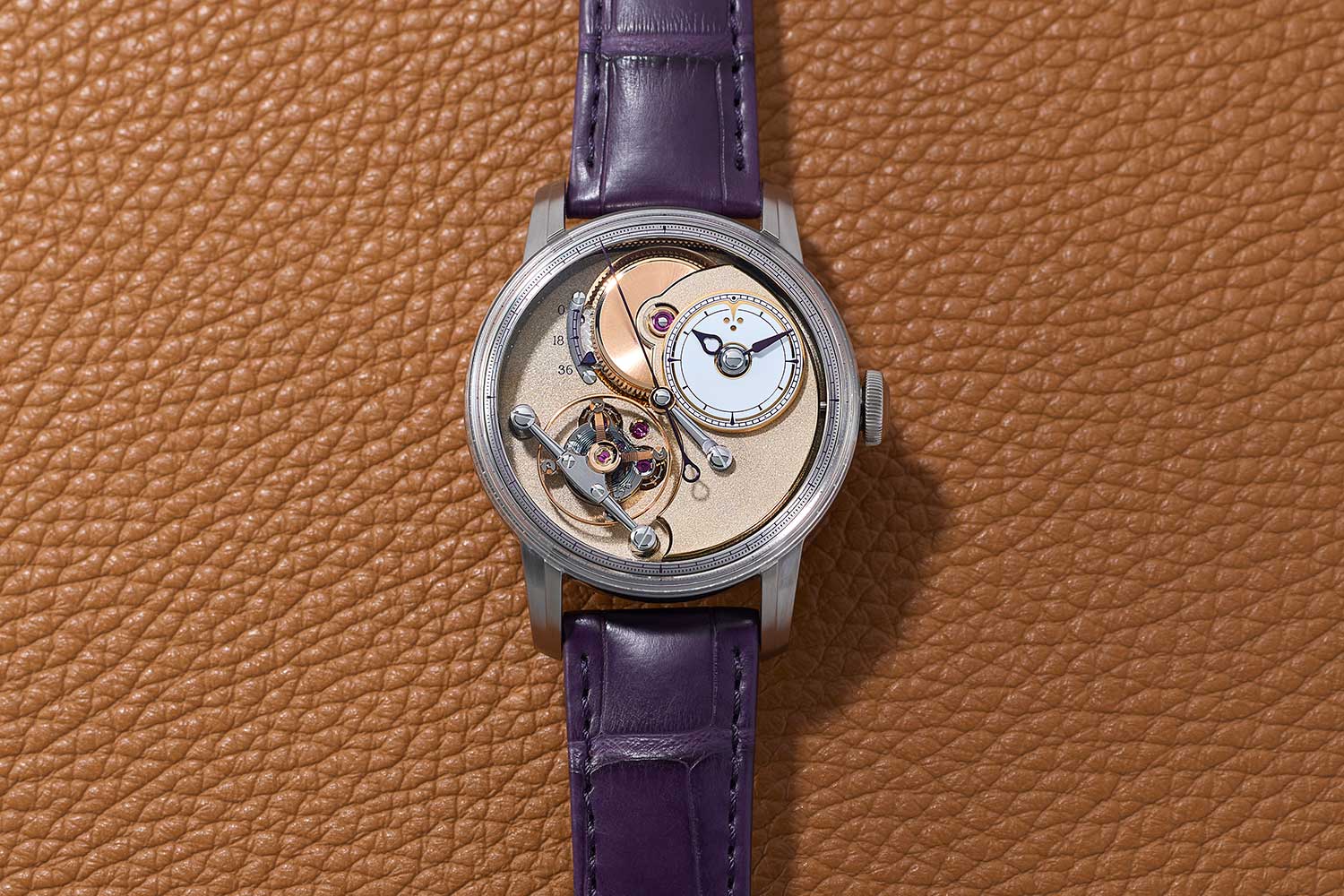
Cleguer Inspiration One Souscription (Image: Atom Moore for Revolution)
To realise his vision, Mathieu partnered with part manufacturers and artisans in the industry, including metiers d’art dial maker Atelier Blandenier. Following the Souscription series of 12 watches in titanium, four more batches of 12 will be produced in four additional case materials while 20 movements will be reserved for bespoke commissions. What we have here is the finished prototype of the Souscription series.
On paper, it is a manual winding watch with a power reserve indicator. In the metal, however, it is about as interesting and unconventional as a watch like this can get, with a number of thoughtful and unexpected details. The fine time-only category has become a crowded field in recent years, but it is also in the simplest of watches that distinctions can be most properly made. Where there is the least room to move, and where it might seem that there are only so many ways to arrange a going train without simply reproducing an ébauche, there is, paradoxically, the greatest opportunity to showcase creativity and articulate a point of view. This is especially true of the Inspiration One.
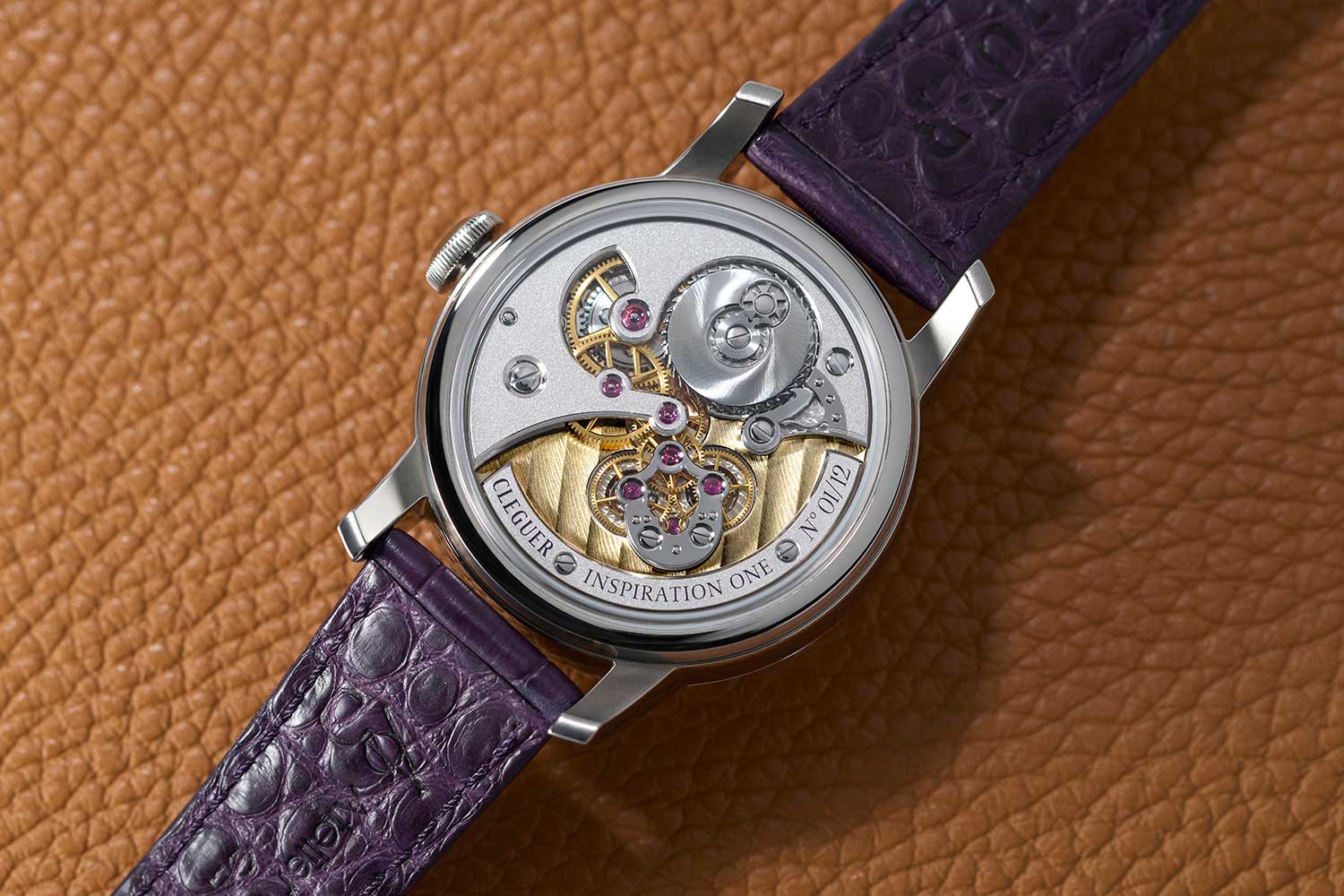
As the dial is the movement, the front and back follow the same diagonal layout that gives the watch a calm, assured beauty (Image: Atom Moore for Revolution)
It has a visually arresting layout both on the front and the back, with a lot to unpack, but the main event is the self-starting double-wheel escapement, which can be regarded as a modern interpretation of Breguet’s natural escapement, and a solution to one of its most persistent practical limitations.
Design and Aesthetics
The Inspiration One Souscription has a classically proportioned titanium case, measuring 38.5mm in diameter and 12mm in height. It is not the slimmest watch of its kind, but it is immediately apparent that the vertical space has been well spent. The dial of the watch has an enormous amount of depth. In fact, the dial is the movement, and there are six levels in total, from the long sweep of the central seconds hand to its rounded, polished steel bridge, descending through the hour and minute sub-dial, the barrel bridge and the barrel, and finally to the mainplate beneath.
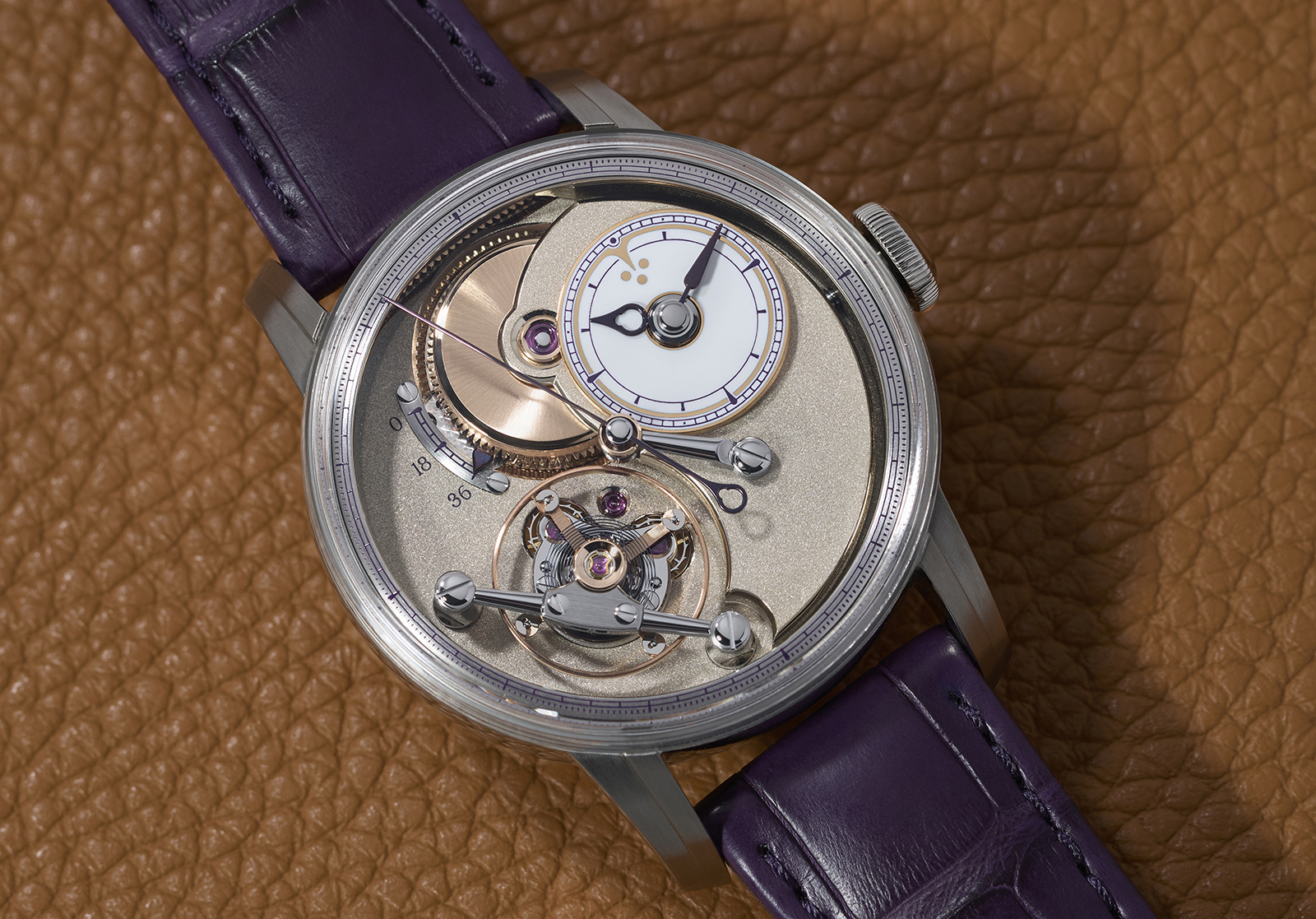
Inspiration One Souscription (Image: Atom Moore for Revolution)
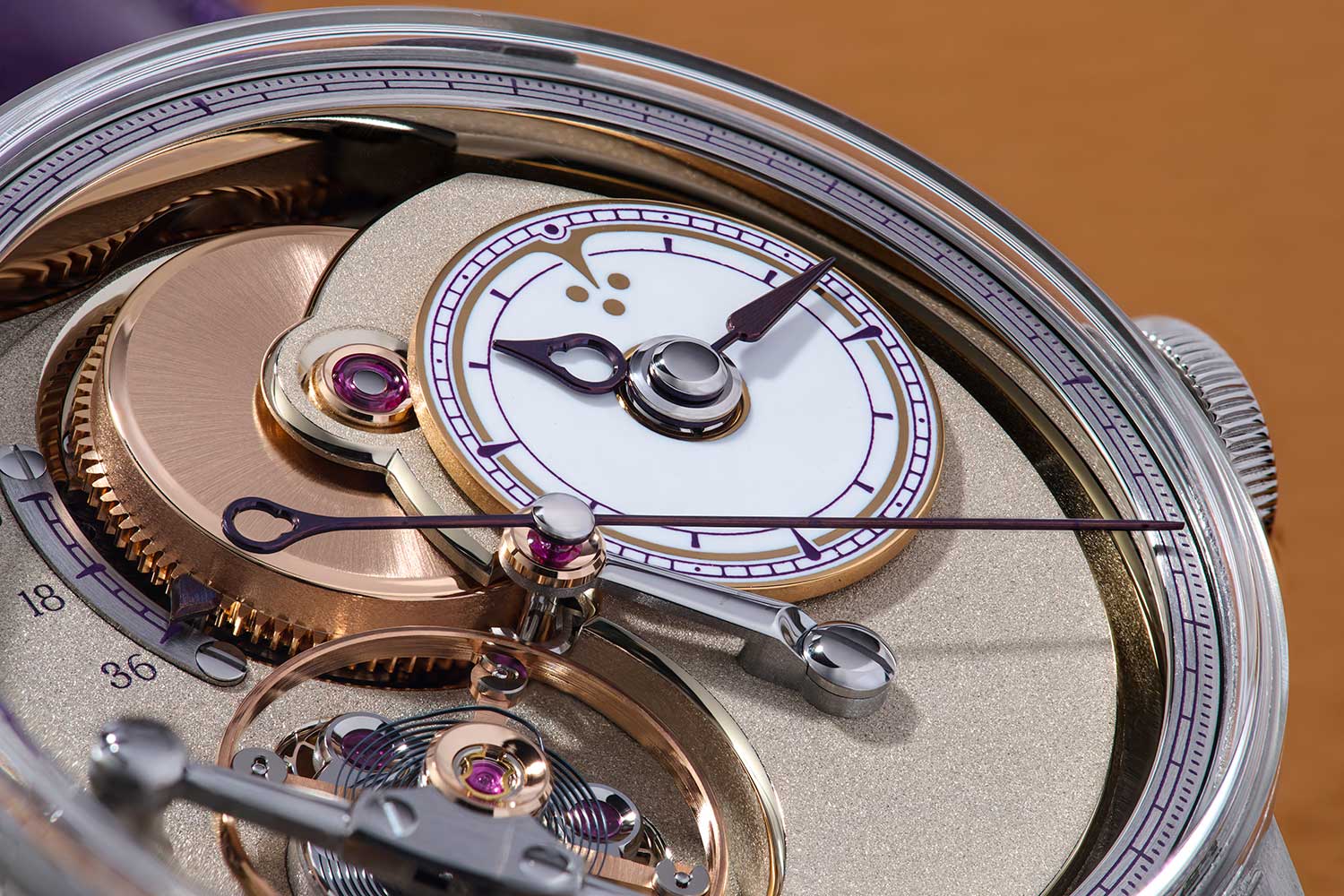
The dial unfolds across six levels, from the long sweep of the central seconds hand to the rounded, polished steel bridge that carries it, descending through the hour and minute subdial, the barrel bridge and the barrel, and finally to the mainplate beneath.(Image: Atom Moore for Revolution)
A crucial early decision was to collaborate on design. “I knew I didn’t have the ability to create a full identity alone,” Cleguer says. He reached out to watch artist Lee Yuen-Rapati (One Hour Watch), who was then still at the very beginning of his own journey. “I told him, I have no budget now, but one day I will pay you. And we started like that.” The collaboration clicked immediately. “In two drawings, he arrived at something very close to what the watch is today.” Yuen-Rapati continues to shape everything from case to dial to brand identity. “Every aesthetic decision is a discussion between me and him.”
The first thing you may notice is the absence of a logo. The brand name is engraved only on the inner flank of the case. It signals that this watch and those to come are meant to be immediately recognisable by the strength of their own visual language alone.
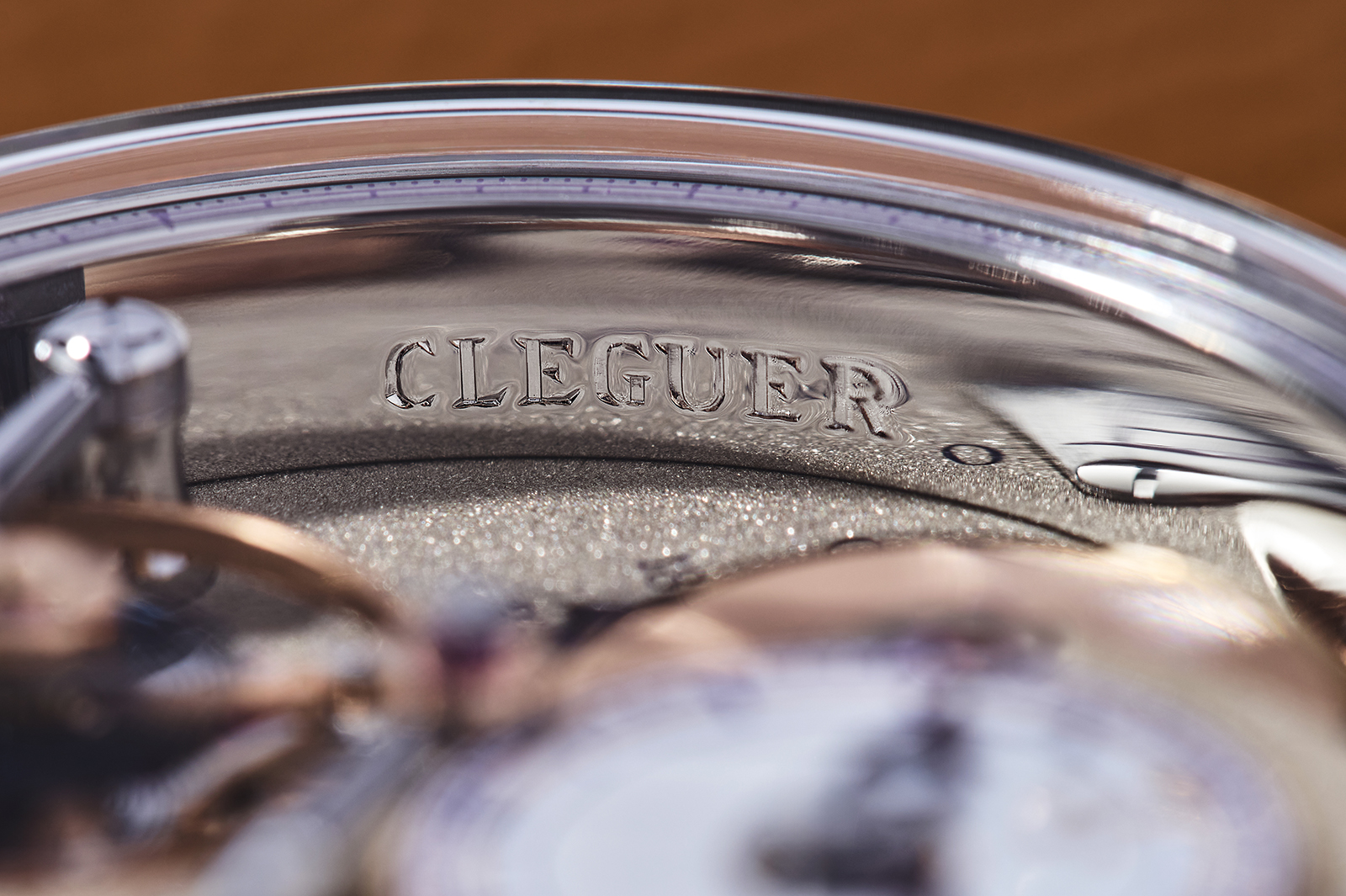
The brand name is discreetly engraved on the inner flank of the case (Image: Atom Moore for Revolution)
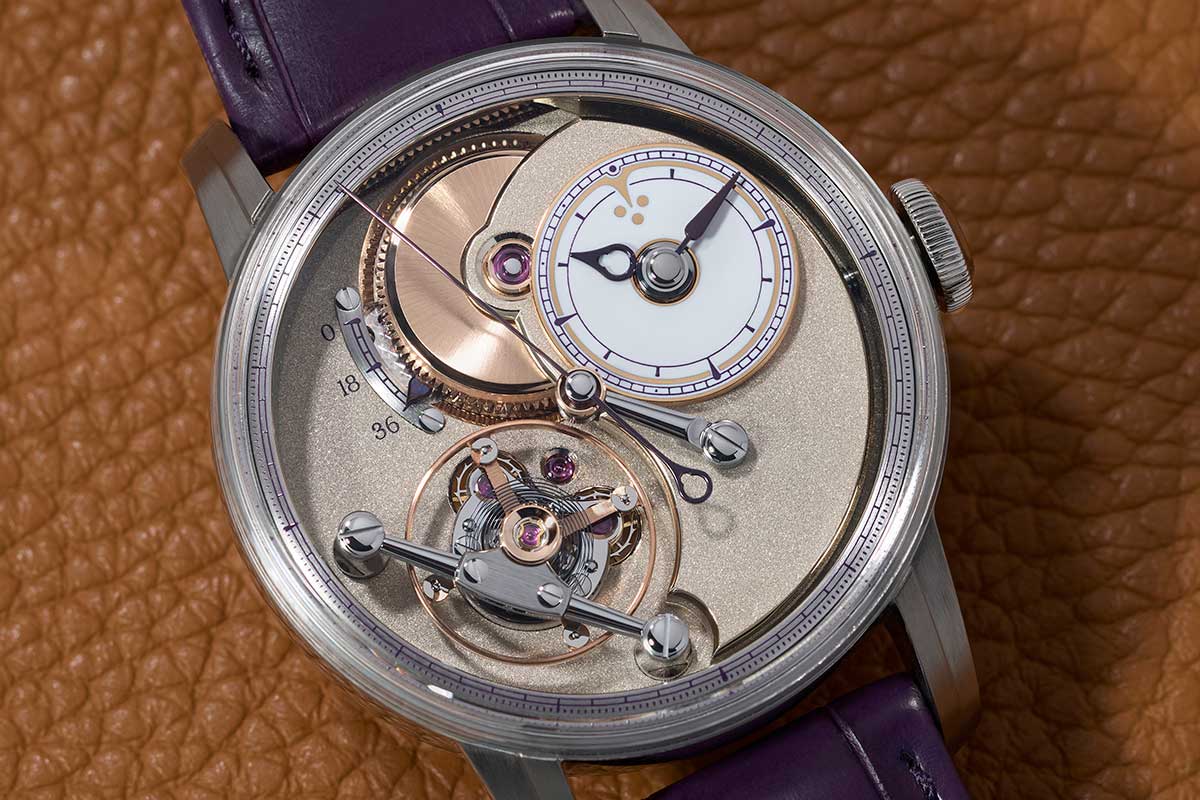
The barrel, dial and balance are laid out in a diagonal axis. At 2 o’clock, time is displayed on a champlevé grand feu enamel sub-dial, with a subtle reference to the Breton flag at the 12 o’clock marker. The sub-dial is mounted on a bridge that partially overlaps the barrel, allowing the latter to remain visible beneath. To the left, there is a power reserve sector scale with its indicator extending discreetly from the barrel.
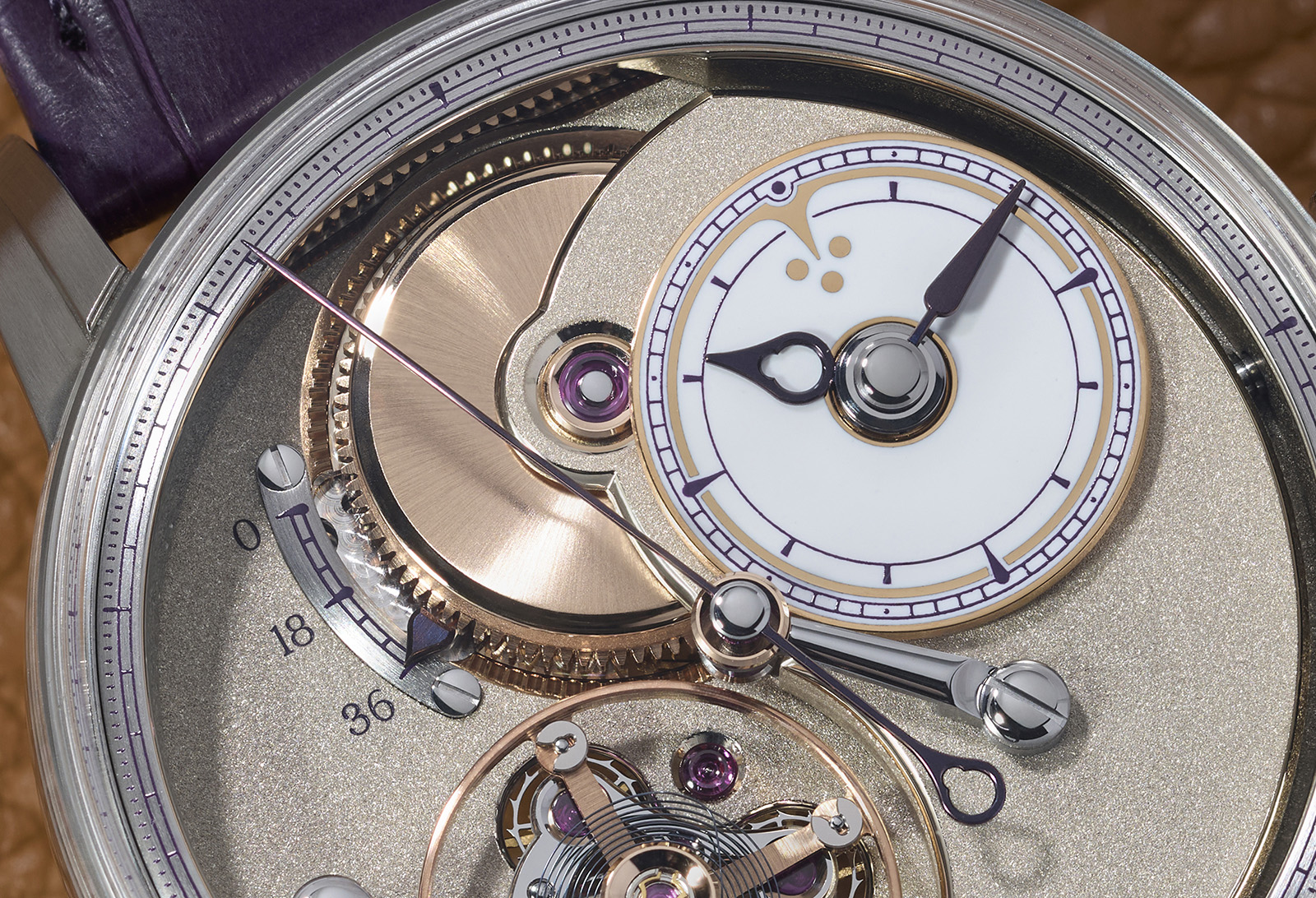
The hour and minute sub-dial is executed in champlevé grand feu enamel, with recesses carved into the metal base, filled with enamel and fired repeatedly until the surface is built up, then ground and polished flush (Image: Atom Moore for Revolution)
Below, a massive 2.5Hz balance occupies the entire quarter from 6 to 9 o’clock, supported by a rounded, polished bridge. The long central seconds hand traverses this layered landscape, which reinforces chronometric focus of the watch. A pleasing detail is that the counterweight of the seconds hand is arranged to pass directly over the pivot of the balance, the barrel arbour, the central axis of the sub-dial and even the screw centre on the seconds bridge, briefly aligning the principal axes of the movement as it turns.
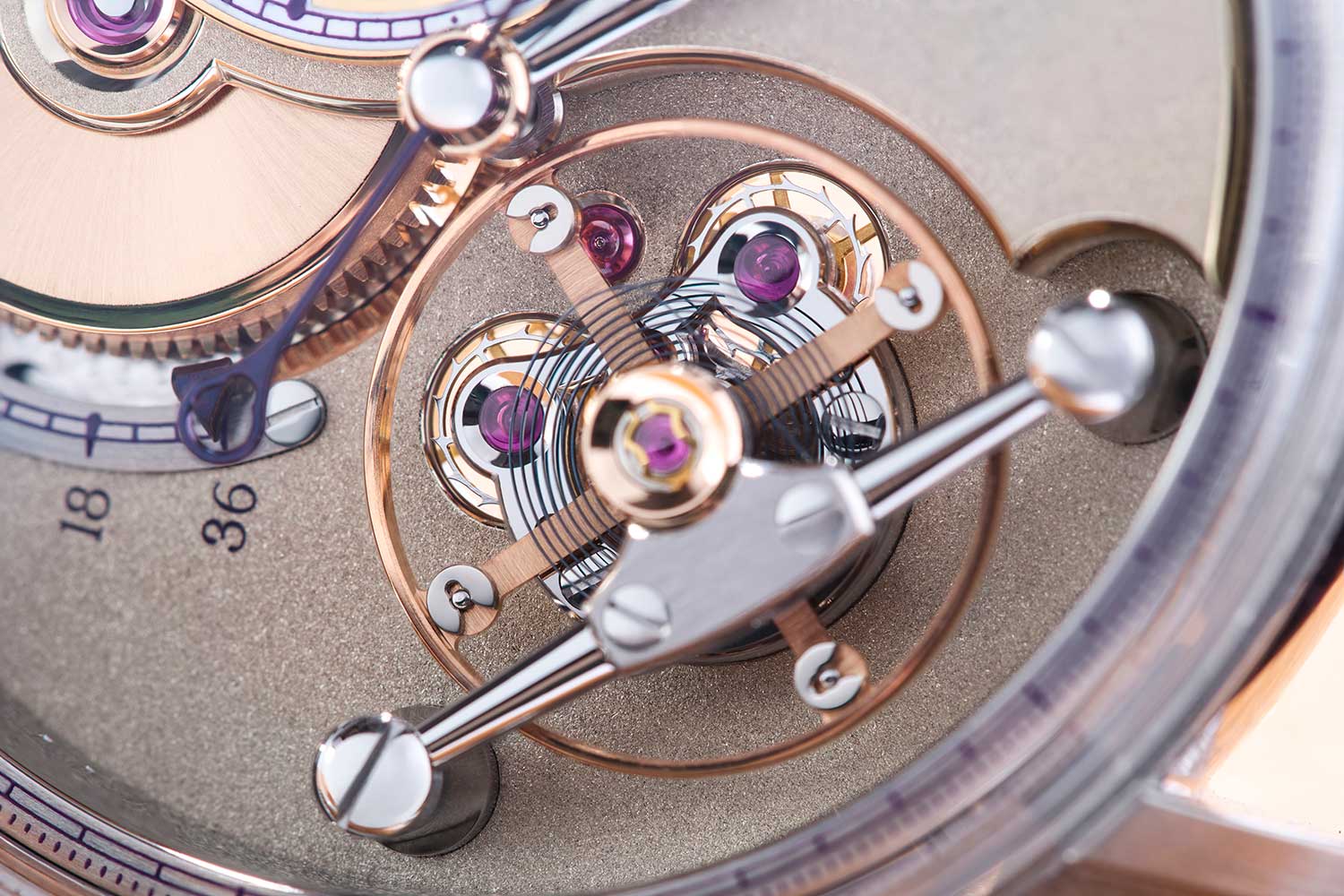
A massive 2.5Hz balance occupies the entire quarter from 6 to 9 o’clock, supported by a rounded, polished steel bridge (Image: Atom Moore for Revolution)
The Innate Escapement
“From the beginning, I wanted the first watch to be about chronometry,” he explains. His long-standing interest in the natural escapement became the technical foundation. “The problem is that a traditional natural escapement is not self-starting,” he says. “Most modern solutions rely on silicon, but I wanted a mechanical solution.”
He spent years iterating. “I think I went through more than 20 versions of the movement. Changing dimensions, reworking components, starting again.” An early attempt at a self-starting system was abandoned due to its high inertia and instability. “It wasn’t the right solution. I had to rethink everything.” It took him five years of reworking before he had an epiphany and decided to abandon the defining characteristic of the natural escapement – its direct impulse transmission – in favour of an indirect, tangential impulse system, conceived to achieve both reliable self-starting and greater security.
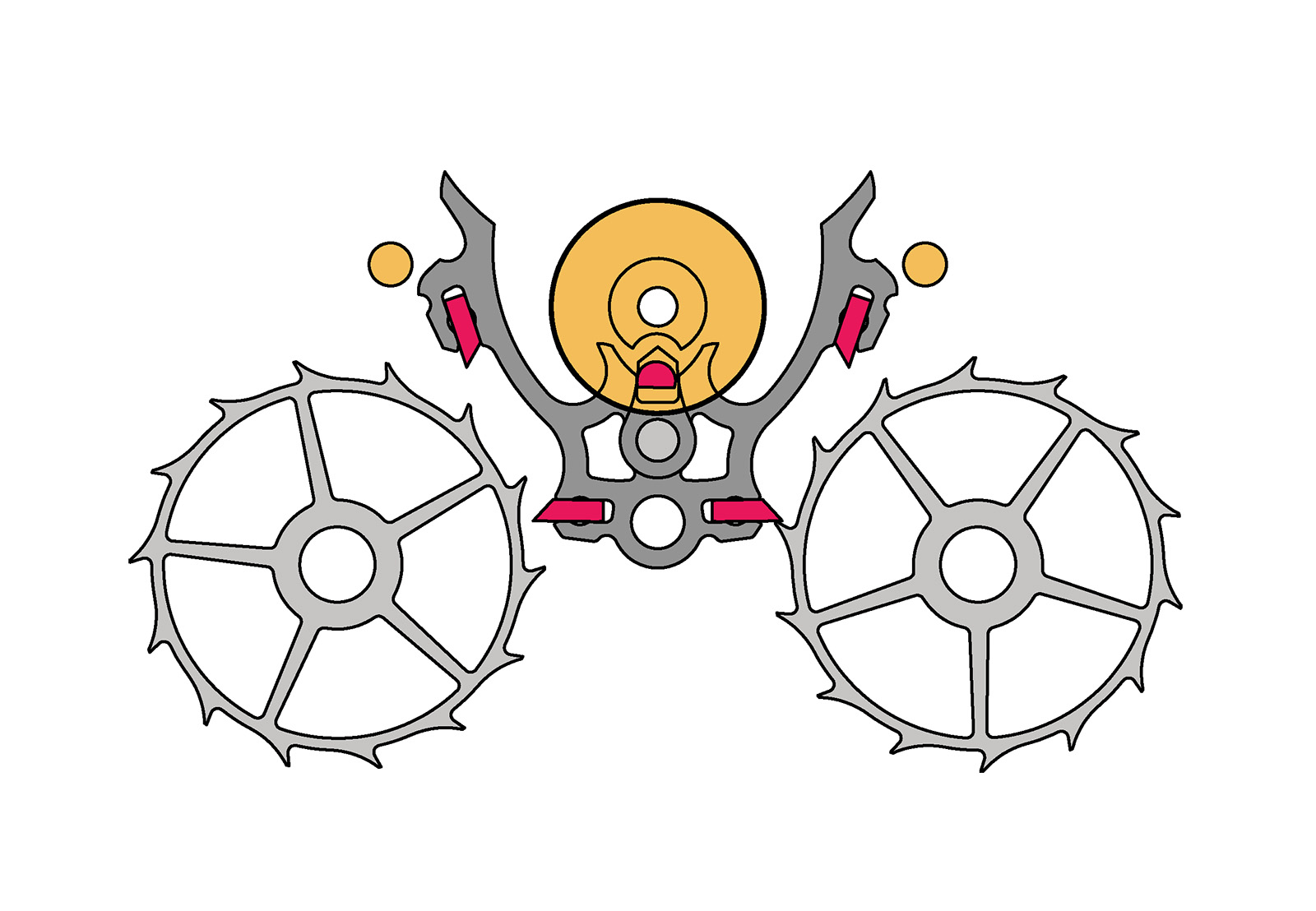
Cleguer’s Innate Escapement
The natural escapement, invented by Abraham-Louis Breguet in the late 18th century, was an attempt to address the limitations of both the detent and the lever escapement. While the detent delivers an impulse directly to the balance axis, it does so in only one direction, leaving the return oscillation without impulse – the so-called lost beat. Breguet’s solution was to preserve its direct impulse system and thus eliminate the need for lubrication, while ensuring two active vibrations. He employed two contra-rotating escape wheels that alternately deliver impulse directly to the balance in both directions.

Breguet invented the échappement naturel, so called because the impulses are delivered directly to the balance wheel, eliminating the need for oil. Shown here is an early configuration of the échappement naturel in the half-quarter repeating pocket watch No. 1135 where the escape wheels are geared together and feature vertical teeth with which they are locked and unlocked by the lever in the middle (Image: Wikipedia)
Yet Breguet’s original natural escapement carries with it certain structural limitations. The absence of draw at the locking pallet meant that the lever is not held in a secure position against its banks during the supplementary arc. As such, the stability of the locking condition depends on the inertia of the system itself, which is insufficient to guarantee consistent positioning under the disturbances encountered in portable use.
This has largely been addressed in modern executions, but a persistent limitation is the lack of self-starting ability. Because impulse is confined to a narrow region about the equilibrium position, and because no restoring force acts to bring the system into engagement at rest, the balance cannot be set into motion solely by the torque of the mainspring.
In the Swiss lever escapement, with a lift angle of 53°, the balance receives impulse over most of that arc. From the point of view of the balance, impulse is delivered from the centre outwards until roughly ±22.5°, after which the escapement enters the final 4° on each side where locking occurs. In other words, the balance is driven through the majority of its interaction with the escapement, and only encounters locking at the very end of the lift. Energy is hence introduced early and over a relatively wide angular interval, and the system naturally builds amplitude.
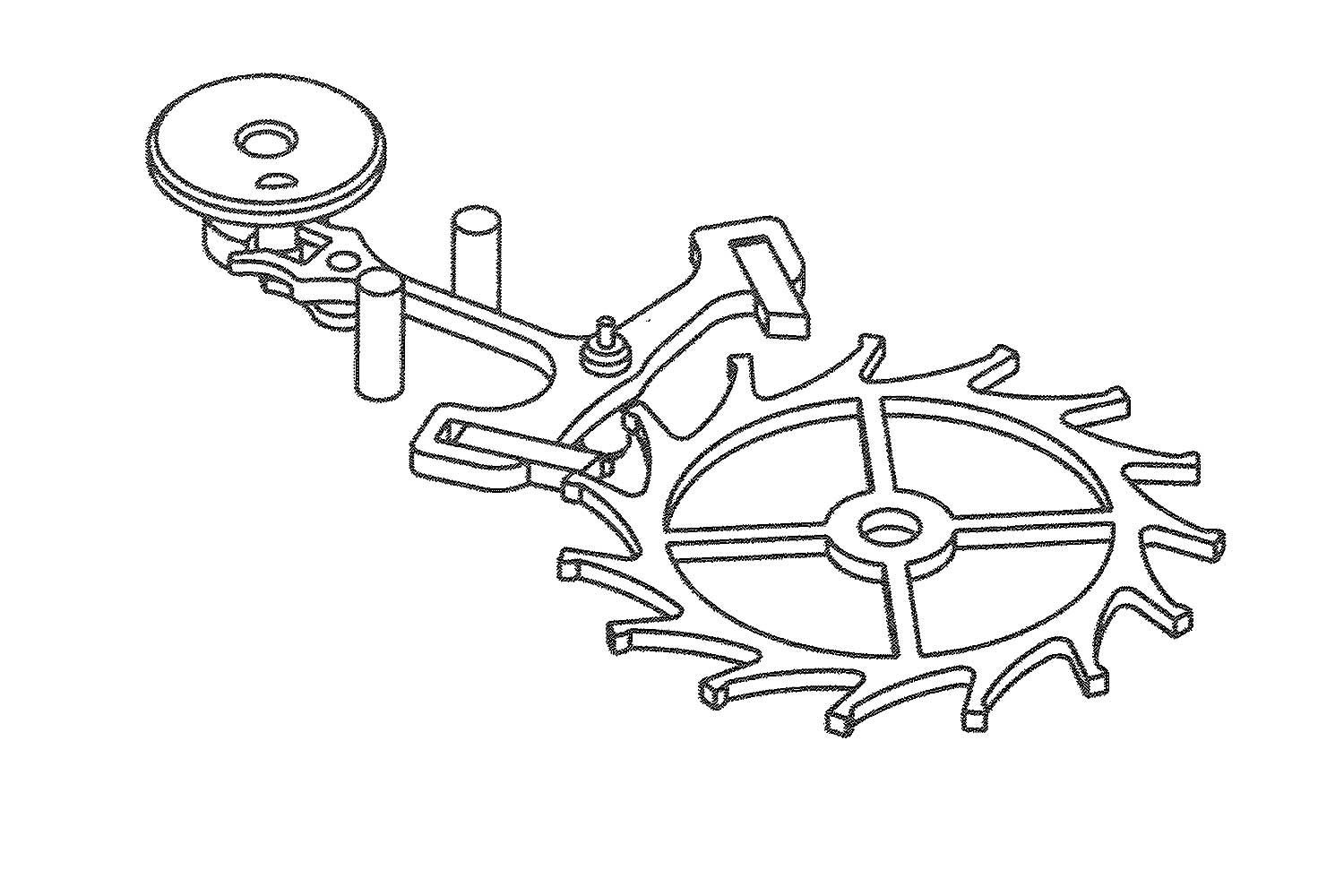
Swiss lever escapement
The modern natural escapement operates on a fundamentally different arrangement. Impulse is not symmetrical from the centre, pushing on one side happens from -4.5° to +26.5° and on the other from -4.5° to +26.5°, over a 31° arc. That off-centre push was developed on the detent escapement, giving it better efficiency. While one tooth is pushing the balance wheel, the locking jewel is already in position to lock from −26.5° to −4.5°, and the other from +4.5° to +26.5°. This means that the escapement is completely free only within a window of 9°, so even if a first impulsion happens, it’s difficult for the balance wheel to overcome the 22° of locking position, meaning that self-starting rarely occurs.
Mathieu’s Innate Escapement has a lift angle of 36°. Impulse is delivered from the centre out to about ±14°, with the final 4° on each side being the locking range. Impulse occupies the greater portion of the lift. The balance is hence accelerated over most of its contact with the escapement, before entering a short terminal phase where the escapement locks.
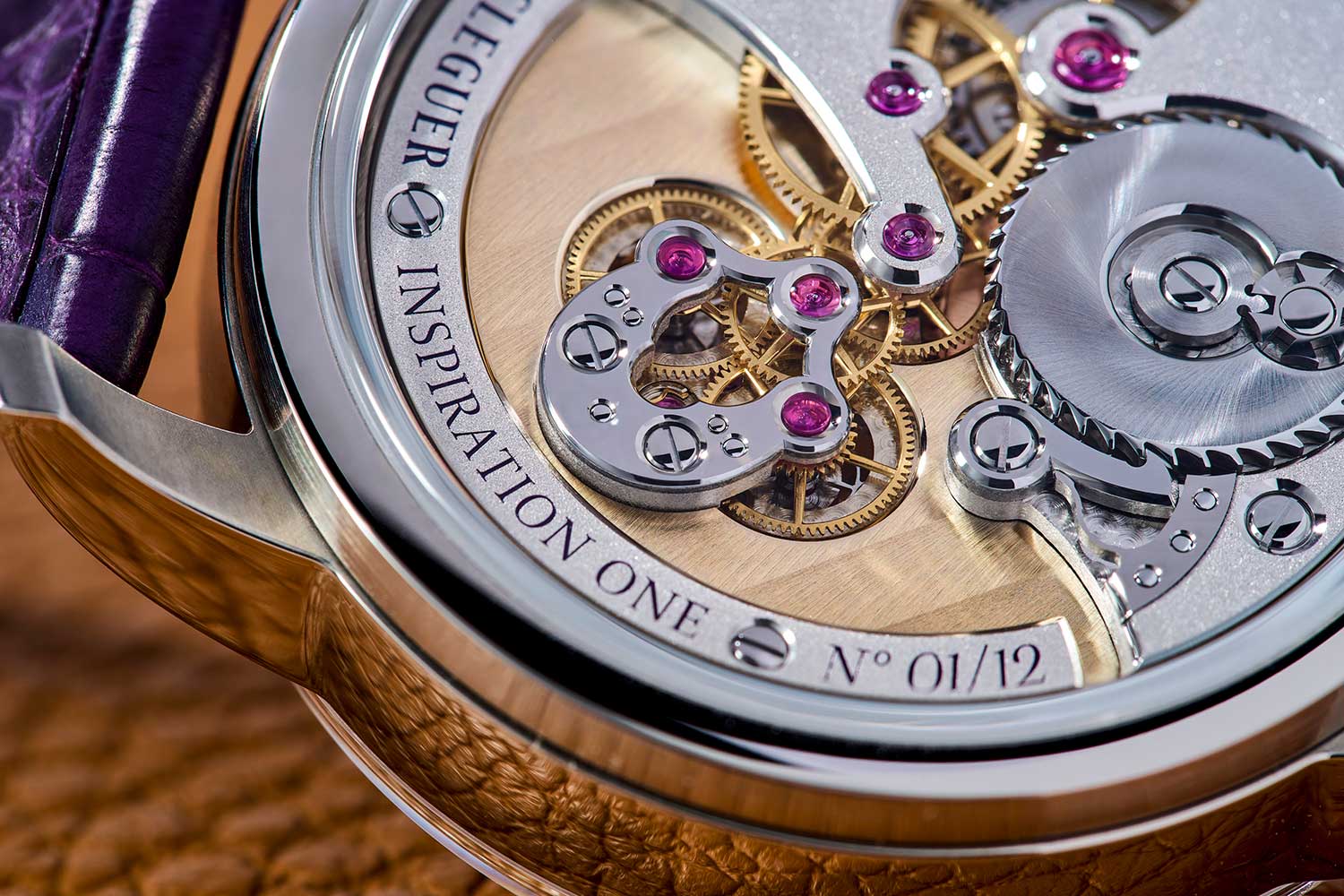
The escapement drive wheels are supported by an intricate black-polished steel bridge (Image: Atom Moore for Revolution)
The escape wheels are mounted on a mating pair of gears driven by the finishing wheel. An intermediate wheel is interposed in the train to carry the drive across, which then turns a pair of meshing gears on which the two escape wheels are mounted.
Below is an animation of the Innate Escapement:
His escapement works as follows. At a given moment, one of the escape wheels, for instance, the right wheel, is locked by a tooth bearing on the locking pallet of the lever. The lever is held against its right banking, and the balance, having just received impulse, continues its motion freely. The roller jewel is outside the fork, and the guard pin is in its safety position, preventing unintended displacement of the lever. As the balance loses momentum and reverses direction under the action of the hairspring, it swings back toward the centre. The roller jewel enters the fork, while the guard pin aligns with the safety notch, permitting correct engagement. The roller then drives the lever away from its banking, initiating the unlocking phase.
As the lever rotates, the locking pallet withdraws from the tooth of the second escape wheel, releasing it. Because the escapement is arranged such that locking and subsequent impulse occur on the same wheel, the released wheel is already in a position where a tooth approaches the impulse pallet. Almost immediately after release, this tooth comes into contact with impulse pallet and drives the lever further in the same direction. The force from the escape wheel is transmitted through the lever to the balance via the fork, accelerating the balance in its return arc.
During this phase, the roller jewel remains engaged between the fork horns, and the guard pin runs clear, allowing free motion while maintaining safety. As the impulse concludes, the lever continues slightly under inertia until a tooth of the first escape wheel comes to rest against the opposite locking pallet. The lever is now held against the opposite banking and the cycle repeats on the return swing.
When the mainspring runs down, the balance wheel comes to rest at its equilibrium position, centred by the hairspring. Thanks to the clever geometry of the lever, the tooth of the escape wheel always comes to rest in front of either of the impulse pallets. As the watch is wound from a complete stop, the escape wheel tooth will press upon the impulse pallet, disturbing the balance from equilibrium and initiating a small oscillation. That would cause a complete disengagement of the lever, hence starting an oscillating cycle.
While it is completely different in terms of geometry, materials and fundamental action, it is worth contrasting it with another escapement, the Ulysse Nardin Dual Ulysse Escapement. Both escapements employ an intermediary with four distinct contact points but they differ in a fundamental way. In the UN Dual Ulysse, the unlocking of one escape wheel does not immediately lead to impulse from that same wheel. Instead, after release, the impulse is delivered by the opposite wheel, which comes into contact with the corresponding impulse surface only after the rocker has rotated sufficiently. The sequence hence requires a transfer of function between the two wheels; one wheel is released, and the other subsequently delivers impulse.
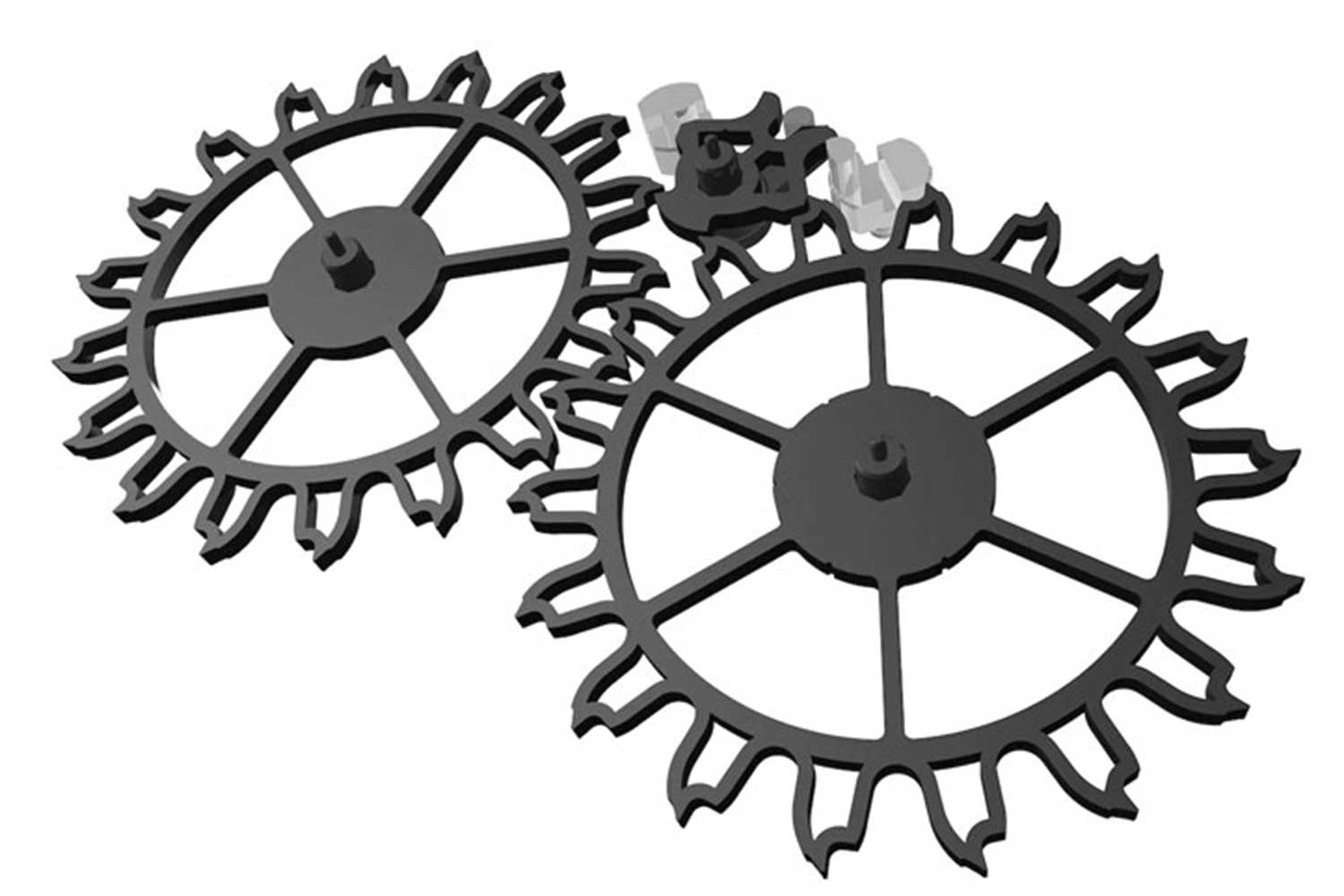
Dual Ulysse Escapement
In Mathieu’s escapement, however, locking and subsequent impulse occur on the same wheel. The wheel that has just been released is also the one that immediately delivers impulse, before locking is then taken over by the opposite wheel. This removes the intermediate transfer of function between wheels at the moment of release. A greater proportion of the lever’s motion is directly associated with torque transmission, which contributes both to improved efficiency and to its ability to initiate oscillation from rest.
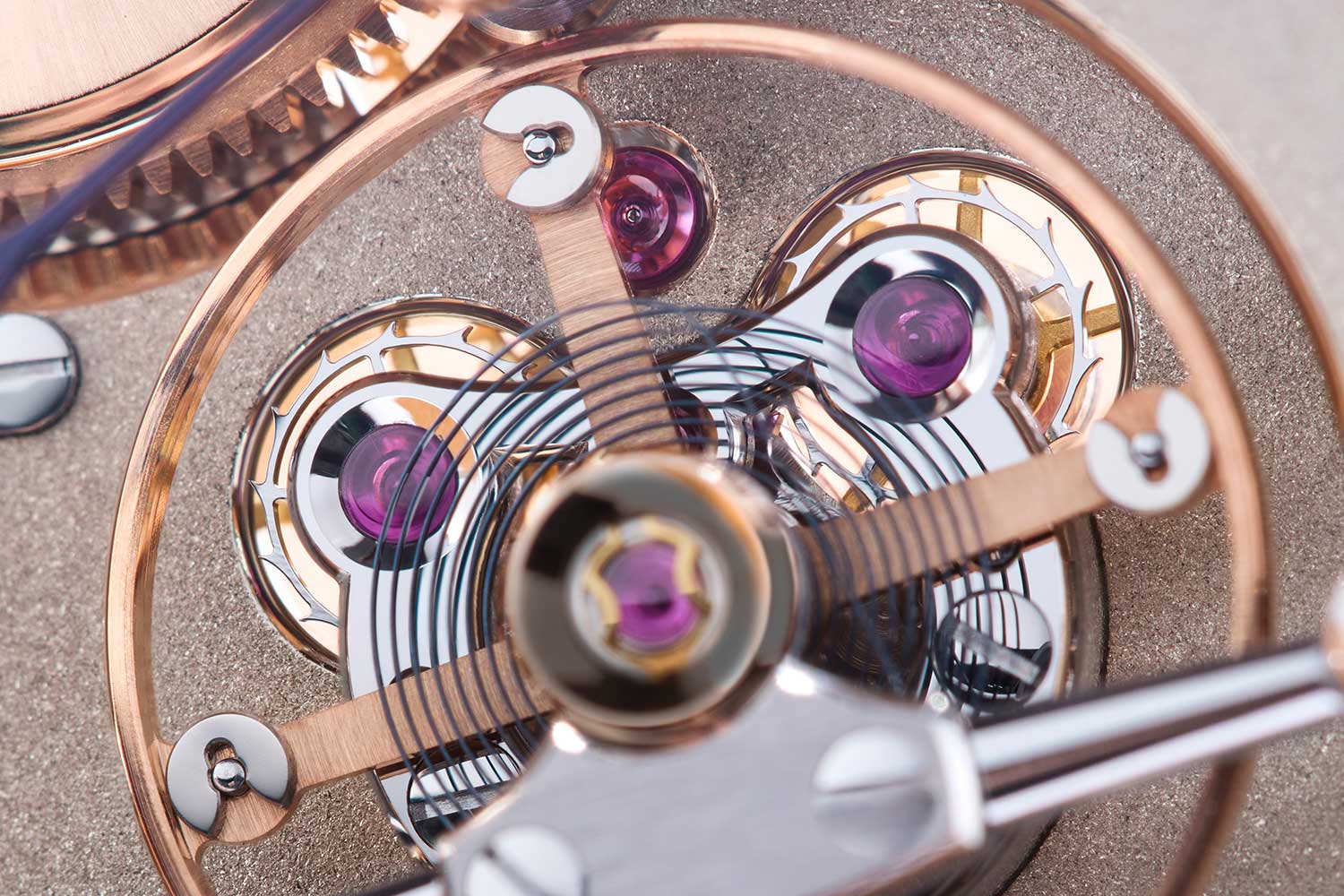
(Image: Atom Moore for Revolution)
The broader point is one of trade-offs. Double-wheel escapements are inherently complex with unconquerable technical obstacles. For every solution present on the market, there are trade-offs. The aim is simply to ensure that what is gained outweighs what is conceded. Without resorting to lightweight materials such as silicon, their manner of drive necessitates some concession to inertia but this can be seen as the lesser compromise in the context of a wristwatch as it avoids the need for a second, independent gear train, which would impose far greater constraints on space, complexity and overall architecture.
Importantly, in the Innate Escapement, impulse is delivered tangentially without sliding friction. There is light sliding on the locking face as the pallet disengages the escape wheel tooth, but it is far less pronounced than in the Swiss lever. The lever has an intricate and ingenious geometry that enables the escapement to lock and bank on the same side, allowing a counteracting force to be maintained between the escape wheel and the banking pin.
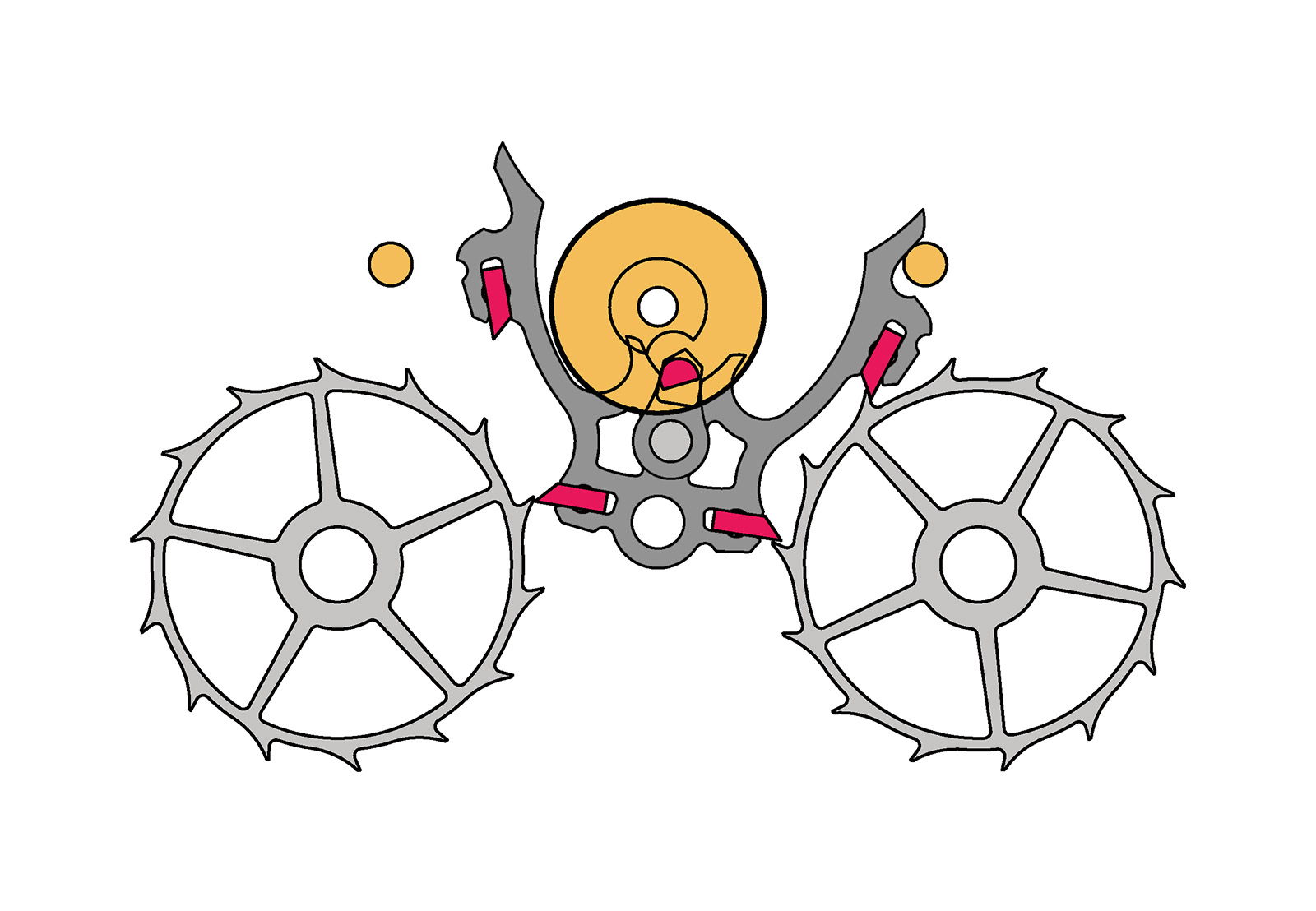
The right wheel is locked with its tooth bearing on the locking pallet of the lever and the lever is held against its right banking.
The twin escape wheels are visible through cutouts on the dial side and the entire escapement is supported by a black-polished bridge with numerous internal angles. It is paired with a competent oscillator. The balance spans 12.9mm in diameter, beats at 18,000vph and has a high moment of inertia of 50mg.cm2, which makes it more resistant to disturbances and inherently stable in its rate. It is free-sprung and attached to a Breguet overcoil hairspring.
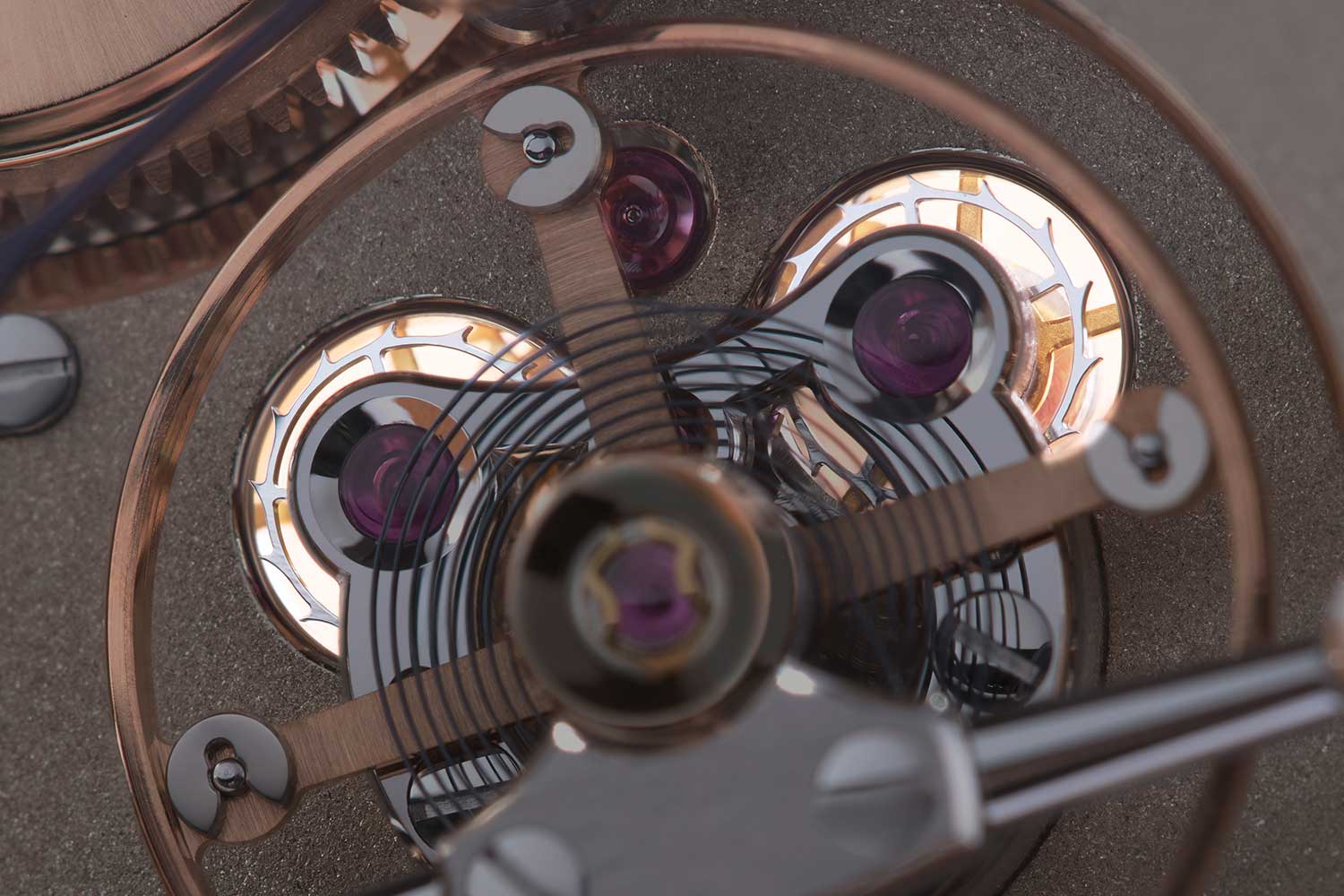
(Image: Atom Moore for Revolution)
The movement is driven by a single barrel that occupies nearly half the diameter of the calibre, extending from the centre almost to the edge of the base plate. It is, in effect, taken to its natural limit; any further increase in diameter would encroach on the central seconds pinion. Within those constraints, the proportion is ideal, maximising the energy that can be stored without disturbing the underlying architecture.
Other Highlights Across the Movement
The other highlight is the construction of the mainspring barrel. It is based on the motor barrel. In a standard barrel, the arbour remains stationary during running while the barrel turns around it, so the arbour bearings are not the surfaces carrying the rotating mass.
In this case, an arbour fixed to the barrel passes through a hollow hub that is connected to the ratchet. During winding, the ratchet turns the hub to coil the mainspring. The hub has a cylindrical sleeve to which the mainspring is hooked. During running, the hub is stationary while the barrel rotates on its own arbour, which enables it to be jewelled. This ensures that the rotating barrel is properly carried on a bearing during running, essentially reducing friction where it matters most.
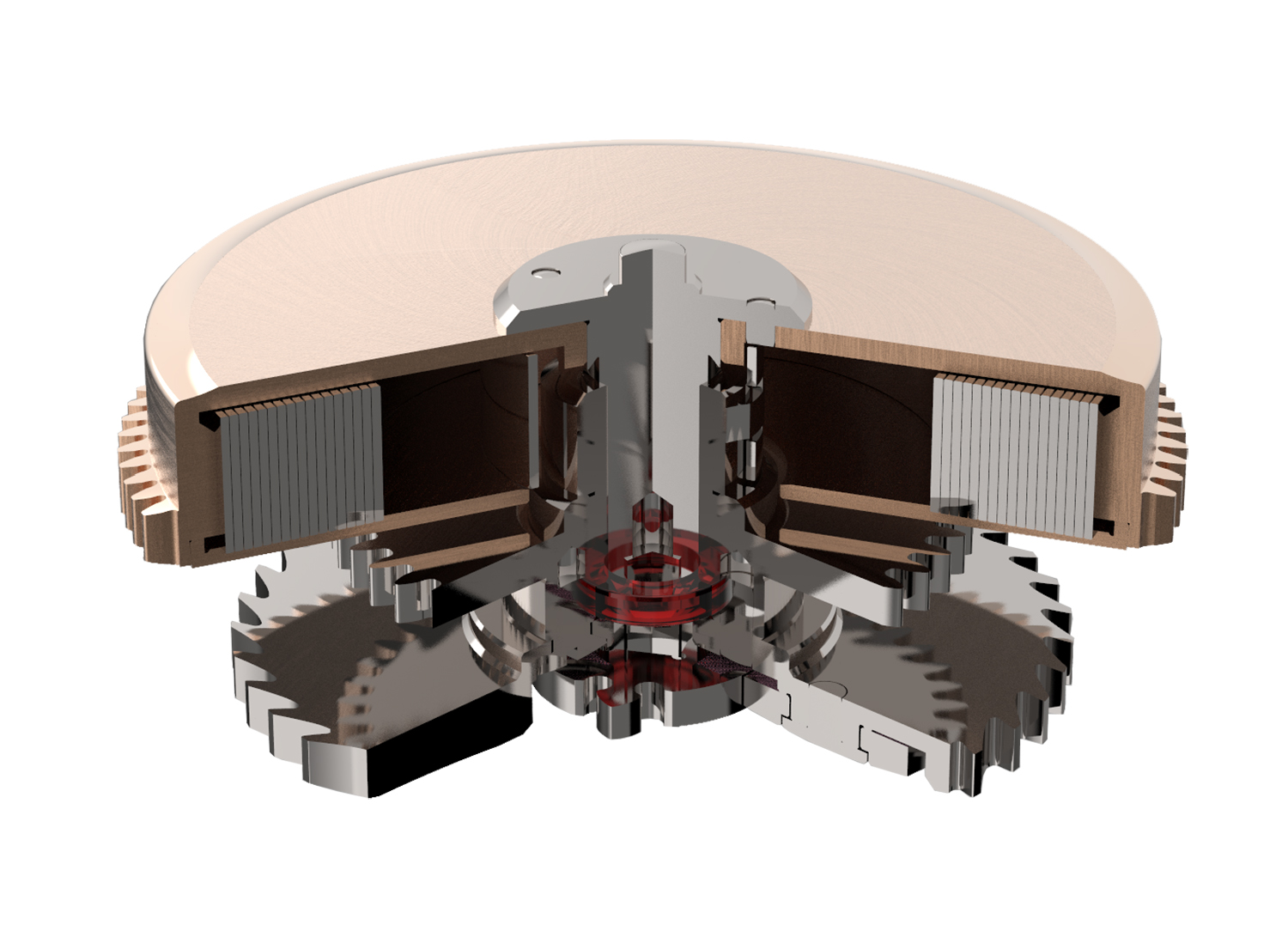
The complete motor barrel with the stopwork ratchet comprises of three sub-assemblies and 18 parts in total
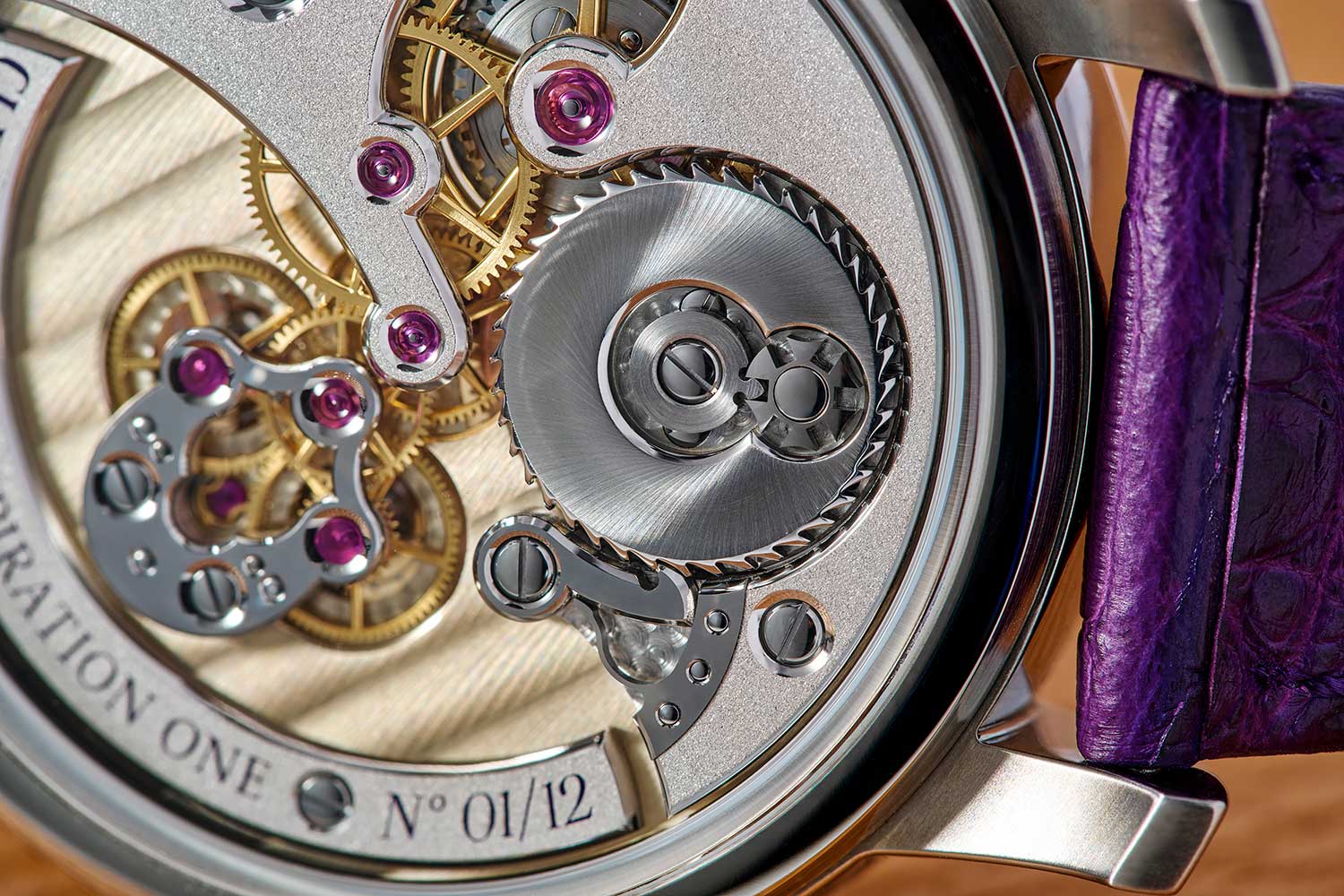
Stopwork ratchet and click, which gives the act of winding a distinctly tactile satisfaction felt as much as it is heard. (Image: Atom Moore for Revolution)
This is paired with a Maltese cross stopwork carried on the ratchet, which appears to be mysteriously disconnected from the rest of the winding train. In reality, it is mounted above a winding wheel on top of the barrel. Turning the crown drives the crown wheel, then an intermediate wheel, and finally this winding wheel, which rotates together with the ratchet to wind the mainspring.
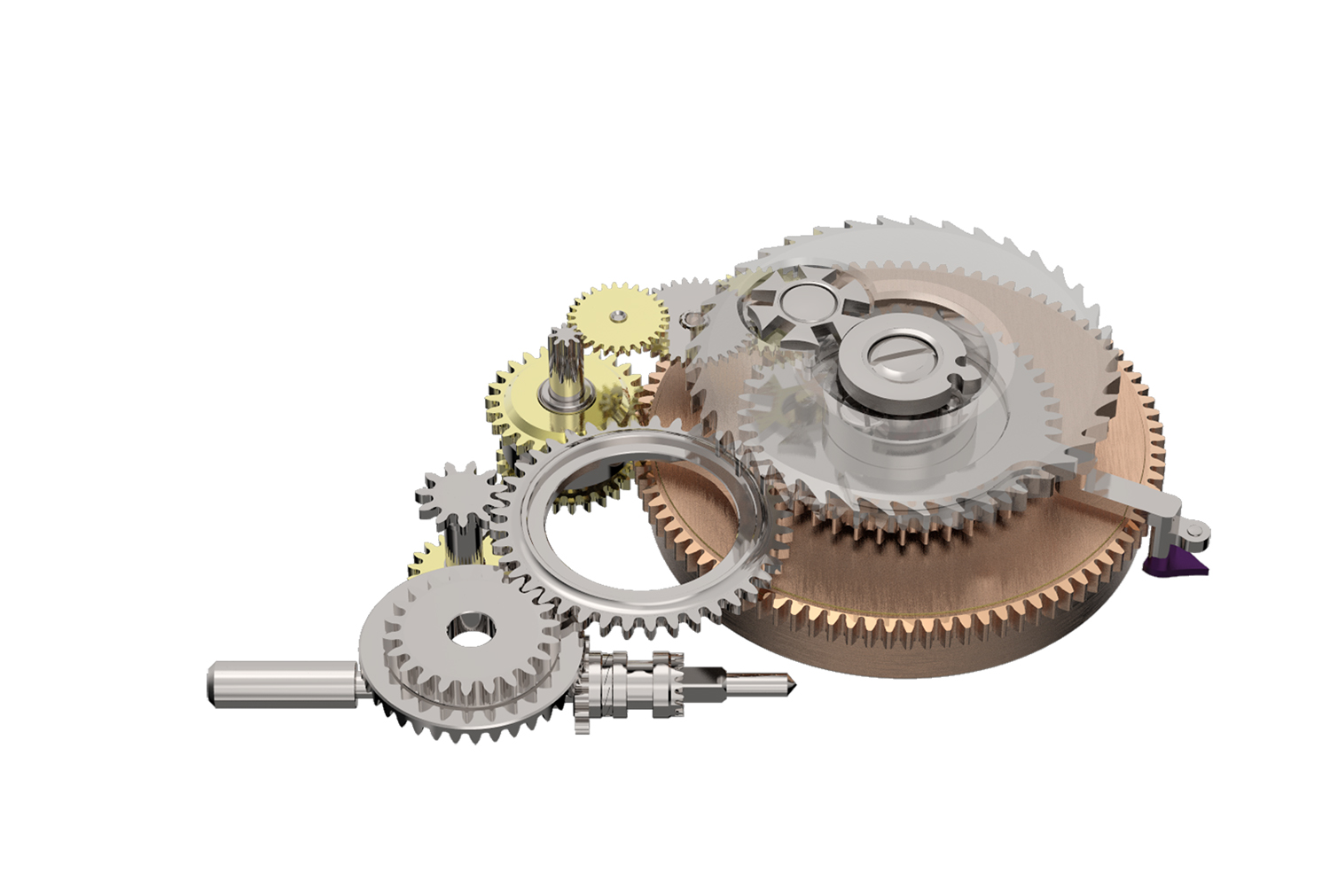
The manual winding and power reserve trains
The Maltese cross stopwork is a traditional form of a constant force mechanism. It prevents the barrel from operating at the extremes of the mainspring, where torque is either excessive or diminishing. Power is thus restricted to the most stable central portion, here spanning approximately 36 hours. It consists of a wheel shaped like a Maltese cross and a single finger attached to the arbour. The two remain in contact throughout the barrel’s motion, and the protruding arm of the cross limits the usable portion of the mainspring by physically blocking further rotation. The complete barrel with the stopwork ratchet comprise of three sub-assemblies and 18 parts in total.
Another unusual detail is that the crown wheel is cut with axial teeth, engaging the winding pinion at 90 degrees. As it turns, it drives the arbour to which it is attached, carrying with it a wheel beneath. This lower wheel then transmits motion to the intermediate winding wheel. This was necessary as the barrel ratchet is not directly aligned with the crown wheel.
Another aspect that adds to the visual intrigue is that the offset centre wheel appears to be mounted on the same axis above an intermediate winding wheel. But in fact, the winding wheel is capped, and the pinion of the centre wheel passes through this cap, which creates the impression that they share the same axis.
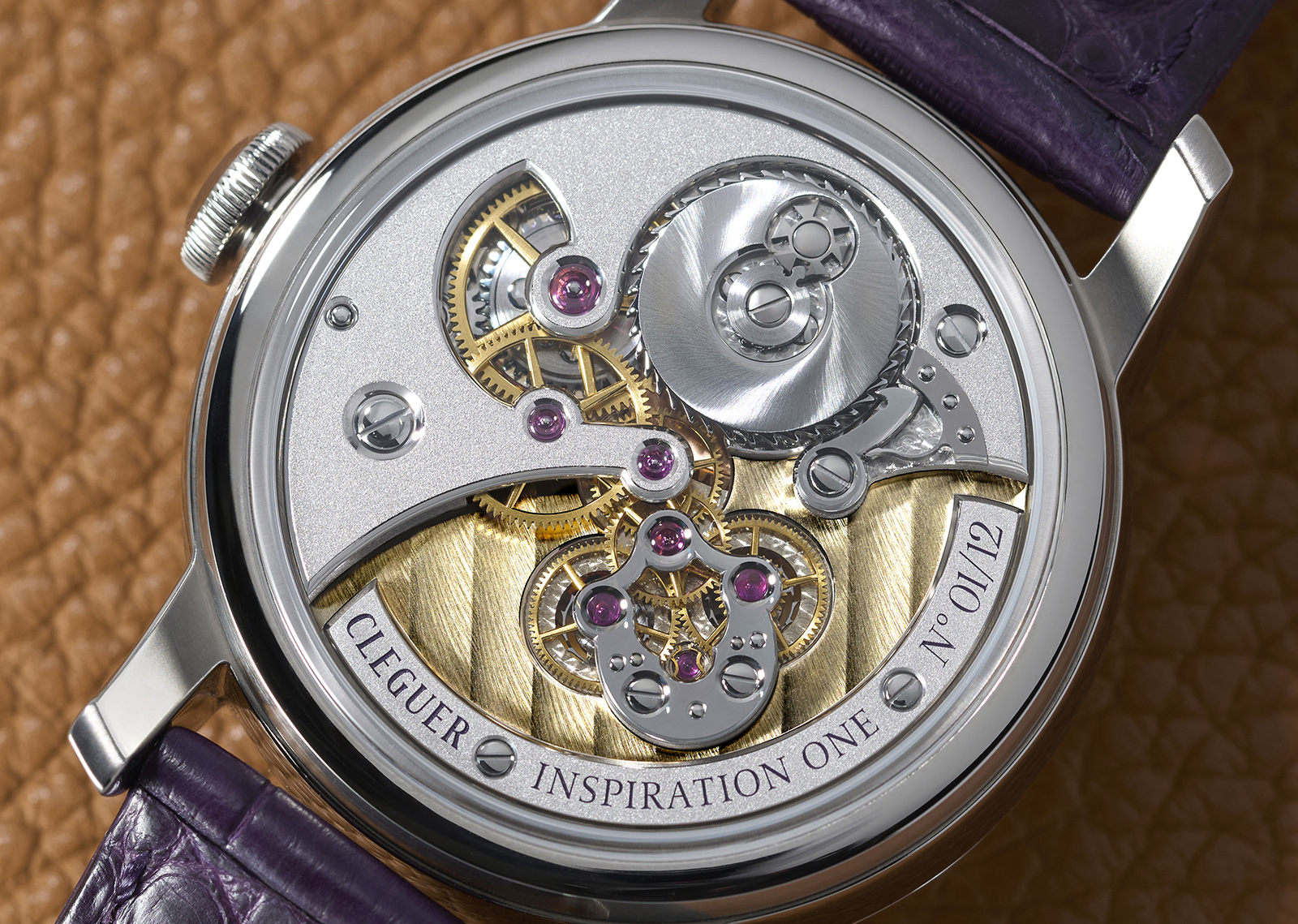
The offset centre wheel appears, somewhat mysteriously, to share its axis with the winding wheel beneath (Image: Atom Moore for Revolution)
What is apparent, looking at each component, is the level of granularity with which it has been thought through. Even the differential for the power reserve indicator departs from a conventional planar arrangement. For compactness, the planet gear is pinned vertically in the carrier and engages with axial teeth on the input wheel.
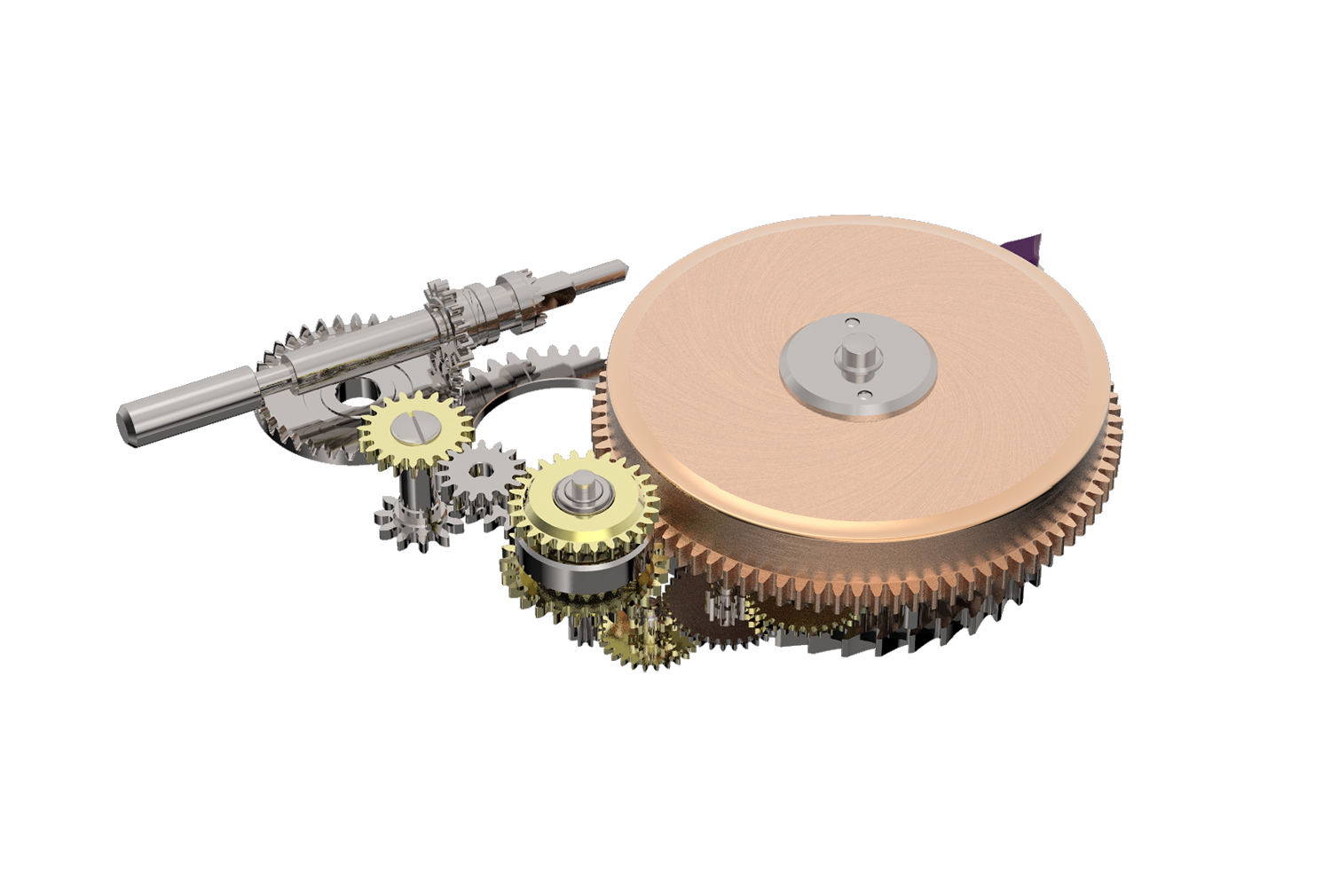
To keep the differential compact, the planet gear (a pinion) is carried vertically within the carrier and meshes with the axial teeth of the input wheel
While placing the power reserve indicator beside the barrel is visually simple, the solution required to achieve this is anything but, with a power reserve train that is rather convoluted, and creatively so. The differential takes its inputs from the crown wheel and the barrel, and its output train drives a sector gear integrated with the power reserve indicator, formed as a C-shaped element with a toothed segment and a purple-tipped indicator.
Materials and Finishing
Unsurprisingly, the effort devoted to finishing is commensurate with that of its construction. The base plate and bridges are made of German silver. On the front, the barrel bridge and the base plate are frosted and plated in a champagne hue. The warmth of these components contrasts with the polished steel bridges of the central seconds and balance wheel, which are rounded on their top surfaces. They are secured by screws that are finished just as elaborately. Their top surfaces are mirror polished and their edges are finely bevelled and polished, creating a bright, continuous rounded chamfer that catches the light. Jewels on the other hand sit in gold chatons.
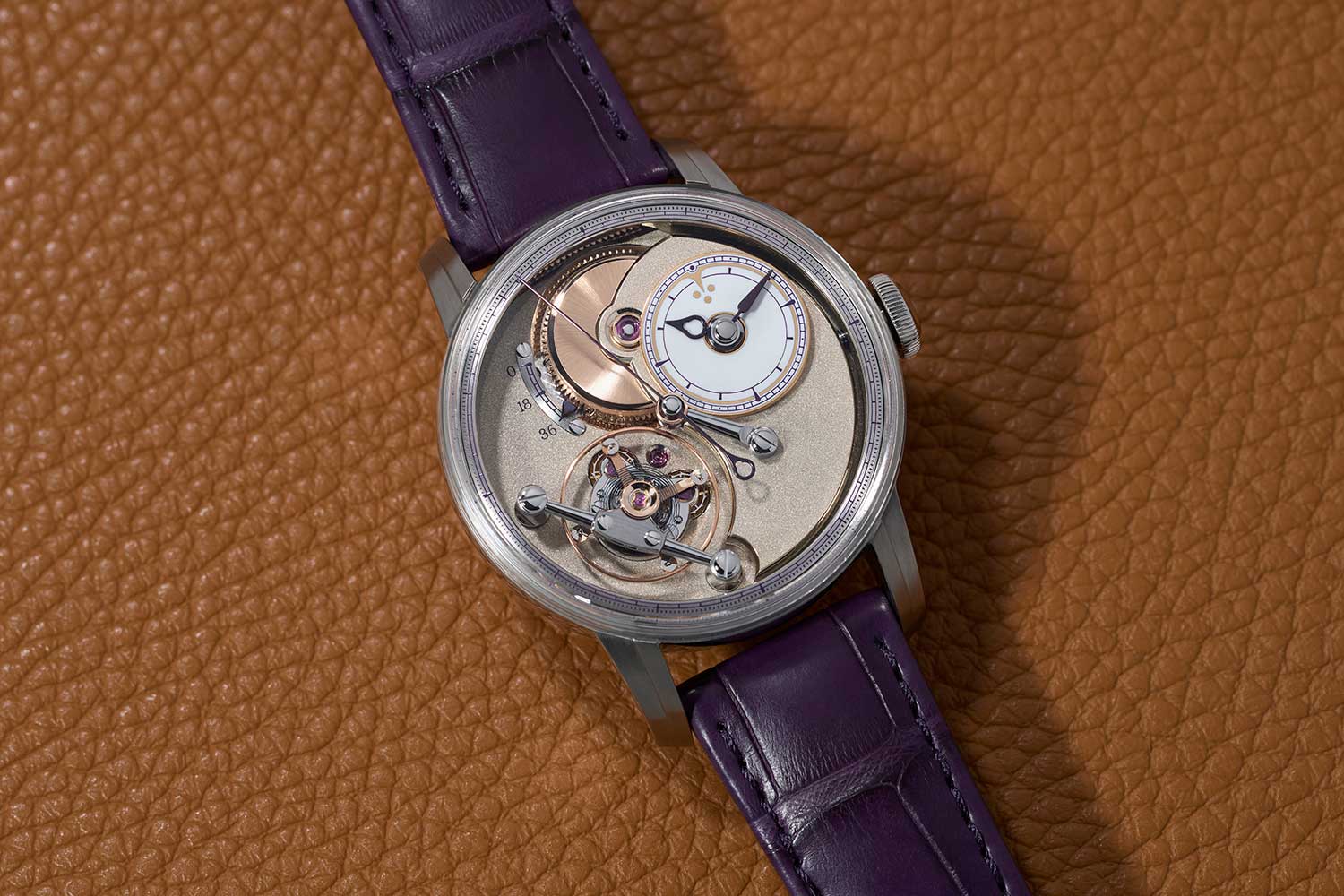
Inspiration One Souscription (Image: Atom Moore for Revolution)
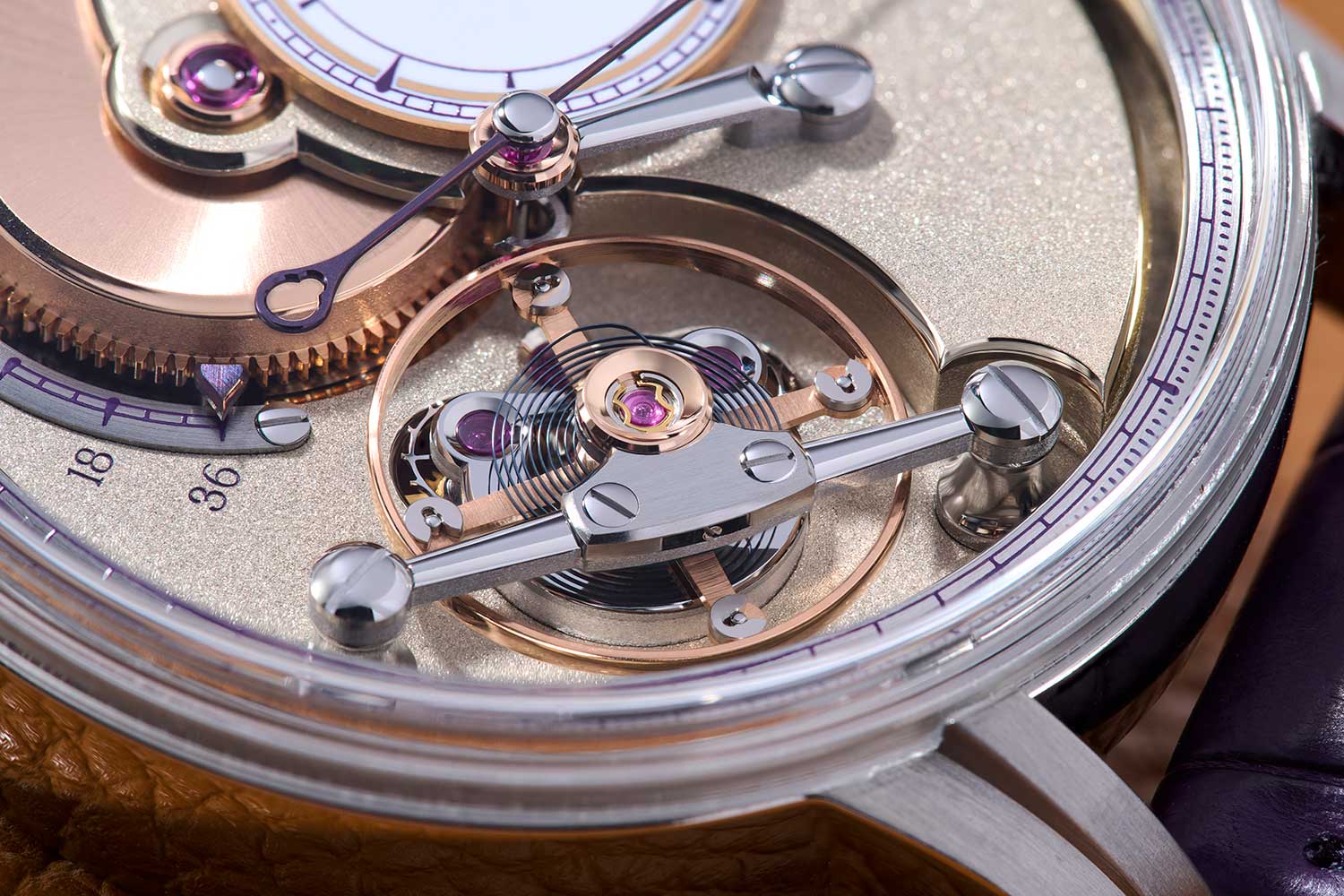
The massive 12.8mm balance is supported by a steel bridge with a flat, satin-finished central section and rounded, polished spans secured by two screws set on pillars at the extremities. (Image: Atom Moore for Revolution)
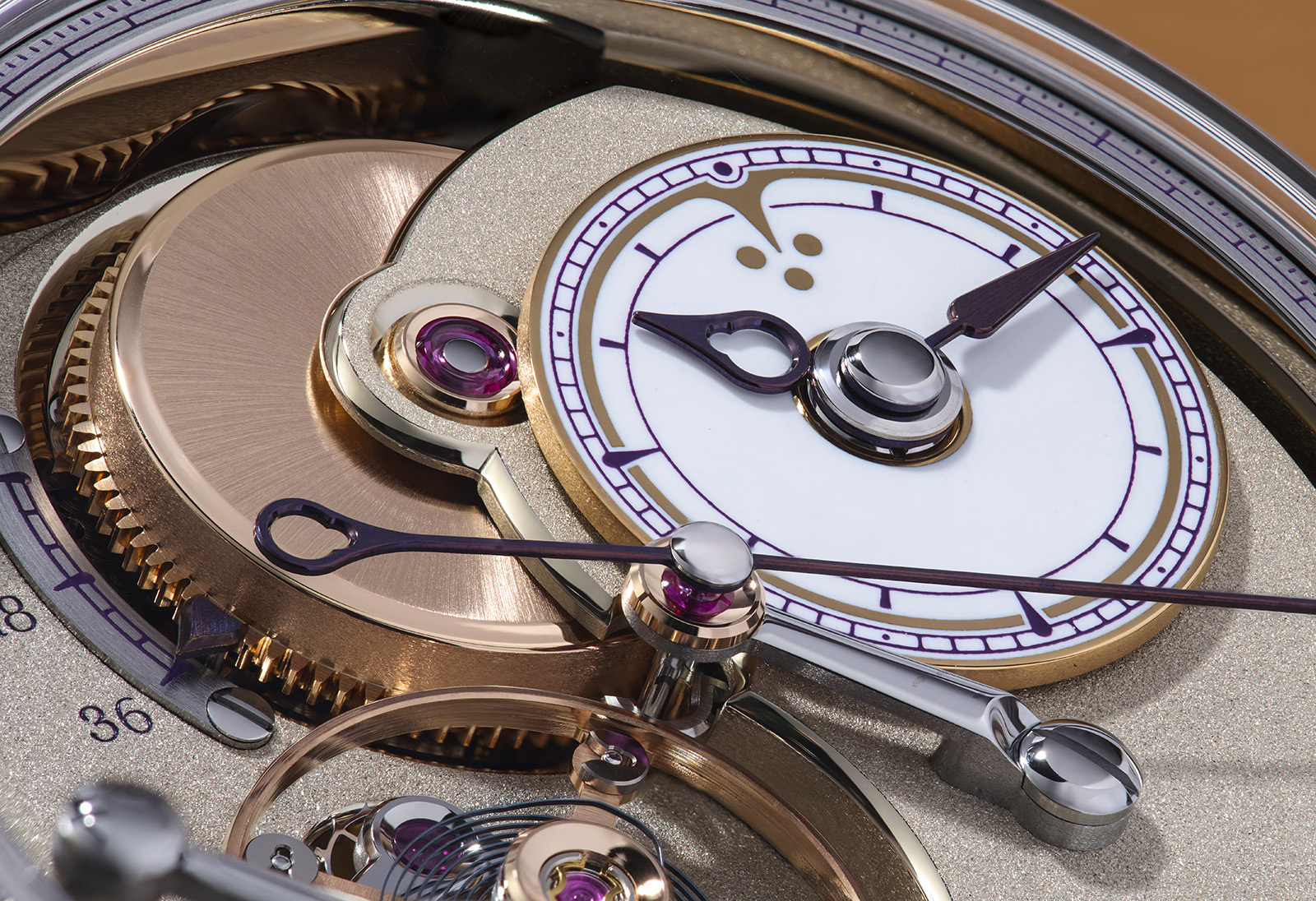
A broad, rounded bevel runs along the barrel bridge (Image: Atom Moore for Revolution)
On the back, the underside of the base plate is finished with Geneva stripes with its recesses set off with perlage. The train bridge, by contrast, is frosted and rhodium-plated, with broad, polished bevels. As it partially reveals the offset centre wheel beneath, its form gives rise to numerous sharp internal angles. The plating once again enables the steel components such as stopwork ratchet with bevelled, polished teeth, the black-polished click and bridge of the escapement drive to stand out.
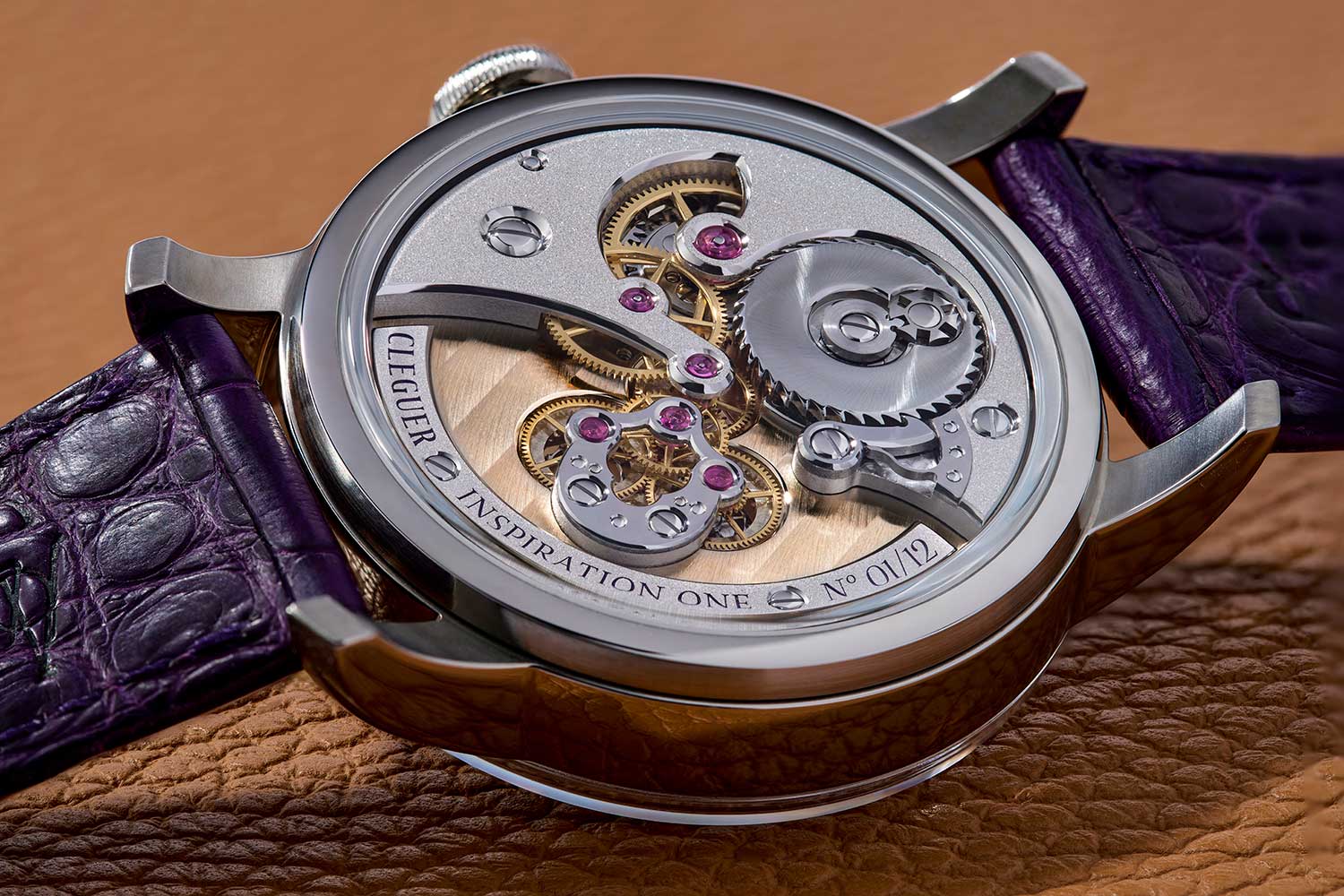
The Inspiration One Souscription makes deft use of finishing to elevate the already unusual qualities of the movement (Image: Atom Moore for Revolution)
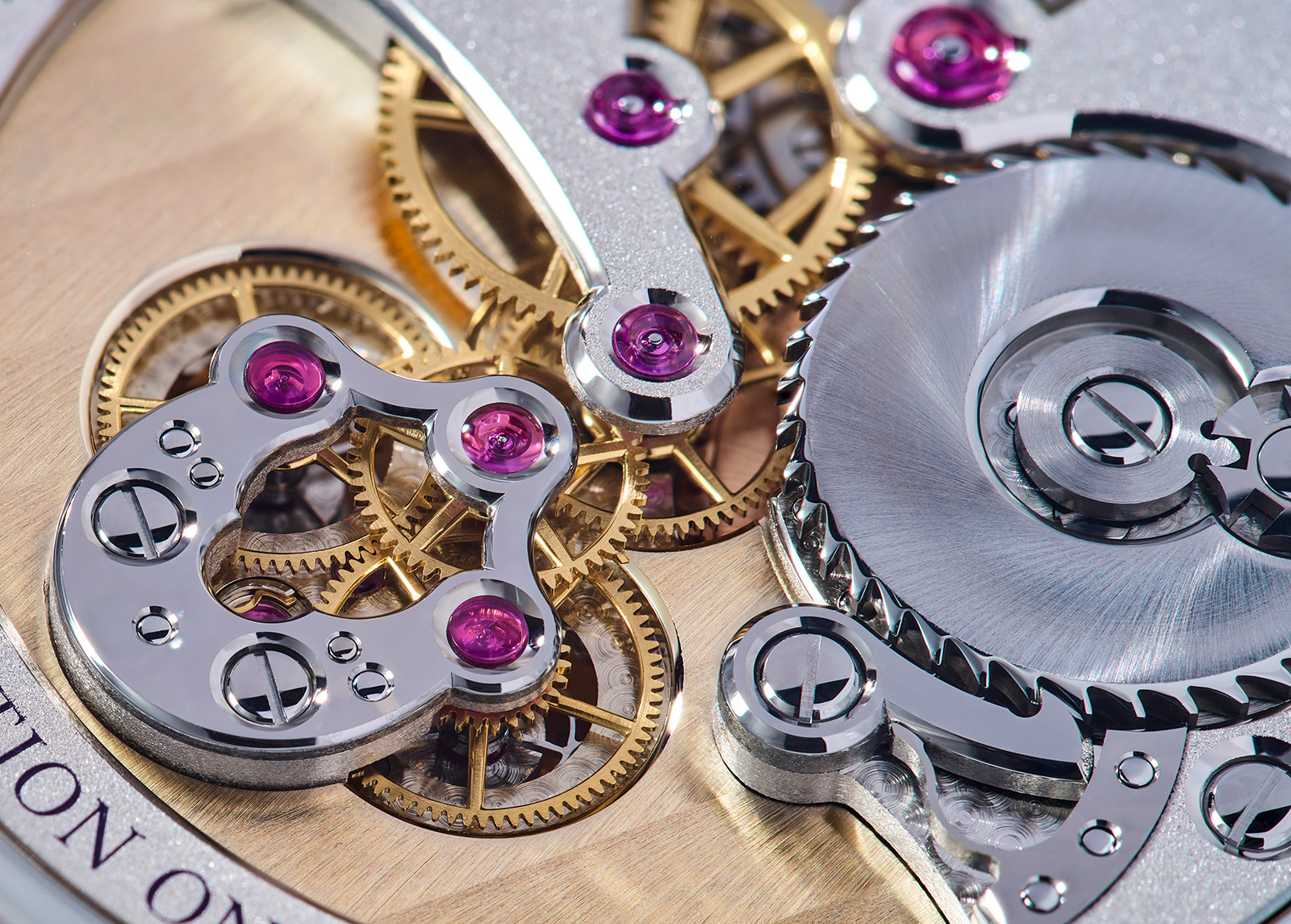
A closer look at the lavishly finished steelwork (Image: Atom Moore for Revolution)
Importantly, the impression you get is one in which the finishing serves to elevate the already unusual and accomplished construction of the movement rather than becoming an end in itself.
While it is increasingly difficult to stand out in this crowded field of finely finished time-only watches, the Inspiration One has managed to do just that. It engages both the eye and the mind. In the end, it makes its case through the seamless integration of design, engineering and execution, and the beauty with which they are carried through.
The Sousciption model in titanium, all allocated, is priced at CHF 56,000 while the subsequent models in precious metals – four variations beginning with white gold – are priced at CHF 95,300.
Tech Specs
Movement Hand-wound; power reserve of 36 hours; 2.5Hz or 18,000vph
Functions Hours, minutes, central seconds
Case 38.5mm x 12mm; titanium (Souscription)
Dial Champlevé grand feu enamel
Strap Purple alligator leather with a pin buckle
Price CHF 56,000 for the Souscription model and CHF 95,300 for precious metal
Availability Sousciption is sold out; four precious metal models, limited to 12 pieces each, and 20 bespoke creations are available directly from Cleguer
You may also like
Editorial
Fleming Series 1 Mark II
Mar 31, 2026
Editorial
Fleming Series 1 Mark II
Mar 31, 2026
Editorial
Gerald Charles Announces the Masterlink Perpetual Calendar and the Mini Maestro
Mar 31, 2026
Editorial
Gerald Charles Announces the Masterlink Perpetual Calendar and the Mini Maestro
Mar 31, 2026
Editorial
My Take on the Louis Vuitton Watch Prize for Independent Creatives 2026
Mar 27, 2026
Editorial
My Take on the Louis Vuitton Watch Prize for Independent Creatives 2026
Mar 27, 2026