
Making a Splash: Hublot and ‘Future Archaeologist’ Daniel Arsham
Editorial
Making a Splash: Hublot and ‘Future Archaeologist’ Daniel Arsham

Imagine a falling drop of water frozen in mid-air. This idea of motion suspended in time is the vision behind Hublot’s new creation with Daniel Arsham: the MP-17 MECA-10 Arsham Splash Titanium Sapphire.
This is the second collaboration between the Swiss watchmaker and the artist who calls himself an “archaeologist of the future.” Last year’s Arsham Droplet took the traditional idea of a pocket watch and turned it into a fluid, otherworldly sculpture. The new Splash expands this philosophy onto the wrist. The asymmetrical creation is part watch, part wearable sculpture.
For Hublot, it is another demonstration of the “Art of Fusion,” the brand’s restless instinct to combine art, materials and mechanics in ways that disrupt convention. For Arsham, it is his first wristwatch design, a rare opportunity to translate his philosophy into an object that lives with the wearer. Together, they’ve created a timepiece that challenges how we think about watches, art and perhaps even the nature of time itself.
From Droplet to Splash: A Fluid Evolution
When Hublot and Arsham unveiled the MP-16 Droplet, it was unlike anything the brand — or anyone else for that matter — had attempted before. A transformable pocket watch encased in a droplet-shaped titanium and sapphire cocoon, it looked less like a traditional timekeeper and more like an artifact from a future museum. It could be worn as a pendant, displayed as a desk sculpture, or carried in the pocket like a relic from a lost sci-fi civilization.
That first piece was bold and made a big splash with both press and public, and the new wristwatch is just as eye catching. The Splash represents water not only as form, but as impression. A droplet falls, splashes, then freezes.

Hublot MP-17 Meca-10 Arsham Splash Titanium Sapphire
For Arsham, this is the heart of his philosophy. In his work, time is never linear but cyclical, slippery, elusive. “Time doesn’t have a shape,” he once said, “and sometimes, my memories don’t feel like memories — they feel like predictions.” He takes contemporary objects and reimagines them as if uncovered centuries from now, corroded but eternal. In the Splash, that philosophy has been distilled into a compact artwork.
Daniel Arsham: Archaeologist of the Future
Daniel Arsham is a cultural force as much as a creator. Based in New York, his work moves between sculpture, architecture, performance and film. He casts everyday objects — cameras, basketballs, cars — in geological materials, transforming them into “future relics.” You’re never quite sure if you’re looking at something from centuries past or centuries ahead.

Daniel Arsham
In his 2016 exhibition Circa 2345 at Galerie Perrotin, New York, Arsham described his practice as “collapsing time.” That tension between nostalgia and futurism resonates perfectly with the world of horology, where watches are both technological marvels and heirlooms, contemporary tools and future legacies.

Arsham in his 2016 exhibition Circa 2345 at Galerie Perrotin
Arsham’s reach is wide. He has collaborated with fashion houses, carmakers, musicians and even the Pokémon franchise, always leaving his imprint — that uncanny blend of familiar and strange, comforting and unsettling. His aesthetic is instantly recognizable: pale hues, crystalline surfaces, organic erosion.
Some of his most acclaimed pieces — like eroded casts of 20th-century cameras or his crystalline Porsche 911 — turn familiar cultural icons into archaeological specimens. They appear simultaneously ancient and futuristic, as though excavated from a parallel timeline. The resonance with watchmaking is obvious. A mechanical watch, too, is a cultural artifact, one that collapses eras into a single object: centuries of craft, years of engineering, hours and seconds in motion.
The Droplet was Arsham’s first horological experiment with Hublot. The Splash is his first wristwatch with the brand. For him, it marks a shift from object to companion — a sculpture that not only reflects on time but keeps it, a relic of tomorrow you can wear today.

Hublot MP-17 Meca-10 Arsham Splash Titanium Sapphire
Arsham in Culture: From Dior to Pokémon
To understand why this collaboration resonates beyond the walls of traditional horology, it helps to look at Daniel Arsham’s footprint in a broader cultural context. Few contemporary artists have moved so fluidly between the rarefied world of galleries and the mass appeal of pop culture.
Arsham has worked with Dior, reinterpreting the house’s heritage codes through his signature lens of erosion and crystallization. For Adidas, he created sneakers that looked as though they had been unearthed from some archaeological dig, relics of a sportswear future that had already aged into myth.
Then there are the cultural icons. His crystalline reimagining of the Porsche 911 was both sculpture and symbol, a car eroded into a relic yet still charged with motion. His work with Pokémon struck a different chord — characters like Pikachu and Charmander, recast in crumbling stone and mineral, transformed into nostalgic relics for a generation that grew up with them.
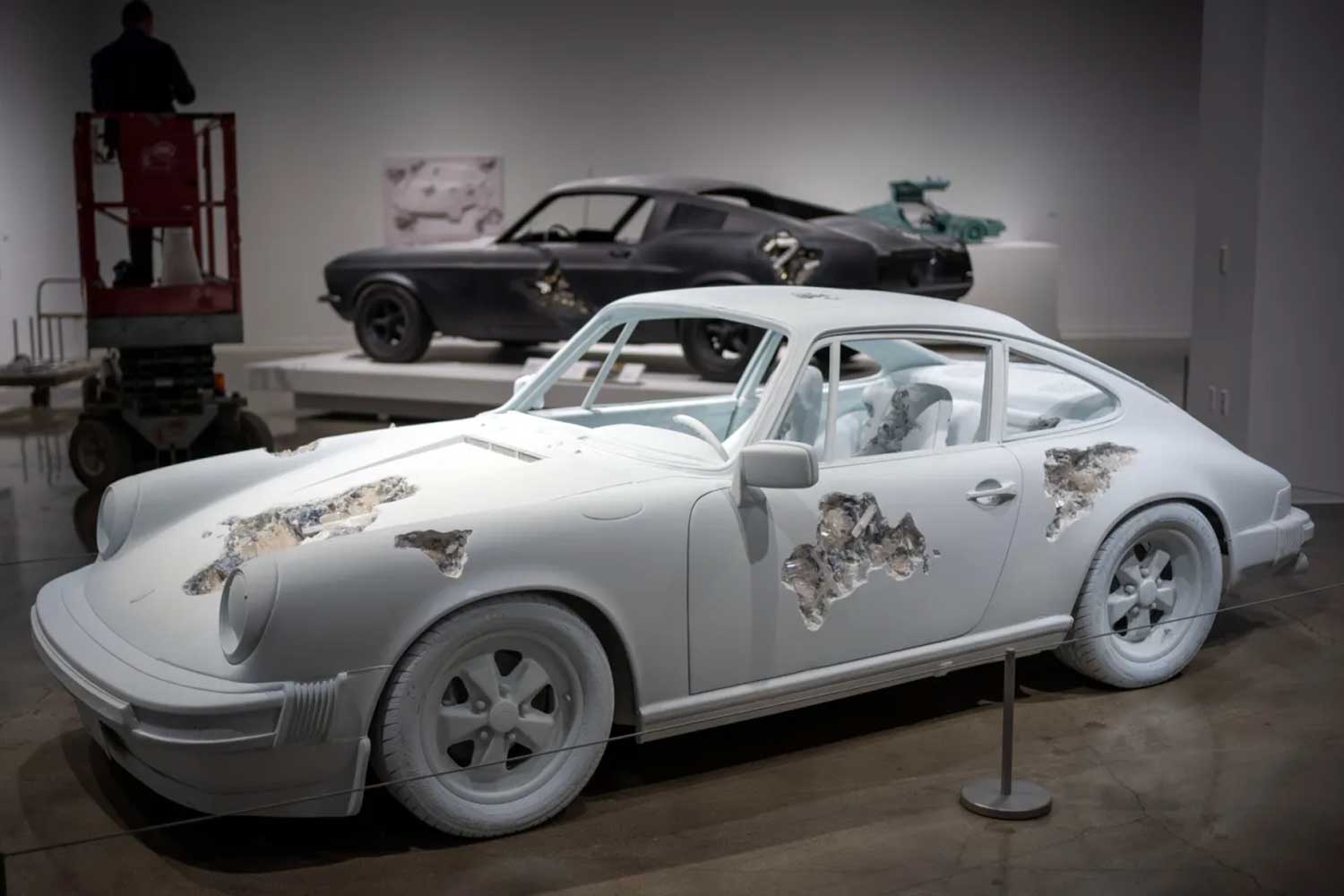
Blue Calcite Eroded Porsche 911 by Daniel Arsham at the Petersen Automotive Museum (Image: Hans Gutknecht/MediaNews Group/Los Angeles Daily News via Getty Images)
What ties all of these projects together is Arsham’s ability to collapse time. Whether it’s couture, sneakers, cars, or childhood mascots, he turns familiar objects into “future relics.” Just as he’s done across fashion, automotive culture and pop art, here Arsham takes a familiar object — the wristwatch — and destabilizes it, leaving us to wonder: is this the past, the present, or a memory of the future?
The Hublot Way: Fusion as Philosophy
If Daniel Arsham is the archaeologist of the future, then Hublot is an alchemist of watchmaking. Since its birth in 1980, the brand has thrived on fusion — by the pairing of unexpected materials, as well as the collision of tradition and disruption. Gold with rubber. A porthole bezel studded with exposed screws. The audacity of calling a watch the Big Bang. The list goes on.

Hublot MP-17 Meca-10 Arsham Splash Titanium Sapphire
It was 2005 when Hublot truly ignited, with the launch of that model. The Big Bang embodied a mindset: loud and unapologetic. Two decades later, it remains the icon of the brand, a symbol of boldness and versatility.
But Hublot has never stood still. The Unico movement, the MECA-10 caliber, the tourbillons and high complications — all serve the same mission: to keep fusion alive. That philosophy has extended to art, too. Over the years, Hublot has collaborated with Takashi Murakami, Shepard Fairey, Richard Orlinski and tattoo collective Sang Bleu, each bringing their universe into the watch.

Equally radical is Hublot’s approach to materials: sapphire cases milled from a single block, scratch-proof gold alloys, brightly colored ceramics, carbon composites. Few maisons have pushed experimentation this far or this consistently. To understand the Splash, you have to see it in this context: a culmination of decades of risk-taking, channeled through the imagination of an artist who thrives on rethinking form.
The MP-17 sits firmly within this tradition
At first glance, the MP-17 seems like a departure from Hublot’s playbook. Where are the hard angles, the industrial edges, the monolithic Big Bang proportions? Look closer and you’ll see them. The six H-screws still circle the bezel. The lugs still brace the case. The H-shaped clasp still locks the strap. The DNA is intact, reinterpreted through Arsham’s lens.
The case is 42mm, surprisingly compact for a watch with this much presence. That size is possible thanks to a new evolution of Hublot’s in-house MECA-10 caliber. It has been shrunk down without losing any of its 10-day power reserve. The manual-wind movement is visible both through the dial and the sapphire caseback, a mechanical heartbeat suspended within a crystal cocoon.
The bezel is frosted sapphire, box-shaped, catching light in a way that mimics water refracting under the sun. Lightweight yet tough titanium provides the structure. On the wrist, a grained white rubber is decorated with the Arsham logo. It is Hublot’s Art of Fusion at its purest: disparate materials harmonized into a coherent whole.

Hublot MP-17 Meca-10 Arsham Splash Titanium Sapphire
And then there’s the dial. Or rather, the absence of one. The defining feature is the splash-shaped aperture, jagged and organic, like water hitting a surface in slow motion. Time stands out via accents on the hands, hour and minute markers in Arsham Green, a striking turquoise-mint tone.
There is a small seconds indicator at 9 o’clock, while at 3 o’clock, a larger dial marks the generous ten days of power reserve that the MECA-10 provides.
Inside the MECA-10
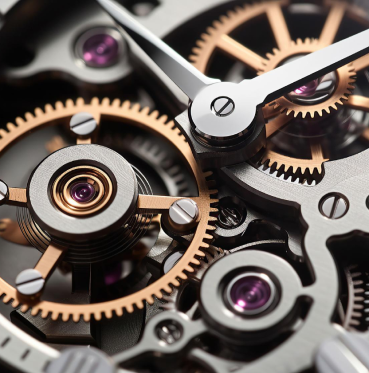
Movement The caliber deserves attention in its own right. The MECA-10 is one of Hublot’s most distinctive in-house movements, with two parallel barrels delivering those 10 days of power. Its design is industrial, with open-worked bridges and a linear power reserve system that has become a signature of the brand.

The MECA-10
In the Splash, this caliber has been re-engineered for compactness without sacrificing that endurance. The architecture remains open, mechanical, honest. The skeletonized bridges, visible through sapphire front and back, reinforce the idea of transparency — nothing hidden, everything in motion. It is both sculpture and mechanism, a reminder that watchmaking, at its best, is functional art. Limited to just 99 pieces worldwide, the MP-17 is as rare as it is radical.
Time as Impression: Arsham’s Fluid Lens
Arsham’s fascination with time goes beyond seconds, minutes and hours, into the erosion of memory, the layering of history and the impression left by a fleeting moment. In his sculptures, cameras crumble, busts dissolve, cars corrode into crystalline husks. They are relics from a future that has not yet happened. In the Splash, that same idea manifests as frozen water. A droplet collides, explodes into motion, then stops. Time, suspended.
Watches, too, are about suspension. They freeze time into measurable units. They record, remind and outlast. By sculpting a splash into a watch, Arsham has collapsed two philosophies into one: the watch as a precision instrument; and the watch as an artifact of memory.
Collectability and Culture
With only 99 pieces, this is for Hublotistas, or for watch collectors who appreciate art as much as engineering and believe that watchmaking is not about nostalgia but about disruption. It is also for the Arsham faithful — a global community of art lovers who collect his sculptures, his collaborations, his visions of what has been and what might be. For them, the Splash is a chance to carry a piece of Arsham’s future archaeology in everyday life.

Hublot MP-17 Meca-10 Arsham Splash Titanium Sapphire
Perpetual Motion
If questioning our perception of time sounds like a tall order, it is with good reason. It is supposed to challenge us. As Julien Tornare, CEO of Hublot, puts it: “Working with Daniel Arsham is a discovery of new design and perception. This watch invites us to see time in a new light, through Arsham’s unique and fluid vision.”
Or, in the artist’s own words: “The watch’s transparent structure captures the clarity and motion of water, suspended, precise and always in flux.”
The Hublot MP-17 MECA-10 Arsham Splash Titanium Sapphire is both watch and sculpture. And Hublot is again showing that the Art of Fusion is as much about philosophy as it is about watches.

Hublot MP-17 Meca-10 Arsham Splash Titanium Sapphire
Tech Specs: Hublot MP-17 Meca-10 Arsham Splash Titanium Sapphire
Movement: Manual winding MECA-10 Caliber HUB1201; 10-day power reserve
Functions: Hours, minutes and small seconds
Case: 42mm; titanium with frosted sapphire, box-shaped bezel; water resistant to 30m
Dial: Sapphire with display of open-worked movement; hour markers in Arsham Green
Price: Upon request
Availability: Limited edition of 99 pieces
Hublot
You may also like

Editorial
Hublot Unveils New Big Bang Meca-10 Street Art Collection at Art Basel Miami Beach
Dec 8, 2025
Editorial
Hublot Unveils New Big Bang Meca-10 Street Art Collection at Art Basel Miami Beach
Dec 8, 2025
Editorial
New Chapters: Collecting a Legacy in Seddiqi’s 75-Year Story
Nov 17, 2025
Editorial
New Chapters: Collecting a Legacy in Seddiqi’s 75-Year Story
Nov 17, 2025
Editorial
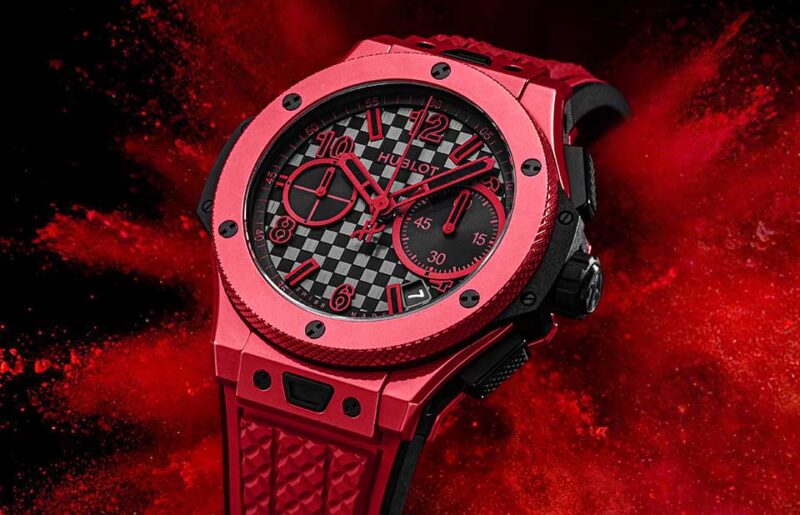
Hublot’s Red Hot 20th Anniversary Big Bang Proves That Watchmaking Can Be Louder, Brighter and Braver
Oct 24, 2025
Editorial
Hublot’s Red Hot 20th Anniversary Big Bang Proves That Watchmaking Can Be Louder, Brighter and Braver
Oct 24, 2025