
Introducing the Roger Dubuis Hommage “Sukoon Al-Layl”
News
Introducing the Roger Dubuis Hommage “Sukoon Al-Layl”

The early years tend to surface quickly in almost any conversation about Roger Dubuis. The watches from that period occupy a particular place in the minds of many, not only because they were made in small numbers but because they were direct reflections of the founder’s own hand, sensibilities and experience as a watchmaker. This year, to mark its 30th anniversary, the brand recently launched the Hommage “La Placide”, which revived the landmark perpetual calendar Roger Dubuis helped develop in the late 1980s and returned to the more classical register of his early watches. It was limited to 28 pieces, echoing the original quantities Dubuis himself produced for each configuration of his watches.
That watch has now been joined by a piece unique unveiled at Dubai Watch Week, the Hommage “Sukoon Al-Layl.” The name translates to “serenity of the night,” a gesture toward the quiet desert landscape that inspired the design and a reminder of Dubuis’ long-standing fascination with astronomical complications. Hommage, after all, was the name of one of the two collections he introduced in 1996, the other being the Sympathie. While the latter had an idiosyncratic case shape, the Hommage was a series of traditional round watches, created as an homage to classical watchmaking.

Roger Dubuis Hommage “Sukoon Al-Layl”
Where the recent limited edition was cased in pink gold, the Hommage “Sukoon Al-Layl” is in platinum, which has the quiet gravitas to suit the watch’s underlying idea of nocturnal serenity. It measures 38mm in diameter and 11mm high. Its dial is remarkably elaborate, consisting of five layers. As with his original bi-retrograde perpetual calendar watches, the composition is unapologetically expressive. It is a play of forms, textures and typography in which the creative use of fonts becomes part of the visual rhythm. It carries forward Dubuis’ design sensibilities; he approached tradition with a theatrical instinct and a willingness to explore its boundaries.
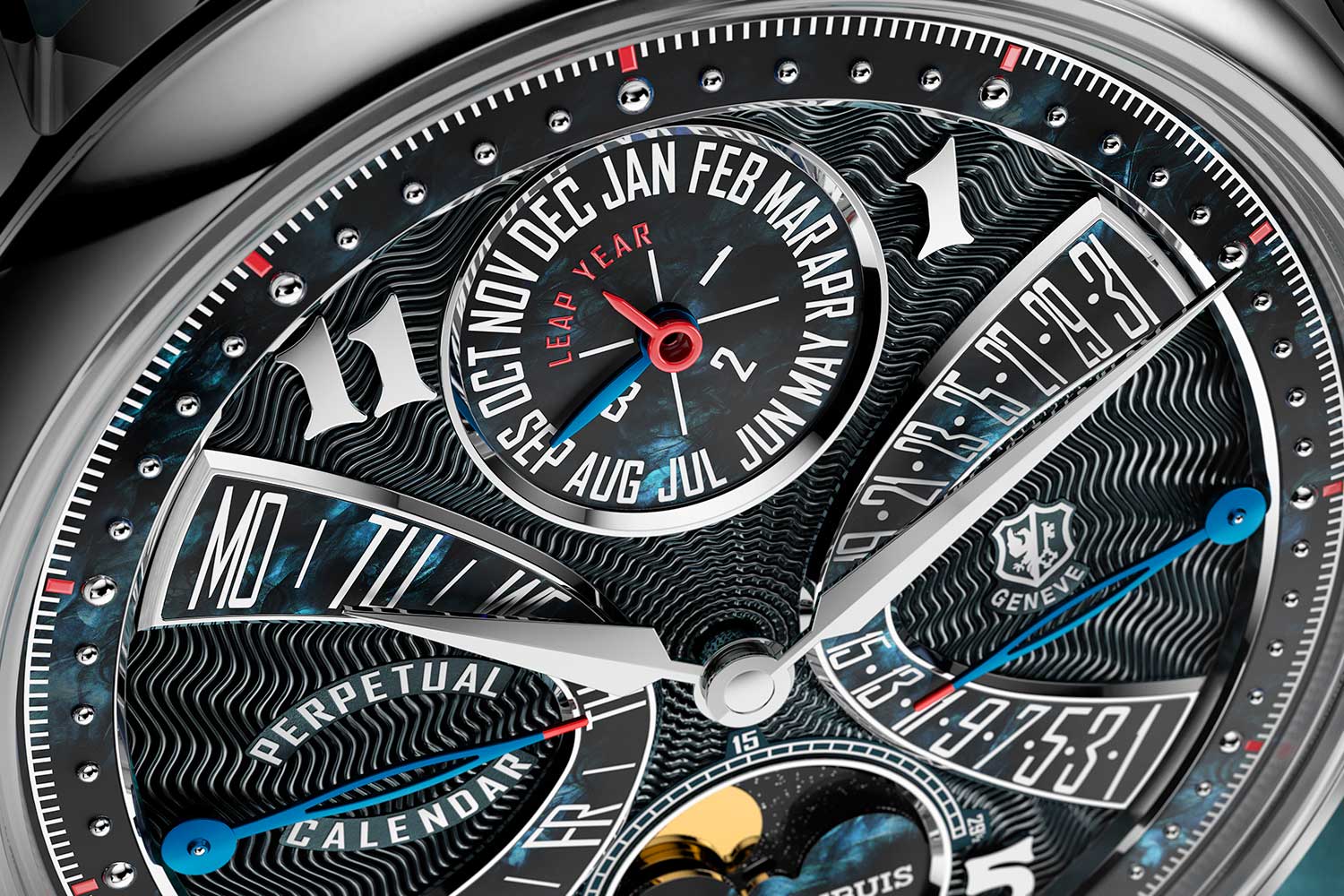
The case crafted in platinum and the dial consisting of five layers
The flange is cut from mother-of-pearl, a material Roger Dubuis adopted early in his career for men’s watches. Here it is worked to a bright sheen, which lends a gentle illumination to the perimeter of the dial. The minute track is transferred onto its surface, and is accentuated with applied domed markers. Mother-of-pearl also forms the calendar displays and subsidiary indications, each framed with bevelled borders. Beneath these layers lies the main dial plate, engraved with a wave pattern associated with Dubuis’s first creations and recreated here to evoke the ripples of sand shaped by desert winds. It is lacquered in a deep Astral Blue, with white-gold hour and minute hands, while the retrograde hands are rendered in lacquered brass to minimise inertia. The four applied Arabic numerals are included as a nod to the region for which the watch was conceived. There is also a sprinkle of red accents that gives it the idiosyncratic quality of the original creations.
The moonphase sits on its own level, with blue aventurine base set with two domed moons in 18k yellow gold. The interplay of materials and surfaces gives the dial its sense of dynamism, structure and dimensionality, an approach that perhaps reflects the language of contemporary Roger Dubuis.
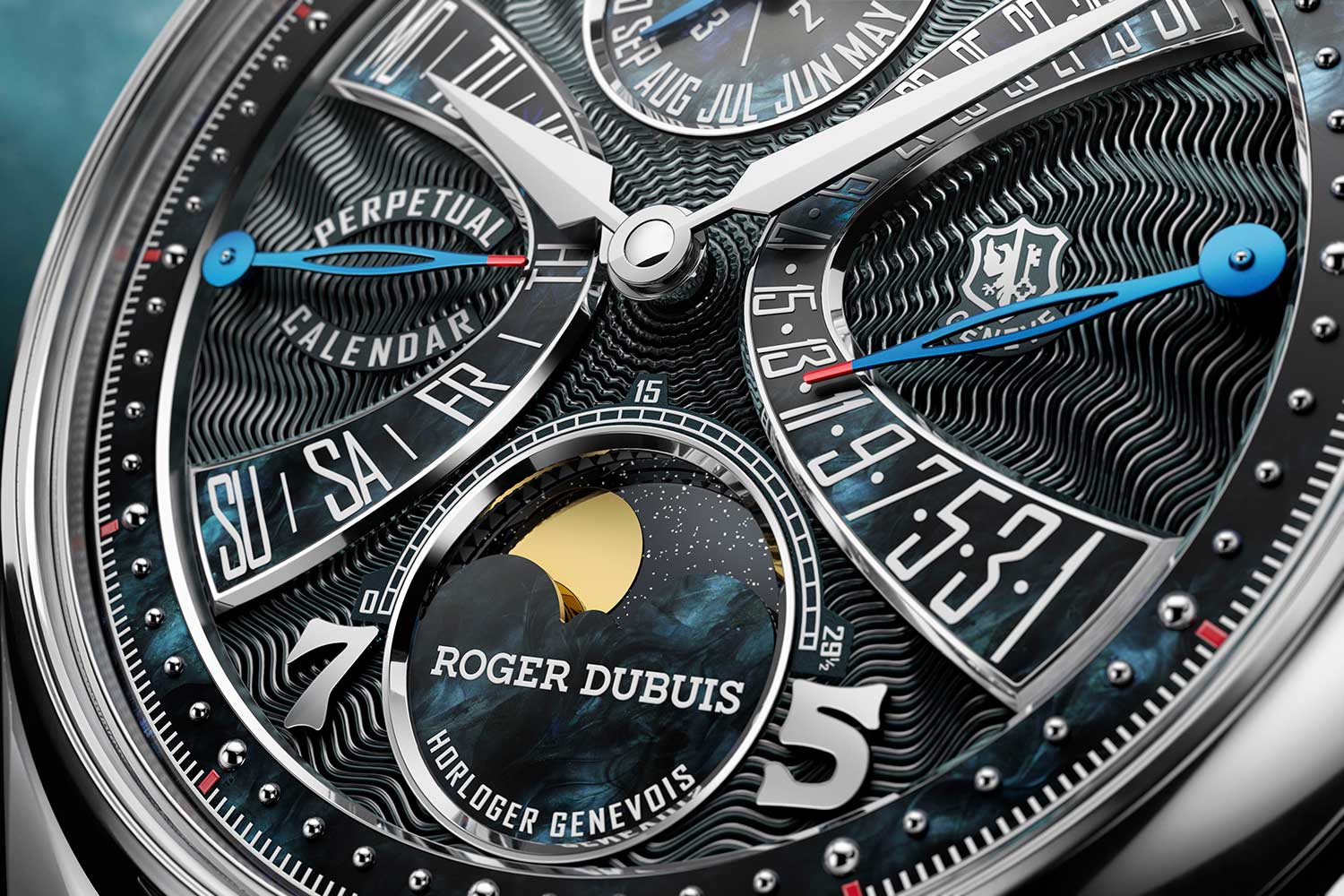
The moonphase with blue aventurine base set with two domed moons in 18k yellow gold
Like the dials of the early watches, it bears the Geneva Hallmark. At that time, only Patek Philippe movements carried the seal and Roger Dubuis saw it as a necessary point of parity in asserting Genevan watchmaking. Notably, Roger Dubuis remains today the only manufacture whose entire production receives the Geneva Hallmark.
The automatic RD1472 calibre combines a refurbished RD14 base with the bi-retrograde perpetual calendar module RD72. The RD14 was the brand’s first in-house movement. Introduced in 2004, a year after Dubuis’ retirement, it emerged during a period when the company was rapidly evolving and building its own calibres to supplant third-party ébauches.
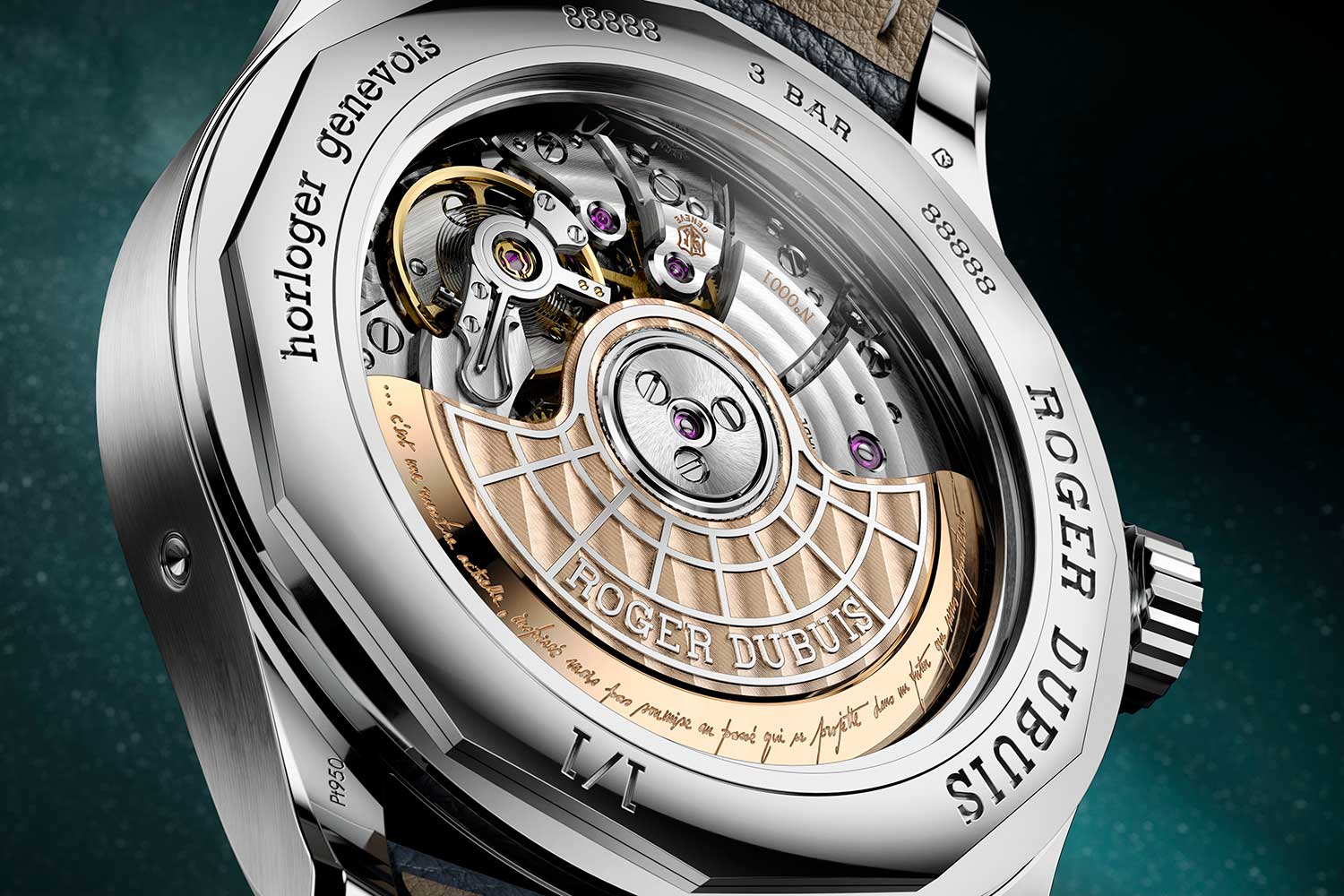
The RD1472 calibre
The RD14 in this watch was upgraded as part of the refurbishment. According to the brand, the axes of the wheels were repositioned, meaning they revisited the layout of the entire gear train rather than simply re-finishing existing components. In a movement, the relative positions of the wheel pivots determine the centre distances between gears, and consequently the exact geometry of each mesh. By recalculating the gear train, they effectively re-established these distances so that the teeth engage under more favourable conditions, reducing losses and improving torque transmission. The movement retains its classical design with finger bridges supporting the train, along with a swan neck regulator.
The bi-retrograde perpetual calendar module RD72 was first used in 1999, but the complication itself has a longer and rather interesting history. The signature display was originally co-developed for Harry Winston by Roger Dubuis and Jean-Marc Wiederrecht, who would later found the complications specialist Agenhor. Until then — and largely even today — perpetual calendars relied on the familiar four-subdial layout. The duo sought to animate the complication by introducing a pair of mobile displays in the form of two retrograde indicators: one for the day and the other for the date. It was a world first and debuted in 1989 in the Harry Winston Bi-Retrograde Perpetual Calendar. Later, when Roger Dubuis founded the company with his partner Carlos Dias, he employed the module in his own watches, in both the Sympathie and Hommage in 1996.
The perpetual calendar RD27 employs a 48-month program wheel with the leap year directly encoded in it. It is executed in a compact way, with the leap-year star and month star mounted coaxially on the same axis, allowing both indications to be presented on a single counter with two coaxial hands. While both retrograde displays employ a classic rack and snail cam system, the rack lever has an extended finger perpendicular to the teeth of the rack. Mounted in opposite directions, each rack finger engages a snail cam attached to a seven-point star wheel and a 31-toothed wheel for the day and date respectively. This finger is in constant contact with the cam throughout, and as it drops from the highest to the lowest point of the cam, the retrograde action occurs. It is a compact and simple yet ingenious system.
With few RD72 parts left in stock, Roger Dubuis had to recreate much of the movement from scratch, from the mainplate and the large bridge to a wide range of components, including levers, springs, wheels and pinions.
The Hommage “Sukoon Al-Layl” is the last of this year’s tributes to Roger Dubuis. It is a compelling revival of his classical yet spirited language of watchmaking, which stands out even today, and where aesthetics and mechanics meet on equal terms, each reinforcing the other.
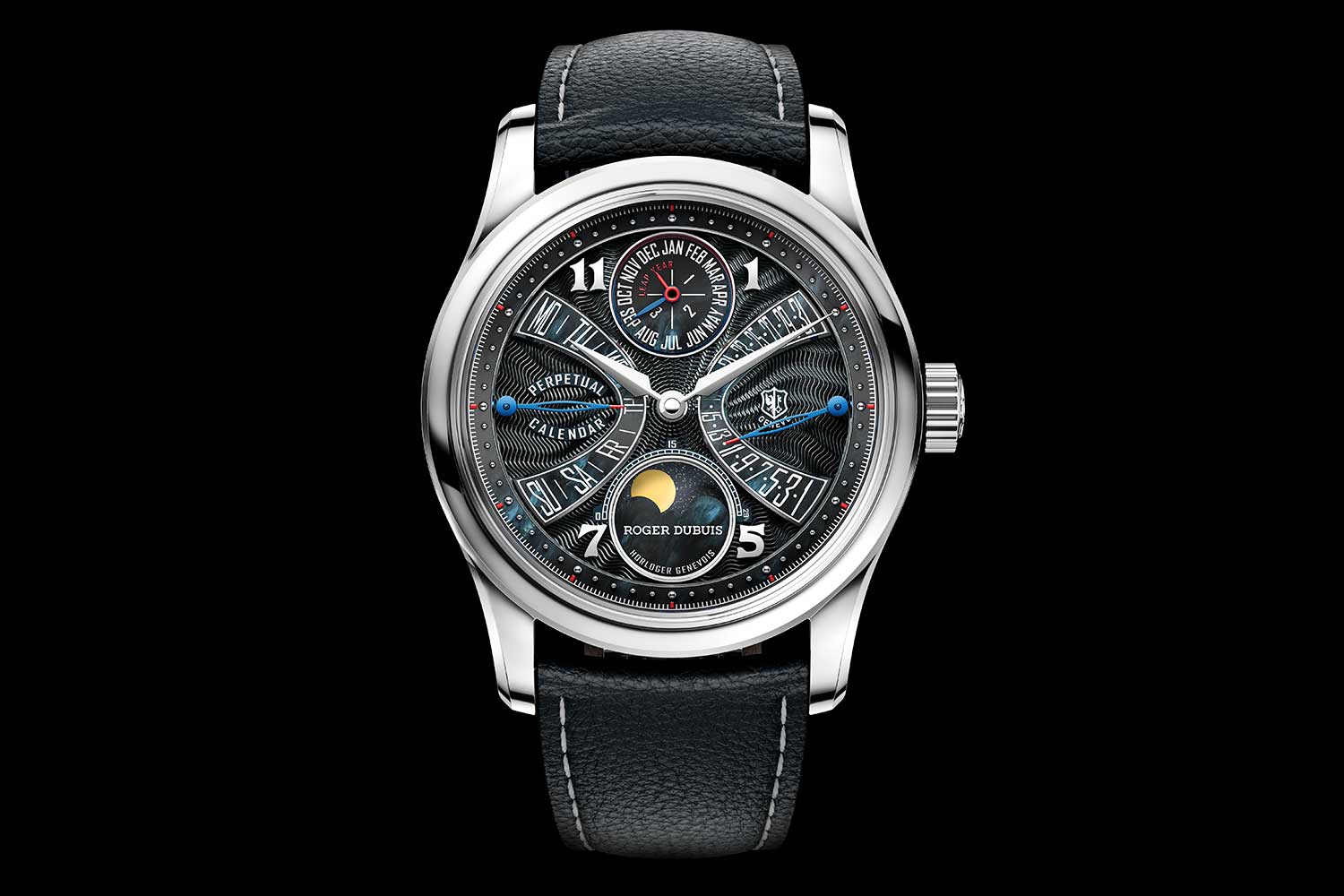
Roger Dubuis Hommage “Sukoon Al-Layl”
Tech Specs: Roger Dubuis Hommage “Sukoon Al-Layl”
Movement: Calibre RD1472; automatic self-winding; perpetual calendar with day, date, month, and leap-year indication; bi-retrograde display; 4 Hz (28,800 vph); 48-hour power reserve; Poinçon de Genève certified
Functions: Hours and minutes; perpetual calendar with retrograde day and date
Case: Platinum; 38mm x 11mm; water-resistant to 30 m
Dial: Mother-of-pearl flange, calendar segments and counters; guilloché with “Astral blue” lacquer; applied Arabic numerals; aventurine moonphase with 18k pink gold moons; 18k white gold hour and minute hands and retrograde hands in brass coated with lacquer
Strap: Astral Blue calfskin leather strap with platinum thread, and a triple-folding platinum buckle
Availability: Piece unique
Roger Dubuis
You may also like

Editorial
The Revolutionary List: 25 Watchmakers and Construction – Roger Dubuis
Dec 15, 2025
Editorial
The Revolutionary List: 25 Watchmakers and Construction – Roger Dubuis
Dec 15, 2025

Editorial
Layers of meaning: Roger Dubuis Hommage La Placide
Nov 12, 2025
Editorial
Layers of meaning: Roger Dubuis Hommage La Placide
Nov 12, 2025
News
Roger Dubuis Debuts The Excalibur Monotourbillon Dr. Woo Episode III
Jun 19, 2025
News
Roger Dubuis Debuts The Excalibur Monotourbillon Dr. Woo Episode III
Jun 19, 2025