
Audemars Piguet introduces the Royal Oak Chronograph 38mm with the New In-House Calibre 6401
Editorial
Audemars Piguet introduces the Royal Oak Chronograph 38mm with the New In-House Calibre 6401

Amid a slate of Audemars Piguet releases, the announcement with the broadest impact is perhaps the arrival of a new in-house chronograph calibre for the Royal Oak Chronograph 38mm. Both the 38mm and 41mm Royal Oak Chronographs have relied on the Calibre 2385 which was based on a legendary ebauche, the Frederic Piguet Calibre 1185. While the 41mm model transitioned to the in-house Calibre 4401 in 2021, its larger dimensions made it unsuitable for the 38mm case, which left the smaller chronograph without an in-house alternative until now.
The new movement is the automatic Calibre 6401. Like the Calibre 2385 and the in-house Calibre 4401, it uses a column wheel and a vertical clutch, but it is entirely different, both in its underlying gear train architecture and in the design of the chronograph mechanism. In terms of proportions, the movement remains close to the Calibre 2385, with a diameter of 27mm and a height of 5.7mm, versus 26.2mm and 5.5mm for the Frederic Piguet-based calibre. It runs at a frequency of 4Hz and offers a 55-hour power reserve, which are improvements over the Calibre 2385’s 3Hz frequency and 40-hour reserve.
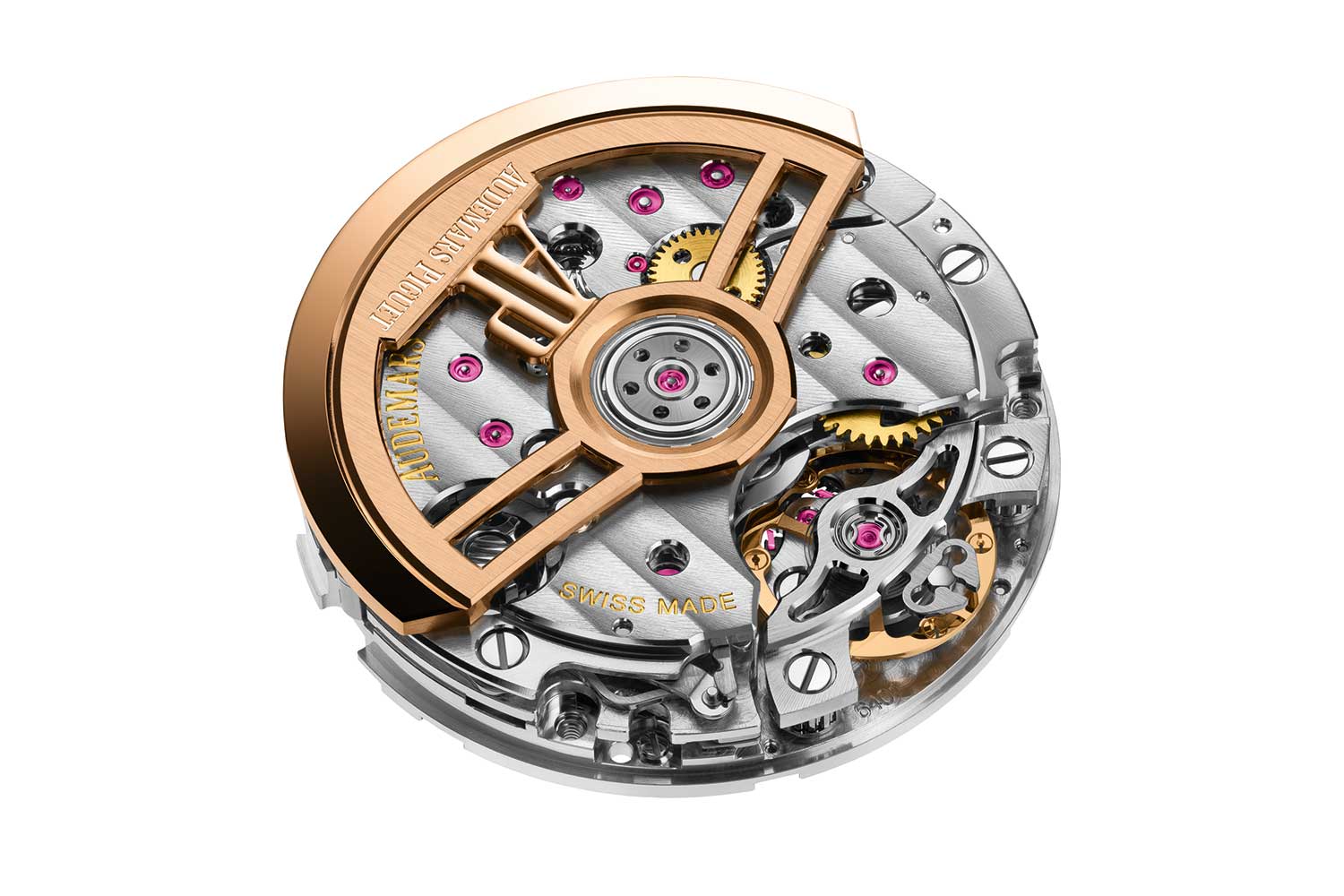
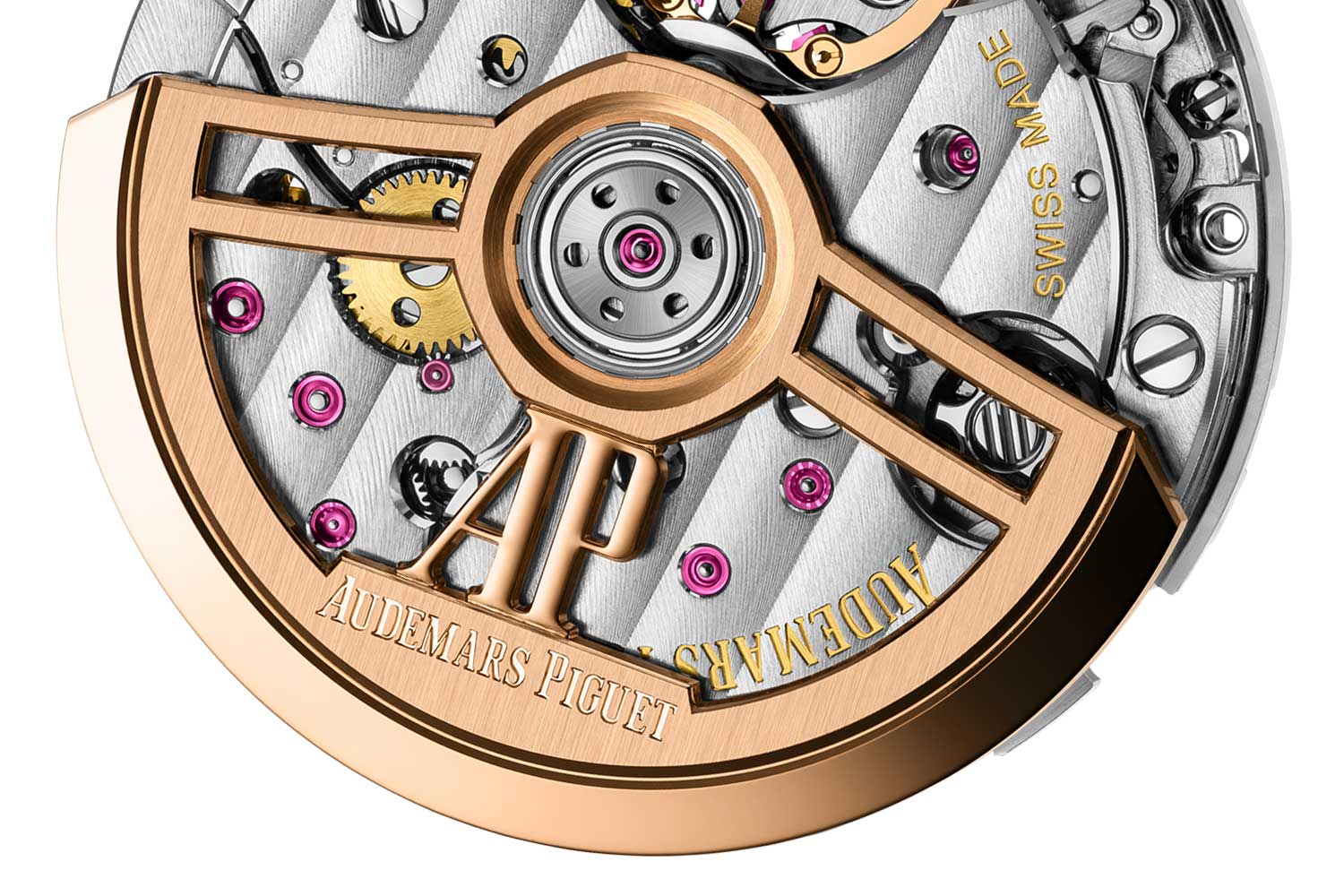
Back view of Calibre 6401
The new movement makes its debut in three references. There is a stainless-steel version with a blue “Grande Tapisserie” dial; a pink gold model with a grey dial; and a gem-set pink gold variant fitted with a sand gold-toned dial. Notably the dimensions of the case have been preserved; it measures 38mm in diameter and 11.1mm in height, a marginal increase over the previous 38mm Royal Oak Chronograph, which stood at 11mm.

Three variations of Audemars Piguet Royal Oak Selfwinding Chronograph 38mm
Calibre 6401
While Calibre 6401 does not offer a flyback function like the 4401, it is impressive in a more fundamental way. Although images are scarce at the moment, it is evident that the gear train layout positions the fourth wheel in the middle, making it a directly driven vertical clutch while the running seconds counter is driven indirectly. This differs from the Calibre 4401 which has an off-centered vertical clutch. Driving the clutch directly and axially from the fourth wheel removes any intermediate transmission wheels, which means fewer losses and less backlash. Effectively, the chronograph seconds remains within the power flow of the gear train and can be left running without compromising timekeeping or part longevity.

View of the Calibre 6401 through the sapphire crystal caseback
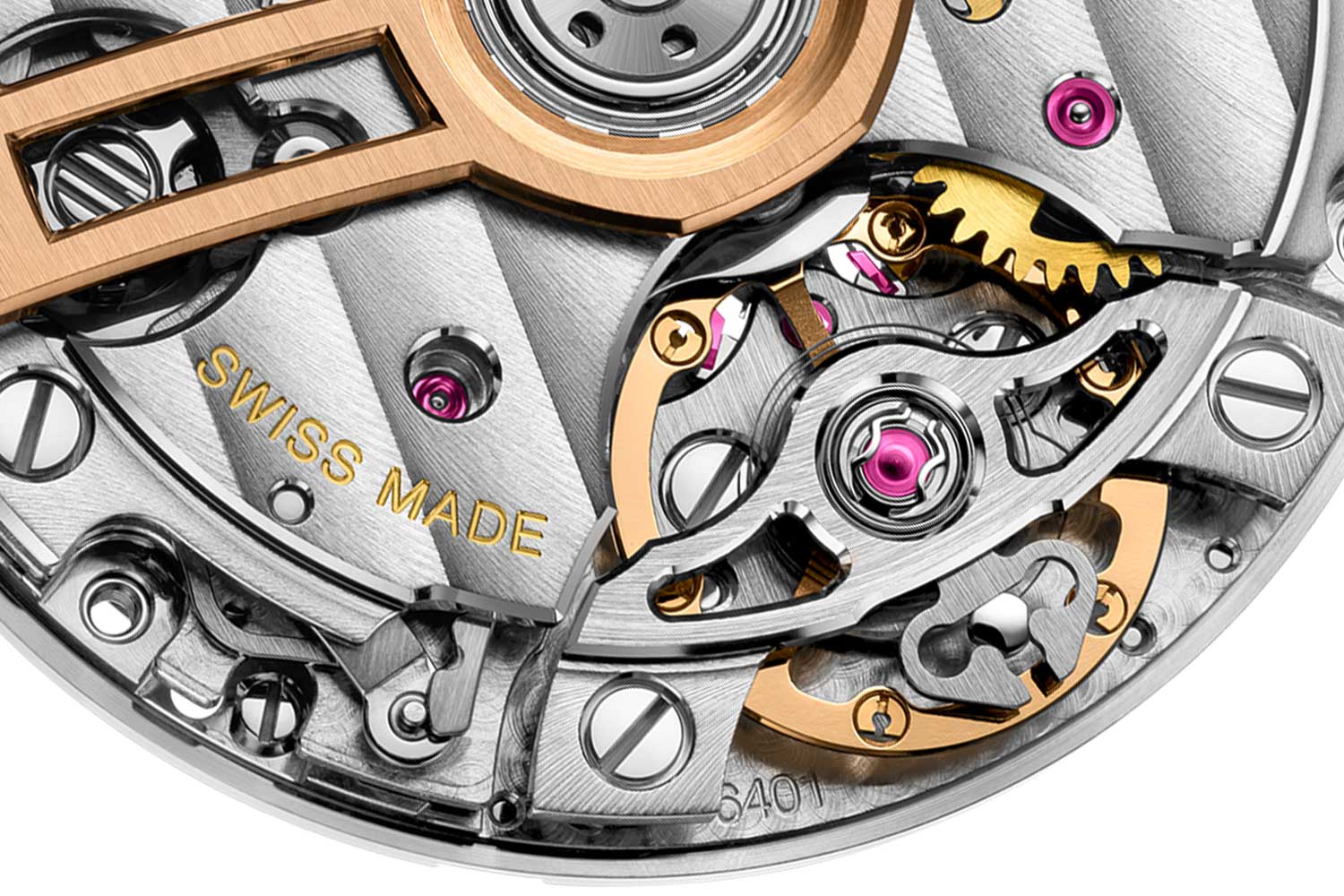
Details on the Calibre 6401
One notable aspect of the Calibre 6401 is that it requires less actuation force, which means a softer pusher. This is not due to any change in the operating lever itself, but to the way the clutch lever is restrained and released, and for which a patent was filed. In conventional chronographs, the clutch lever is held against the column wheel by a return spring, which continuously loads the column wheel and must be overcome each time the pusher is actuated. In the Calibre 6401, that return spring is eliminated.
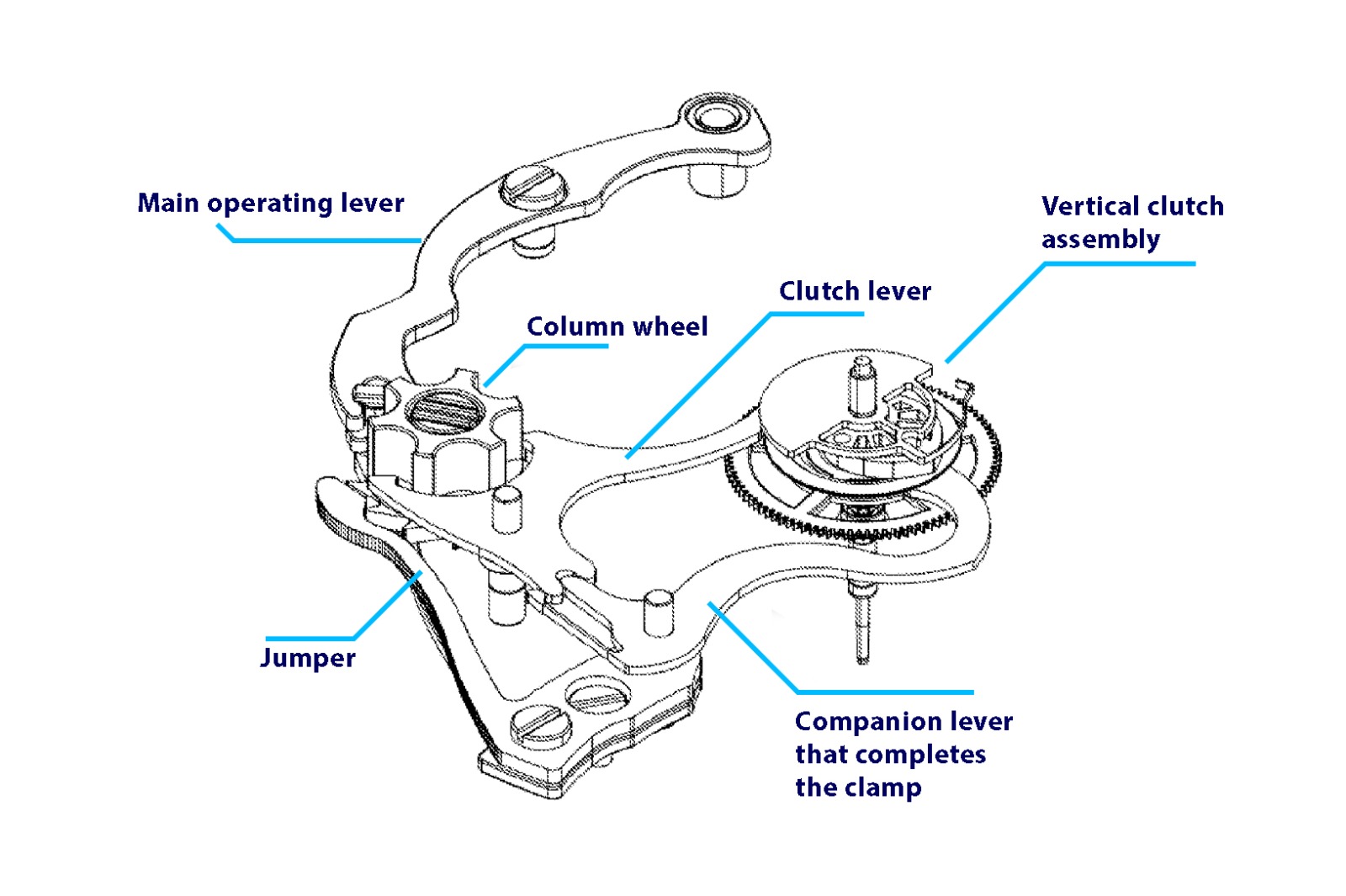
Perspective view showing the clutch lever with twin beaks cooperating with the column wheel. The clutch lever pivots between two mechanically locked positions and, together with the companion lever forms a clamp acting on the vertical clutch assembly to alternately engage and disengage the chronograph. Image: from the original patent
Instead, the clutch lever is geometrically locked in either the engaged or disengaged position by its interaction with the column wheel. At all times, one of its two beaks bears directly against a column flank which positively defines the position of the lever without relying on spring preload. As a result, the operating lever and click are required only to index the column wheel from one position to the next, rather than to force it against a spring-loaded clutch lever. This arrangement also reduces long-term wear on the column wheel and ensures the clutch lever is securely held in either state, which improves stability under shock.

The Grey Grande Tapisserie dial
The clutch itself is otherwise orthodox. When the chronograph is at rest, the cone is held clear of the fourth wheel by a pair of opposing clamp arms. Acting together, these arms sit beneath the wider, upper edge of the cone and support it axially to prevent any frictional contact with the fourth wheel. In this state, the clutch spring is compressed, the chronograph axis remains stationary, and the watch continues to keep time as normal.
Details on the Calibre 6401
Actuating the chronograph causes the column wheel to advance and the clutch lever to move into its engaged position. In doing so, it forces the secondary lever in the opposite direction, which allows the two clamp arms to separate and withdraw completely from the edge of the cone. Once released, the clutch spring is free to act, pressing the cone down onto the fourth wheel and establishing the frictional connection that drives the chronograph train. From this point on, the clamp plays no active role; the cone remains engaged solely under spring pressure, while the clutch lever is again held in a clearly defined, stable position by the column wheel.
The movement is also equipped with an instantaneous date, with the aperture now positioned more centrally between 4 and 5 o’clock. It remains unclear whether the date is quickset. As a result of the new movement architecture, the minute and hour chronograph counters have also swapped positions.

The date window positioned centrally between 4 and 5 o’clock
The balance is free-sprung with six adjustable weights for regulation and has a smooth rim to minimise air resistance during oscillation. Both the use of a full balance bridge and a higher beat rate reflect a set of priorities that align with the demands of an everyday sports watch. Like the Calibre 4401, the rotor is thoughtfully executed. Its bearing hub is rendered as an octagon and the remainder of the rotor is extensively openworked, replete with internal angles. This degree of finishing and visual complexity is still relatively rare in watches in this category, and all of this is visible beneath a sapphire crystal back.
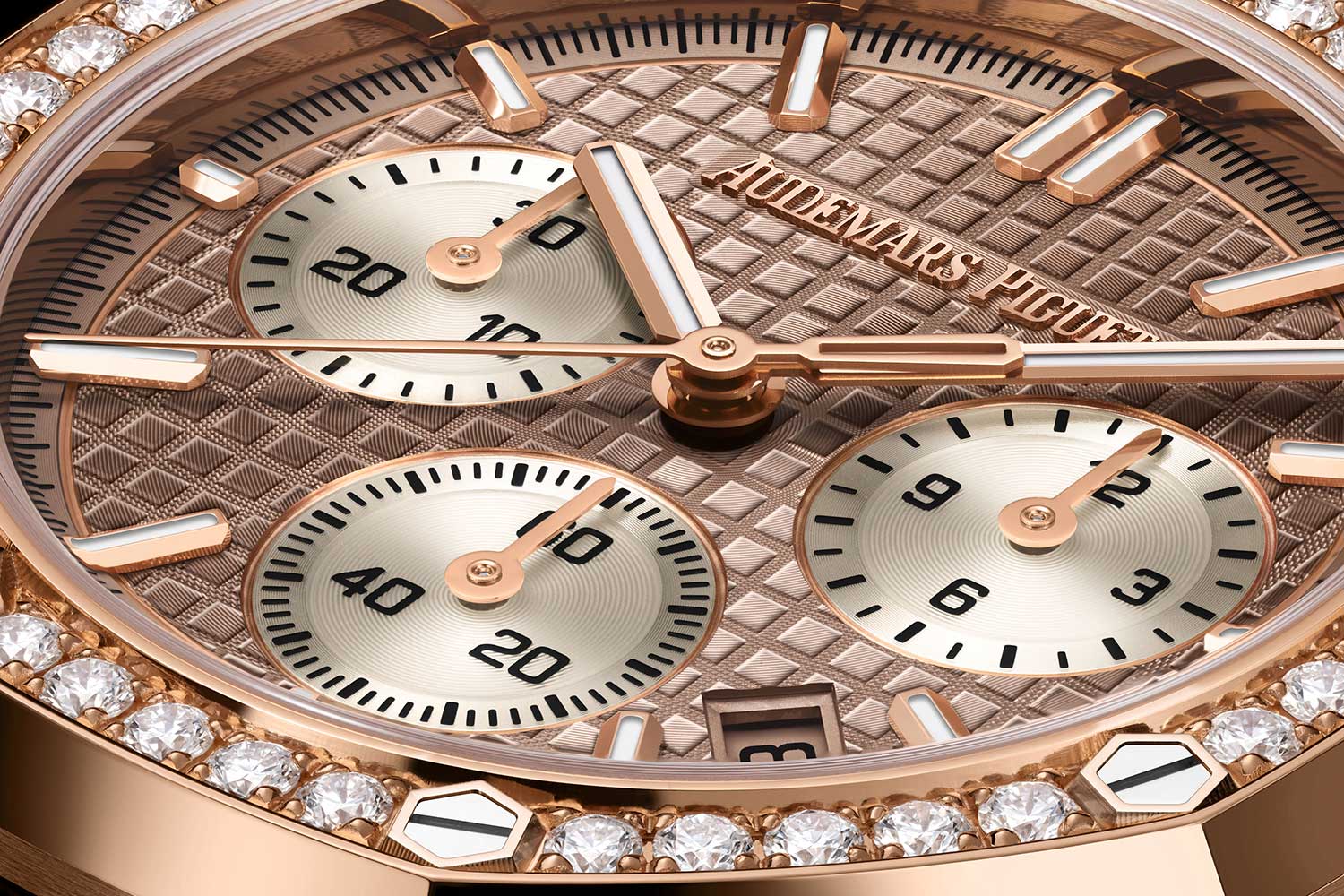
The bezel set with 40 brilliant-cut diamonds (~0.92 carats)
The movement update brings one of the most fundamental watches in the catalogue fully into AP’s in-house universe. It is compact and, insofar as can be determined, well-engineered, and fits the 38mm Royal Oak case as naturally as it should. The caliber will be making its way into the Royal Oak Offshore collection later this year.
Tech Specs: Audemars Piguet Royal Oak Selfwinding Chronograph 38mm
References 26450ST.OO.1356ST.01 (Blue dial), 26450OR.OO1356OR.01 (Grey dial), 26450OR.ZZ.1356OR.01 (Sand-gold dial)
Movement Selfwinding Calibre 6401, power reserved 55h, 4Hz (28,800vph)
Functions Chronograph, hours, minutes, small seconds and date
Case Stainless steel or 18-carat pink gold case, glareproofed sapphire crystal and case back, water resistant 50m
Dial “Bleu Nuit, Nuage 50” or Grey or Sand gold-toned Grande Tapisserie dial, blue or beige counters, silver grey-toned 18-carat white gold or 18-carat pink gold hour-markers and hands with luminescent material, silver grey or pink gold-toned inner bezel
Strap Stainless steel or 18-carat pink gold
Audemars Piguet

You may also like

News
Watches & Wonders 2026 Looks Forward to Its Biggest Fair Yet
Feb 10, 2026
News
Watches & Wonders 2026 Looks Forward to Its Biggest Fair Yet
Feb 10, 2026

Editorial
The Audemars Piguet 2026 Releases Makes Complexity User-Friendly, And Celebrates the Skeleton
Feb 3, 2026
Editorial
The Audemars Piguet 2026 Releases Makes Complexity User-Friendly, And Celebrates the Skeleton
Feb 3, 2026

Editorial
The New Audemars Piguet Royal Oak Offshore Diver
Feb 3, 2026
Editorial
The New Audemars Piguet Royal Oak Offshore Diver
Feb 3, 2026