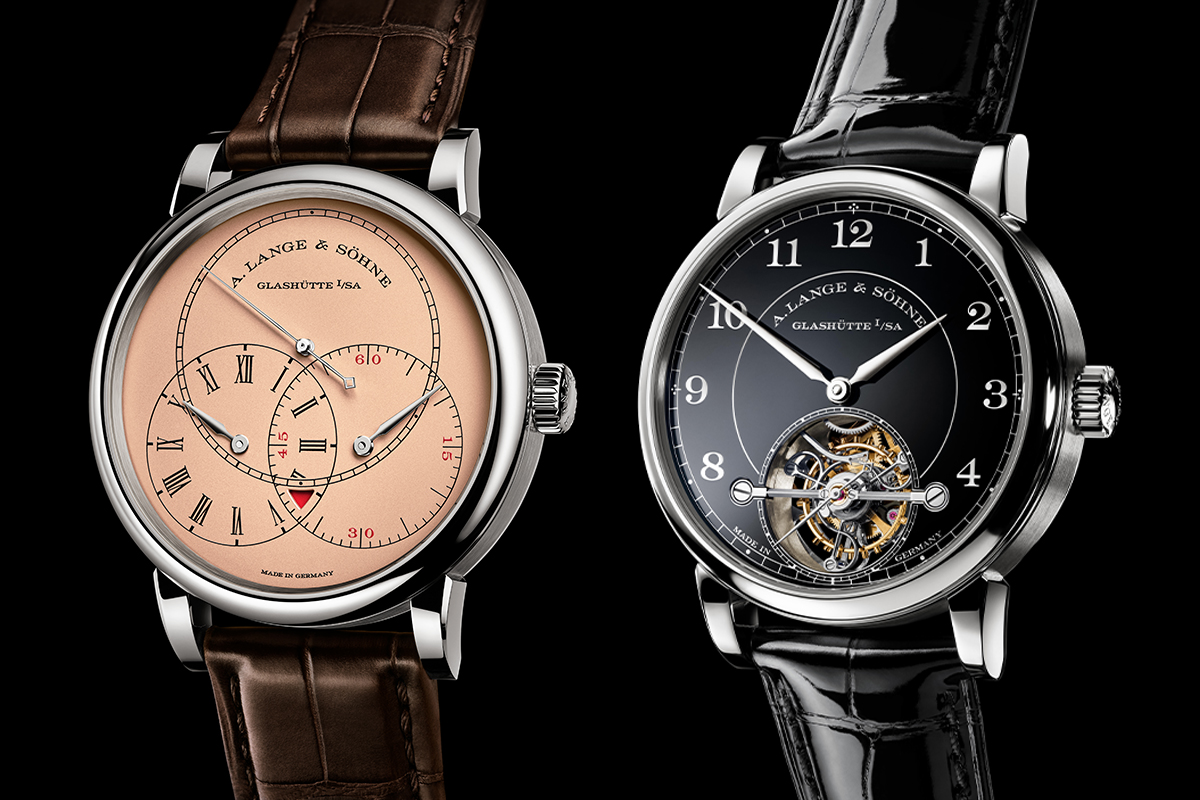
A. Lange & Söhne Unveils Richard Lange Jumping Seconds And 1815 Tourbillon At Hampton Court Palace
News
A. Lange & Söhne Unveils Richard Lange Jumping Seconds And 1815 Tourbillon At Hampton Court Palace

Summary
There are few backdrops more fitting for A. Lange & Söhne to unveil two of its most refined novelties than the Concours of Elegance at Hampton Court Palace. Set against the Tudor palace’s manicured lawns and surrounded by 60 of the most beautiful automobiles in the world, the event is a celebration of craftsmanship and heritage.
For Wilhelm Schmid, Lange’s CEO and a lifelong classic car enthusiast, the setting is personal as well as perfect: it embodies the same pursuit of technical excellence that underpins every watch from the Glashütte manufacture. Just as a concours d’élégance showcases cars that combine engineering wizardry with sculptural beauty, Lange’s new timepieces demonstrate how precision watchmaking can be both a technical tour de force and an aesthetic delight.
This year, Lange introduces a brace of watches that represent two distinct families in the manufacture’s portfolio — the Richard Lange collection, rooted in scientific observation, and the 1815 line, which pays tribute to founder Ferdinand Adolph Lange’s birth year. Yet they share a common thread: both elevate already rarefied complications with subtle but meaningful innovations, and both do so with a level of detail that ensures their place in the canon of modern Saxon watchmaking.
Richard Lange Jumping Seconds
Nine years after its debut, the Richard Lange Jumping Seconds remains a connoisseur’s piece. It was always a watch that “flew under the radar,” as insiders at Glashütte like to say, admired quietly by those who appreciate its seemingly simple dial concealing enormous technical sophistication. Now, in 2025, Lange brings it back in a striking new guise: a 39.9mm white-gold case framing a warm pink-gold dial, limited to just 100 pieces.
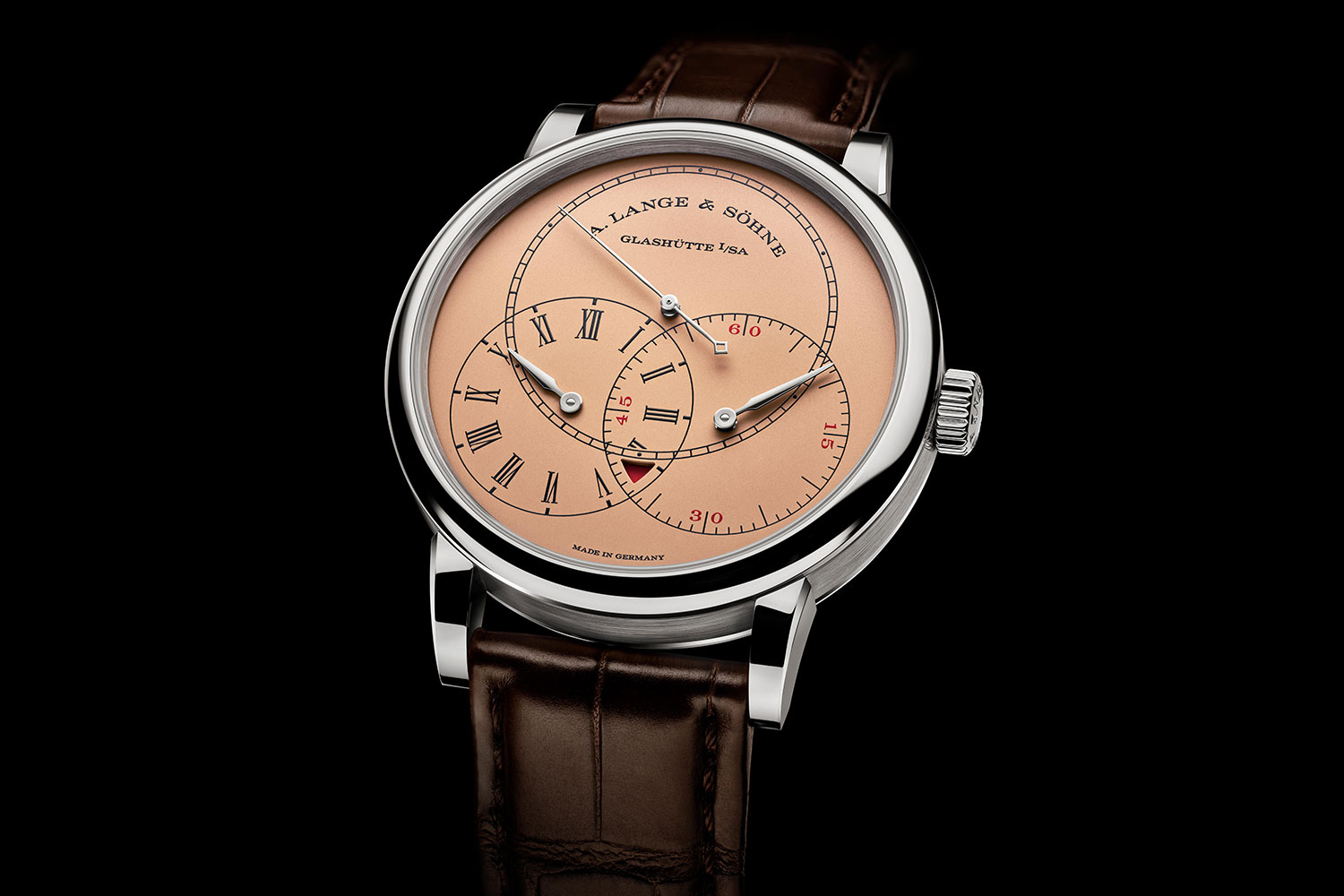
A. Lange & Söhne Richard Lange Jumping Seconds
The dial is a study in purposeful design. What looks like a contemporary three-circle regulator layout actually harks back to the late 18th century. Johann Heinrich Seyffert, Dresden’s most celebrated chronometer maker, devised this arrangement for his No. 93 pocket chronometer — a watch so precise that the great naturalist Alexander von Humboldt took one on his legendary expeditions through South America. Ferdinand Adolph Lange was inspired by Seyffert, and this historic layout of large central seconds and smaller subdials for hours and minutes, became a signature of scientific timekeeping.
Anthony De Haas, A. Lange & Söhne’s Product development Director explains the idea behind the timepiece: “[It] is an unusual watch, both in terms of design and mechanics,” he says. “We focus on something that many people consider to be a minor detail: the seconds. It’s a precision watch that features a not so small seconds hand with jumping seconds — a mechanism that poses a particular challenge in terms of watchmaking — and the convenient setting of the second via zero-reset. At the same time, it is a bow and tribute to historical observation watches with its characteristic regulator design.”
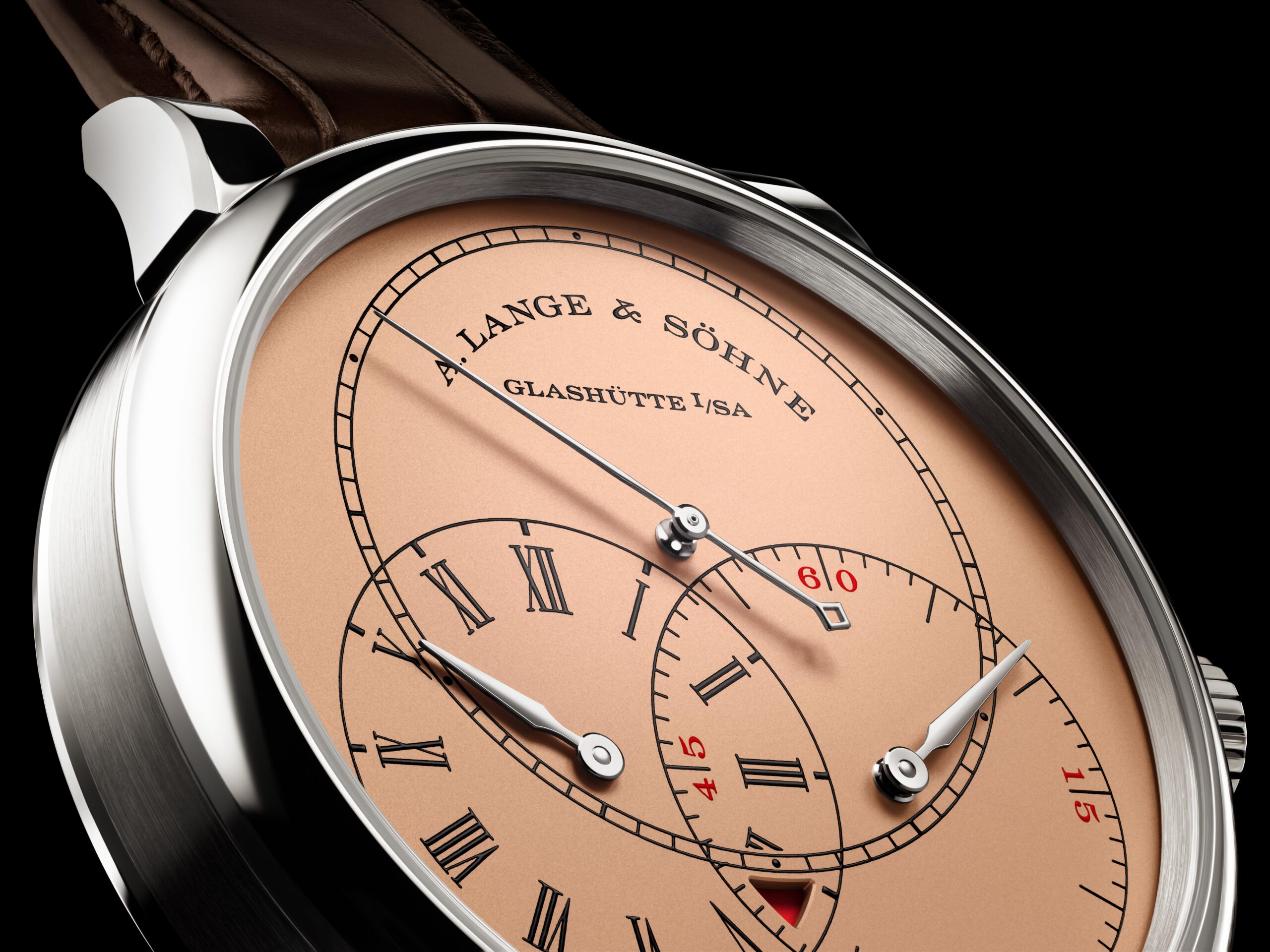
The largest of three time circles is allocated to the seconds while the two smaller ones positioned below on the left and right indicate the hours and minutes
In the new Jumping Seconds, the pink-gold dial contrasts with crisp black markings and hands, its glow offering a different mood from the cooler silver or stark black dials we’ve seen before. Unlike the industry’s more common “salmon” shade, which tends toward matt, coppery tones, Lange’s pink-gold dial has a richer, more luminous quality.
De Haas explains: “We try to be creative in our watchmaking, rather than in naming dial colours. We call things as they are: the dial is pink gold. In fact, there is a colour difference between what people call ‘salmon’ and 750 pink gold. We prefer 750 pink gold because it has a more natural brilliance and depth.”
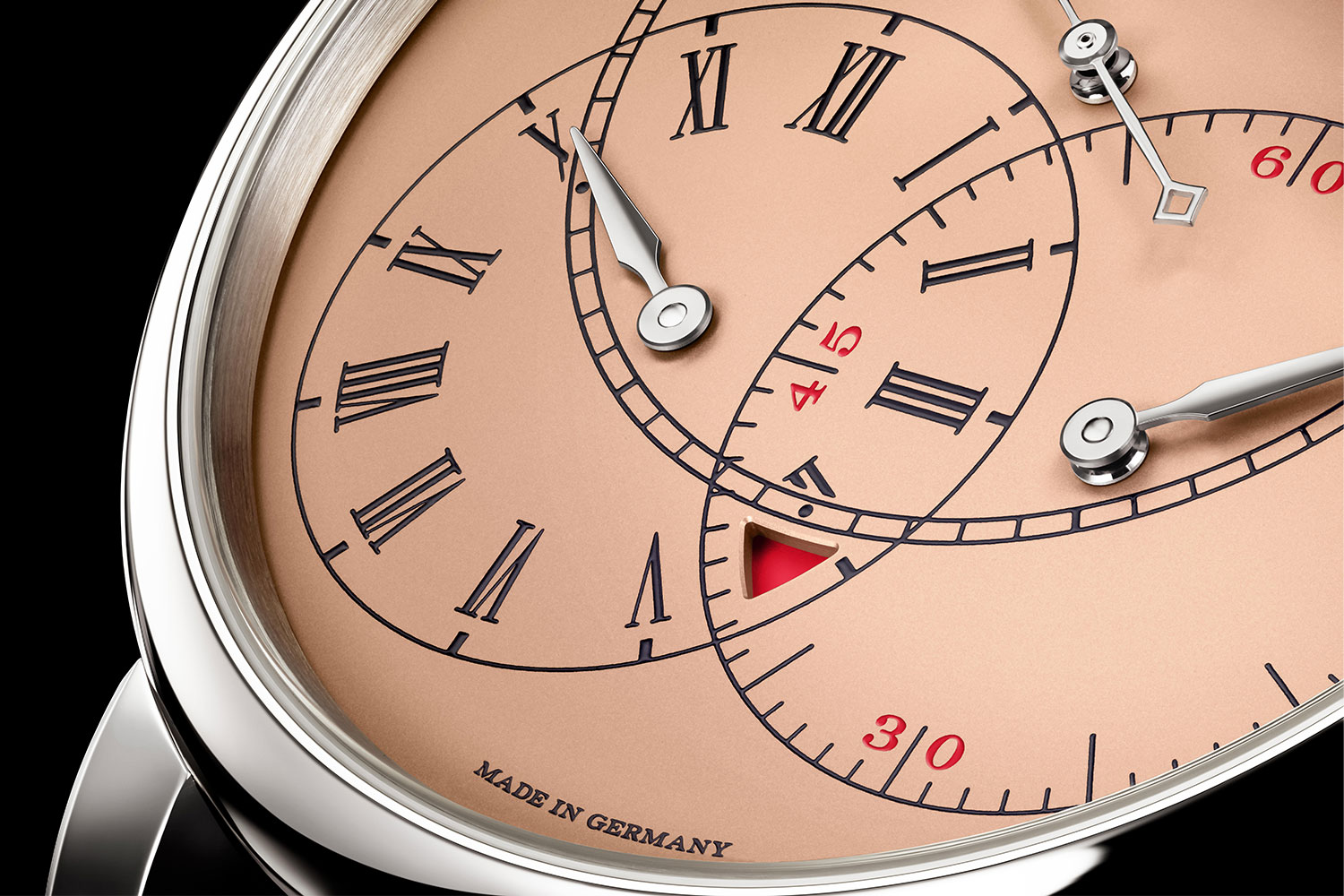
A triangular indication at the intersection between the hour and minute circles switches to red ten hours before the power reserve is depleted, which delivers as a reminder to soon rewind the watch
The metal base reflects light with greater intensity, giving the watch both warmth and legibility in changing conditions. It also joins a growing lineage of Lange pink-gold dials that began with the Datograph in 2019 and has since appeared across the 1815 and Lange 1 families. This continuity is no accident: it creates a subtle thread of warmth across the collection, each iteration offering a distinct play of reflectivity and refinement.
But the Richard Lange Jumping Seconds is not about aesthetics alone. Its genius lies in the choreography of three distinct mechanisms working in concert. First is the constant-force mechanism. Every second, a remontoir spring recharges from the mainspring barrel, delivering an equal pulse of energy to the escapement. This ensures consistent torque and therefore superb rate stability throughout the watch’s 42-hour power reserve.
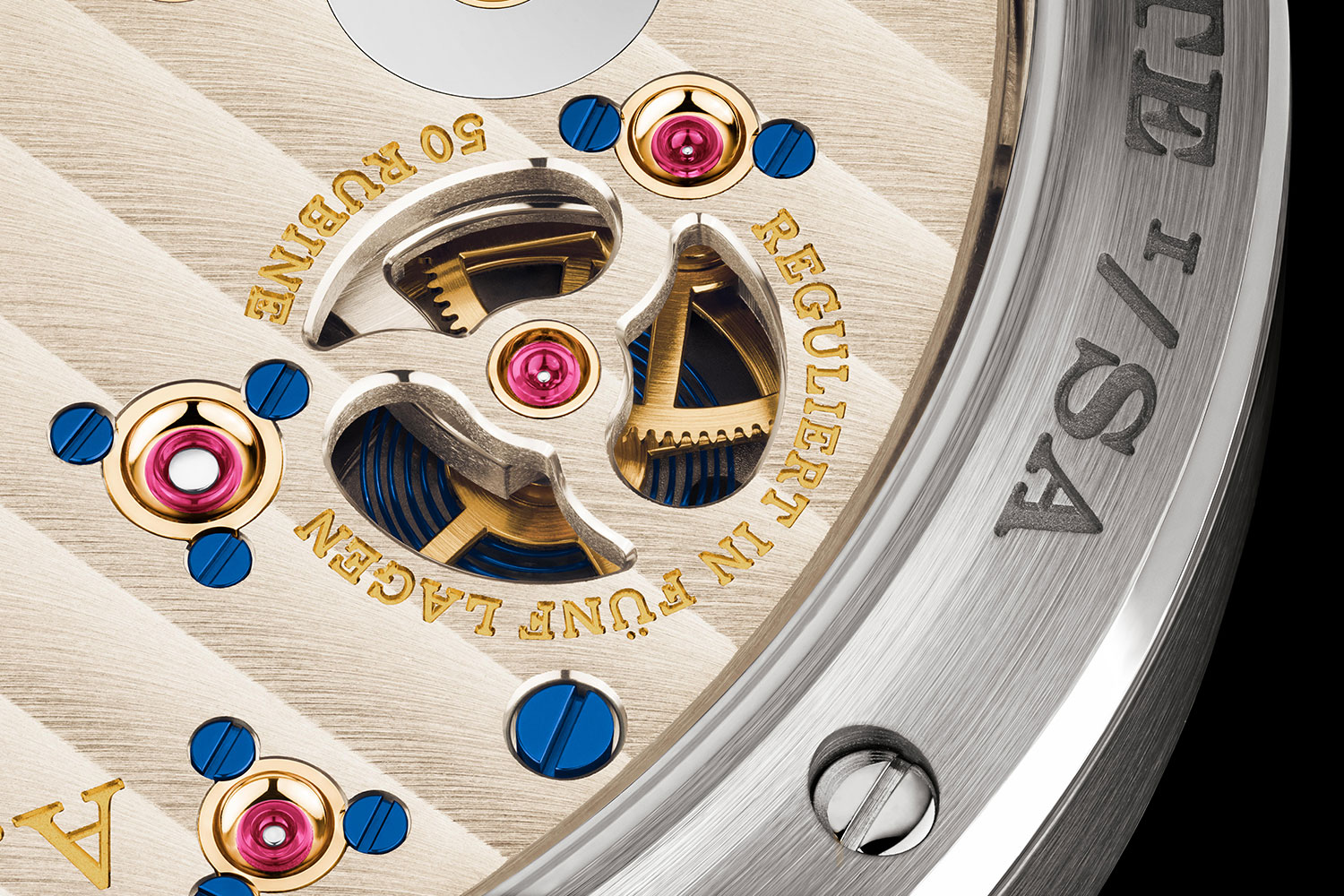
An aperture in the three-quarter plate reveals the remontoir spring of the constant-force escapement
Second is the jumping seconds, in which a star-and-flirt mechanism releases the stored impulse once per second, causing the large seconds hand to advance in discrete steps. To the casual observer, it mimics the tick of a quartz watch, but here it is the revival of an 1867 Lange patent for “seconde morte,” a complication designed to aid precision reading.
Finally, the zero-reset means that when the crown is pulled out, the balance halts and the seconds hand snaps instantly to 12 o’clock. This allows the wearer to set the time with absolute precision, down to the second.

Parts of the zero-reset mechanism can be seen — namely the reset hammer and the arresting spring
Viewed through the sapphire caseback, the movement reveals the remontoir spring, a star wheel rotating beneath a sapphire jewel to govern the seconds jump, and the elaborate clutch system of the zero-reset mechanism. This is connoisseur-level horology: discreet, but deeply satisfying to those who know.
Despite the complexity within, at 10.6mm in height, the case remains slim, elegant, and wearable. The hand-stitched brown alligator-leather strap, the hand-engraved balance cock and untreated German silver three-quarter plate, visible through the caseback, anchor it firmly in Lange tradition.
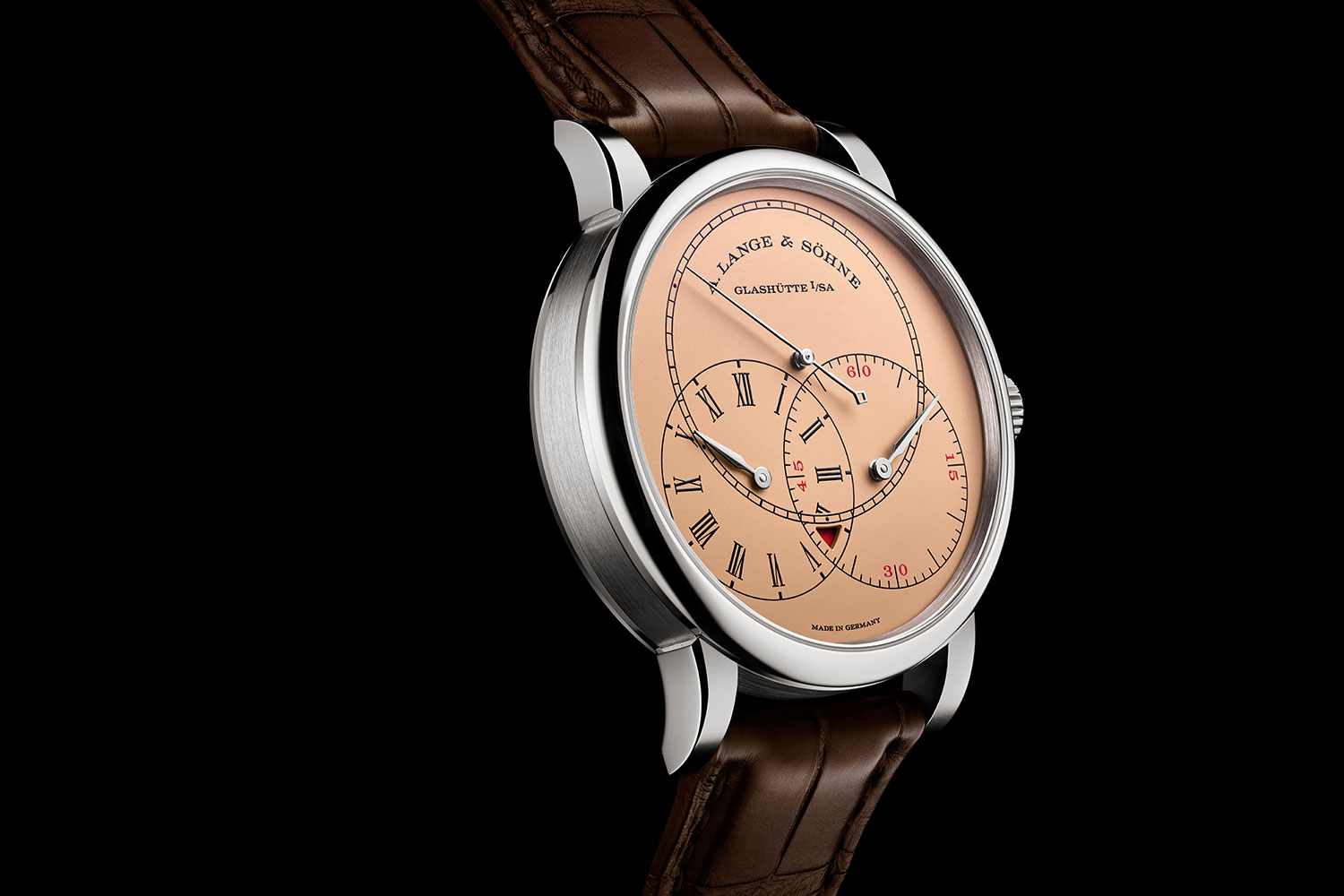
The watch is encased in white gold, measuring 39.9mm at the height of 10.6mm
According to De Haas: “We’re not trying to set records in terms of the height of the movement. Our complications take up exactly the space they need. Nevertheless, it is important to us that everything makes sense in an appealing aesthetic. Each of the complications in this timepiece is a technical challenge in itself. The jumping seconds mechanism in particular is often quite underestimated. And then, in addition, we have the ZERO-RESET mechanism: when the crown is pulled, the seconds hand instantly jumps to the zero position. The combination of these two complications presents a whole new set of challenges.”
As Revolution has noted before, the Richard Lange family is “watchmaking for those who worship accuracy as much as artistry” and this new Jumping Seconds exemplifies that philosophy. The pink-gold dial simply gives it a glow to match the warmth of its historical inspiration.
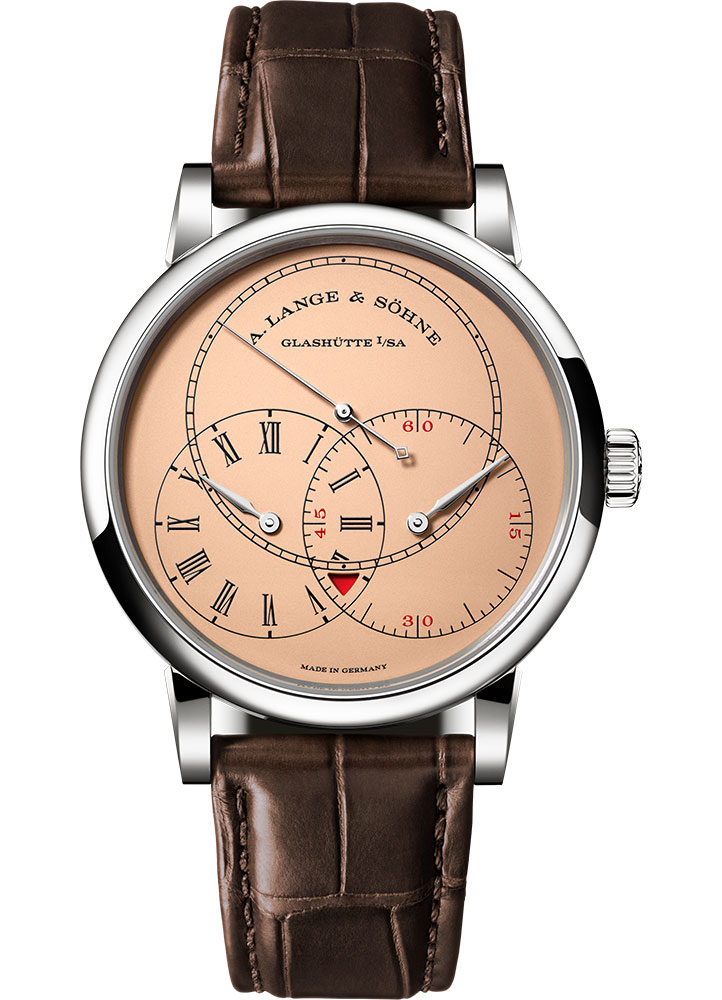
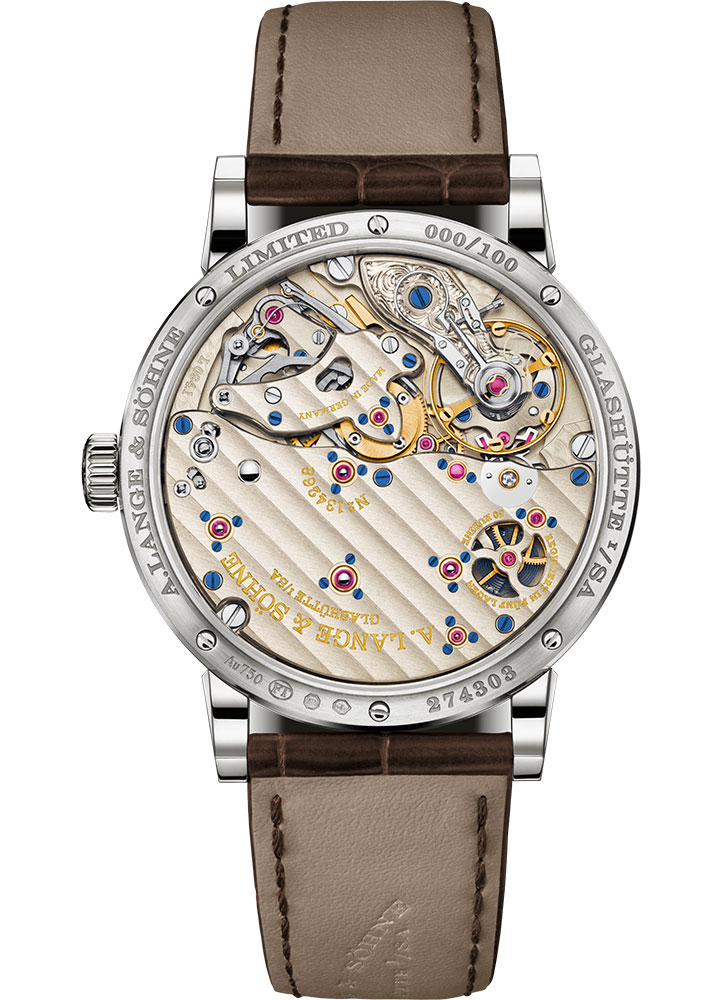
Tech Specs: A. Lange & Söhne Richard Lange Jumping Seconds
Reference: Ref. 252.056
Movement: Manual-winding Caliber L094.1; 42-hour power reserve
Functions: Regulator-style hours and minutes; regulator jumping seconds; stop-seconds and ZERO-RESET function; end-of-power indication
Case: 39.9mm × 10.6mm; white gold; 30m water-resistance
Dial: 750 pink gold
Strap: Hand-stitched dark-brown alligator leather with white-gold prong buckle
Price: On request
Availability: 100 pieces
1815 Tourbillon
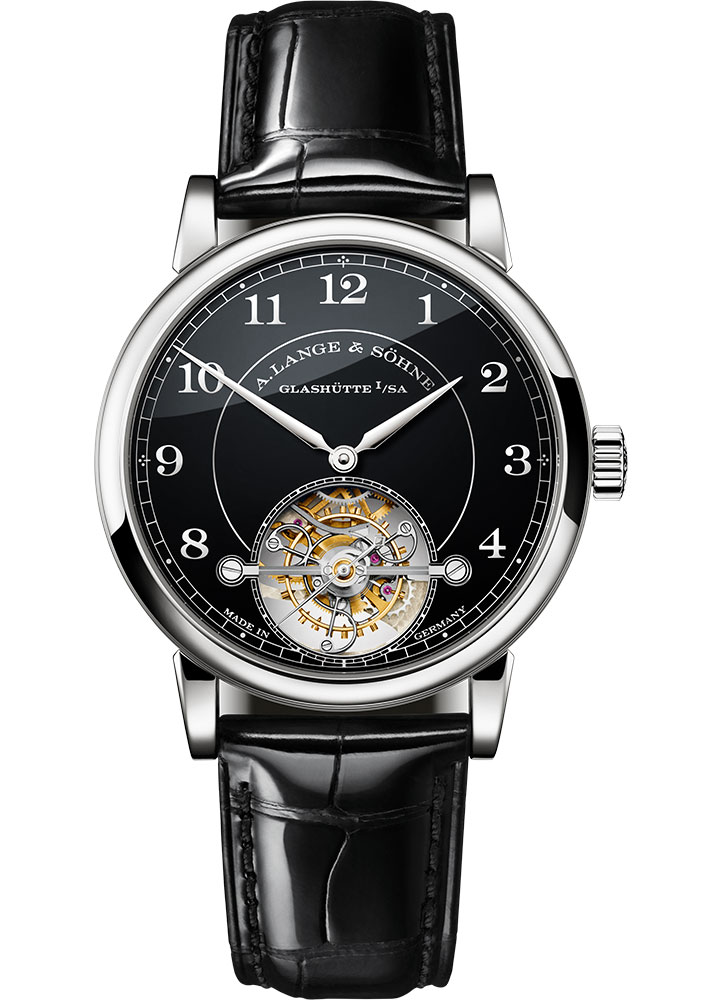
If the Jumping Seconds is about discreet technical mastery, the new 1815 Tourbillon is about boldness — although in typical Lange style, that boldness is balanced by restraint. The watch, limited to 50 pieces, is presented in 950 platinum with a jet-black grand feu enamel dial. It is the twelfth Lange watch to feature an enamel dial, and only the fifth variant of the 1815 Tourbillon, which first appeared in 2014 in platinum and pink gold.
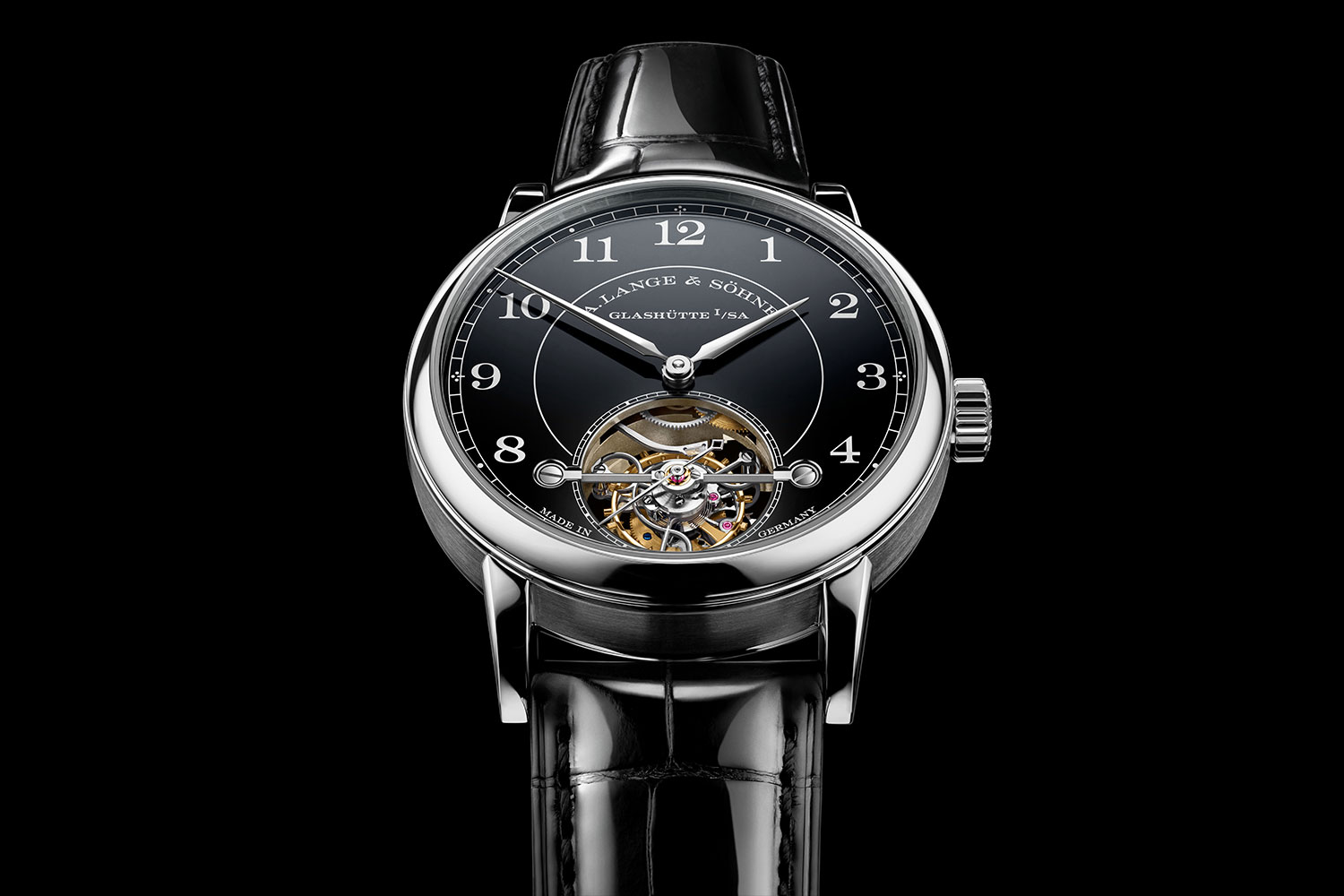
The new A. Lange & Söhne 1815 Tourbillon in 950 platinum
The tourbillon has always been an expression of mechanical refinement, its rotating cage designed to counteract gravity’s pull on the balance. But in the 1815 Tourbillon, Lange goes further: it combines the tourbillon with both a stop-seconds mechanism and the zero-reset function.
Together, these features mean the watch can not only be halted by pulling the crown, but also set precisely to the second, a feat virtually unheard of in tourbillon watches. For Lange, which patented stop-seconds for the tourbillon back in 2008, this is about more than complication; it is about usability and accuracy.
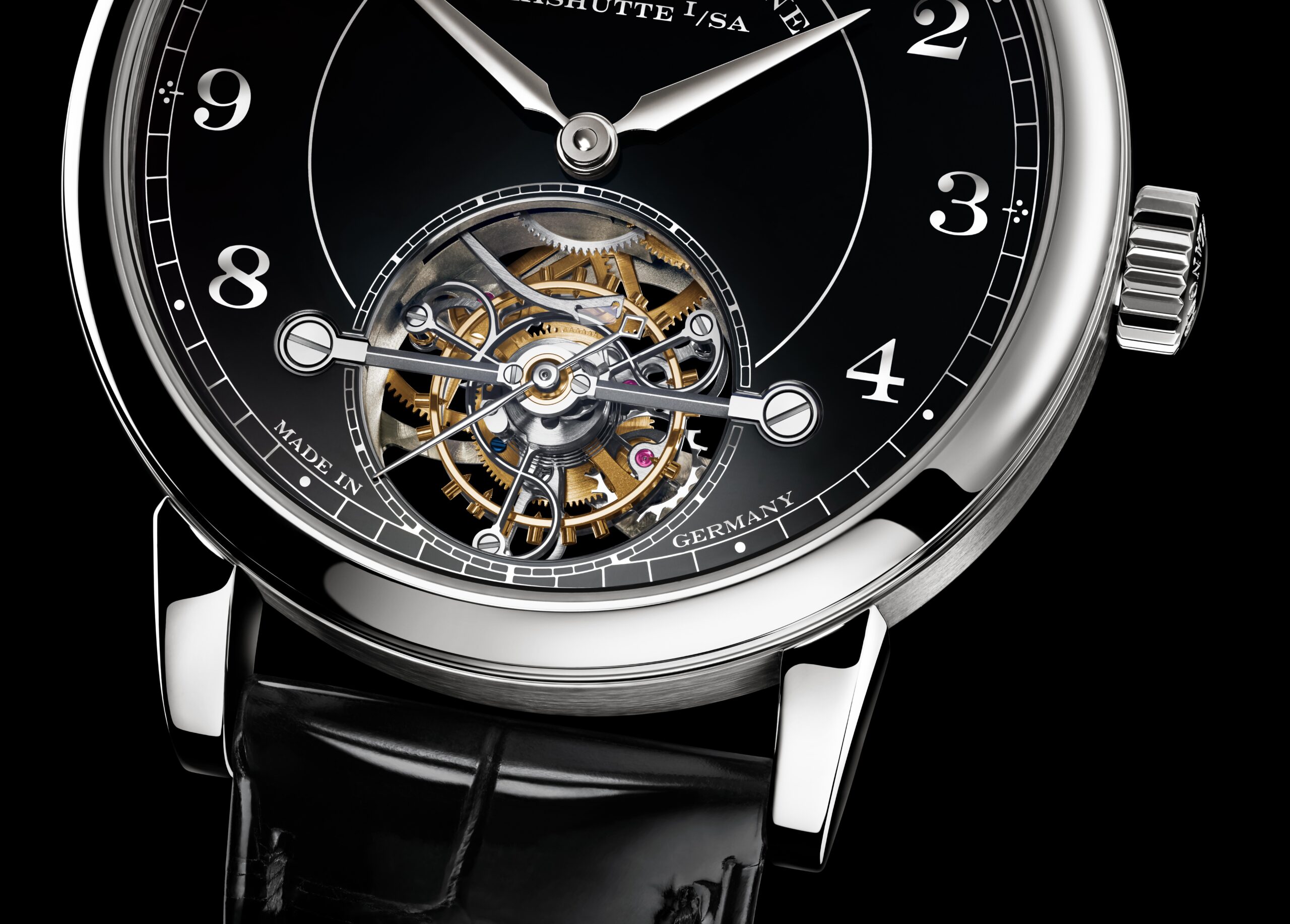
The one-minute tourbillon, combined with stop-seconds and ZERO-RESET — a Lange first
“We manufacture precision watches,” says De Haas. “In this respect, even the smallest step towards perfection is extremely important to us. In fact, this unique combination is a major challenge. As you can imagine, the zero-reset mechanism, in combination with a highly sensitive regulating part such as the tourbillon cage, requires a very precise adjustment of the timing point of respective levers. This unique combination allows the owner to adjust the tourbillon with even greater precision.”
The watch’s case is 39.5mm by 11.3mm and houses a strikingly simple dial: white-gold base, coated in layer upon layer of vitreous black enamel, fired and polished over weeks of painstaking work. More than 100 individual steps are required to create each one. The result is a surface of infinite depth, framing crisp white Arabic numerals and a railway minute track.
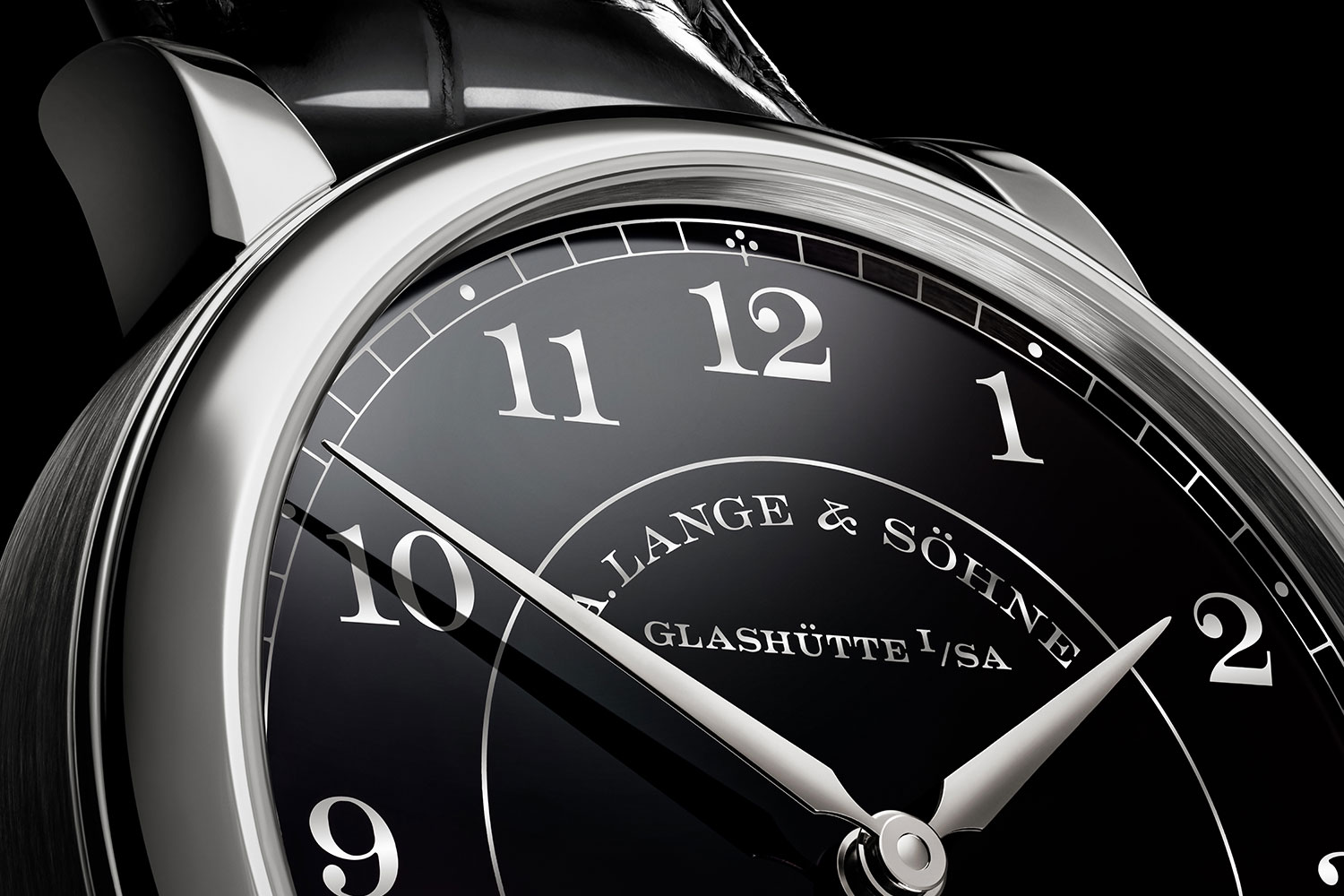
After preparing the basic dial in white gold, the enamel pigments are then crushed and applied, before going through multiple firing procedures and the final surface treatment
De Haas talks about the enameling with a sense of pride saying, “The grand feu enamel dial of the 1815 Tourbillon is crafted in our manufacture from the first to the very last step: this includes preparing the basic dial in white gold, crushing and applying the enamel pigments, multiple firing procedures and the final surface treatment.
“Often several dials have to be produced in order to obtain a single flawless dial. Corrections are not possible — even the slightest imperfection renders a dial unusable. Today, few watchmakers have mastered this complicated process. As part of the process, enamel pigments are applied and fired, creating thin layers repeated until smooth, and cleanliness is crucial. Preventing bubbles is a challenge, minimized by thin layers and multiple firings, but any external stress can still cause damage. However, the result is a beautiful, timeless enamel dial. In total, the 1815 Tourbillon dial needs up to 30 coats to create its deep, glossy black coating.”
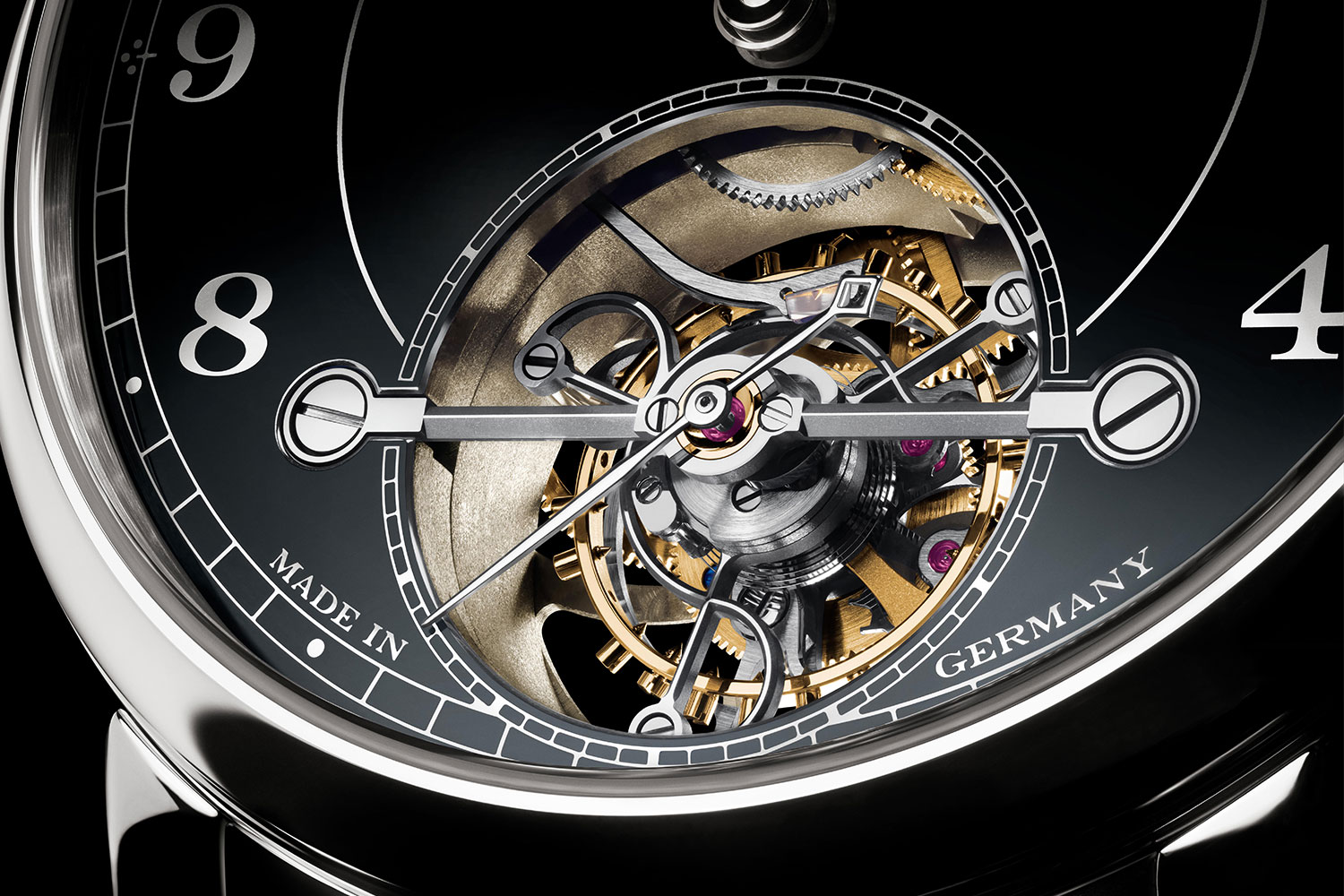
The tourbillon bridge and the upper section of the cage are embellished with elaborate black polish
A large aperture at six o’clock reveals the tourbillon, its bridge mirror-polished to a black sheen using one of watchmaking’s most exacting techniques. From some angles, it gleams like glass; from others, it disappears into inky darkness. It is a touch of theatricality in an otherwise sober composition.
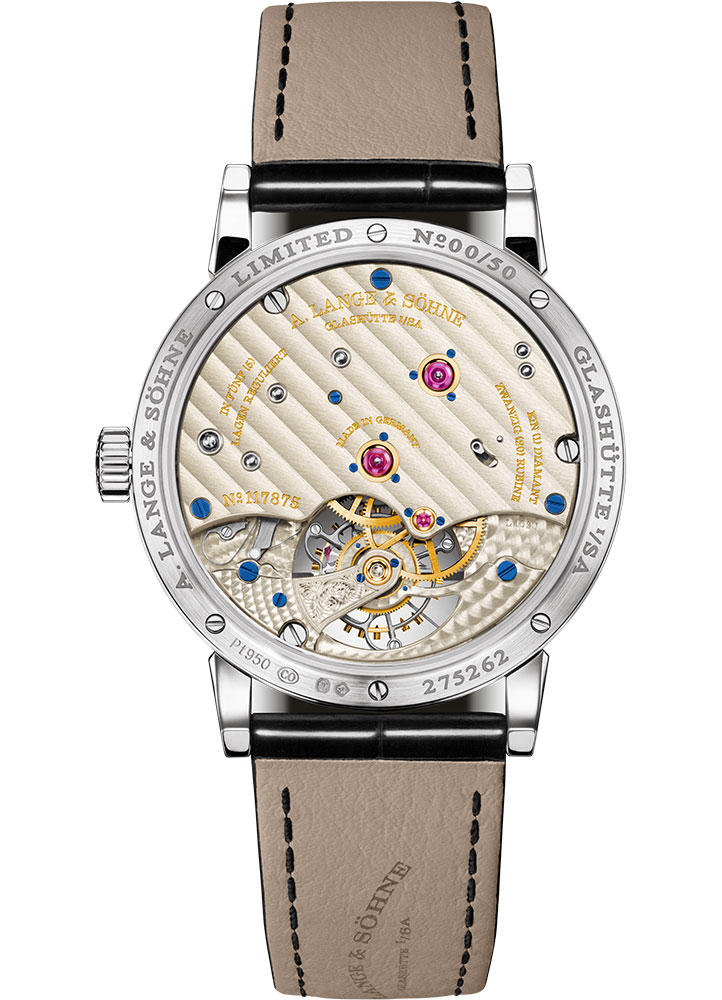
Turning the watch over reveals the calibre L102.1: 262 parts, a diamond endstone set in a gold chaton at the heart of the tourbillon, a screw balance oscillating at 21,600 vph, and a 72-hour power reserve. Traditional Lange features abound: untreated German silver plates, hand engraving, and lavish finishing.
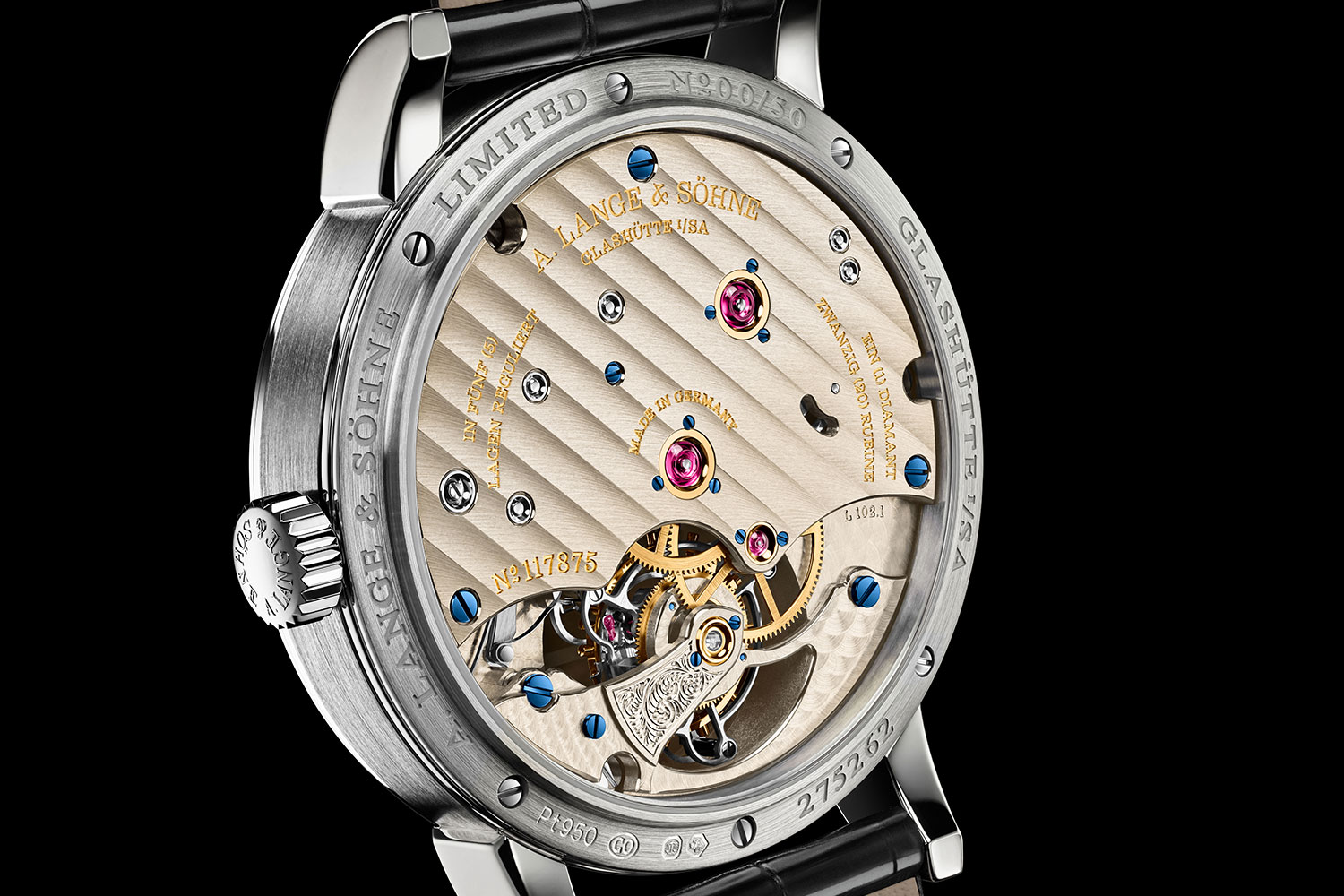
The manufacture calibre L102.1 features a freely oscillating Lange balance spring and a traditional screw balance that assure superb rate accuracy across the entire power-reserve duration of 72 hours
For De Haas, what makes this watch special is that its design draws attention to what is spectacular: the tourbillon. The enamel dial provides a beautiful stage for it without distracting from it. “For me,” he says, “it’s the perfect combination of a complication and elegant classic aesthetics.”
Tech Specs: A. Lange & Söhne 1815 Tourbillon
Reference: 730.094F
Movement: Manual-winding Caliber L102.1; 72-hour power reserve
Functions: Hours and minutes; small seconds; one-minute tourbillon with patented stop-seconds and zero-reset mechanism
Case: 39.5mm × 11.3mm; platinum; 30m water-resistance
Dial: 750 white-gold base with jet-black grand feu enamel
Strap: Hand-stitched glossy black alligator leather with platinum deployant buckle
Price: On request
Availability: 50 pieces
Why did A. Lange & Söhne choose Hampton Court for these launches?
The answer lies in the shared DNA of concours cars and Lange timepieces. Both are built on legacies stretching back centuries, both require obsessive dedication to craft, and both demand that their mechanical ingenuity be cloaked in beauty.
Wilhelm Schmid often speaks of his love for classic cars as an extension of his love for watches: both are machines that stir the soul because they represent more than utility. At Hampton Court, Lange stands not among watch brands, but among Bugattis, Ferraris, and Bentleys, each restored with as much devotion as goes into a Lange calibre.
The Richard Lange Jumping Seconds and the 1815 Tourbillon, in their new guises, are not revolutionary in design. Instead, they are evolutionary: carefully considered, deeply rooted in history, and subtly advanced. They are concours pieces that don’t scream for attention, but that command it from those who truly understand.
In Saxony, tradition is not a weight; it is a springboard. With these two launches, Lange once again proves that its past is its foundation and that true elegance is timeless.
A. Lange & Söhne
You may also like
Editorial
The Revolutionary List: 24 Technically Brilliant Watches – A. Lange & Söhne Double Split
Dec 12, 2025
Editorial
The Revolutionary List: 24 Technically Brilliant Watches – A. Lange & Söhne Double Split
Dec 12, 2025
Editorial
The Lange 1 Daymatic Receives a Honeygold and Brown Makeover
Dec 7, 2025
Editorial
The Lange 1 Daymatic Receives a Honeygold and Brown Makeover
Dec 7, 2025
Editorial
The Revolutionary List: 30 Pioneering Watches – the A. Lange & Söhne Zeitwerk
Dec 2, 2025
Editorial
The Revolutionary List: 30 Pioneering Watches – the A. Lange & Söhne Zeitwerk
Dec 2, 2025